

The right prescription for upstream oil and gas is risk-based vulnerability management that treats safety and production impact as the primary sorting criteria, not patch age or CVSS score alone. Three actions matter immediately: run a full asset discovery sweep across IT and OT, isolate safety instrumented systems (SIS) from general network access, and cross-check every open finding against actively exploited vulnerabilities before touching anything else. This approach follows the SANS Five ICS Cybersecurity Critical Controls, the ONG-C2M2 model's risk-based prioritization guidance, and ISA/IEC 62443's segmentation and lifecycle requirements.
Standard IT vulnerability management assumes you can scan aggressively and patch on a monthly cycle. Upstream operations cannot make either assumption, and that gap is where most programs fail.
- Discover every IT and OT asset, including firmware versions on RTUs and PLCs, before scoring anything.
- Isolate SIS and other safety-critical control loops from routine scanning and remote access paths.
- Check every finding against known-exploited-vulnerability lists before deciding what gets fixed first.
Key Takeaways
Effective vulnerability management in upstream oil and gas depends on scoring risk by safety and production impact first, then matching remediation speed to that score rather than to patch age alone.
| Point | Details |
|---|---|
| Score by operational impact | Weigh safety criticality and production exposure above raw CVSS severity when triaging findings. |
| Follow Now/Next/Never | Use ONG-C2M2's prioritization tiers instead of a flat patch SLA borrowed from IT. |
| Gate the supply chain | Require SBOMs and pre-connection inspection for every new vendor device before it touches production networks. |
| Document accepted risk | Give every deferred fix an expiration date and a documented compensating control. |
| Consider vCISO support | CisoSafe's vCISO and platform combination automates intake and reporting while operations retains remediation decisions. |
Table of Contents
- What Makes Vulnerability Management Upstream Oil Gas Different
- Building a Risk-Based Vulnerability Assessment Framework for Upstream IT/OT
- An OT Patching and Mitigation Playbook for Constrained Sites
- Locking Down the Supply Chain Before Vulnerabilities Arrive
- Governance That Turns Findings Into Action
- A 30/60/90 Runbook for Upstream Vulnerability Management
- Where Conventional Vulnerability Management Advice Falls Short
- A Practical Path to Running Vulnerability Management Without a Full-Time CISO
- Standards Worth Consulting Next
- Sources
What Makes Vulnerability Management Upstream Oil Gas Different
Most vulnerability management frameworks were built for data centers with reliable connectivity and short refresh cycles. Upstream sites break both assumptions. Remote wellheads, drilling rigs, and offshore platforms often run on satellite or microwave links with intermittent bandwidth, and the programmable logic controllers running the wellhead panel today may have been installed fifteen years ago with no planned replacement date.
Safety-critical assets compound the problem. A SIS or an RTU controlling a pressure relief valve is not just another IP address on a network diagram. Running an active vulnerability scan against it the way you would scan a corporate laptop can trigger a fault condition, and a fault condition on a safety loop is not a theoretical risk, it is a shutdown, a spill, or worse. Standard IT scanning tools were never engineered with that failure mode in mind, which is why NIST's ICS guidance calls for engineering-led testing before any tool touches a control network.
The threat picture matches the stakes. Nation-state actors and criminal groups have both targeted energy infrastructure, and CISA's ICS-CERT resources document incidents where operational technology compromise led to real production and safety consequences, not just data loss. Three factors define the upstream risk profile:
- Connectivity gaps that delay detection and force longer patch validation windows at remote sites.
- Long asset lifecycles that leave decades-old firmware running production-critical loops.
- Safety coupling between IT-adjacent systems and physical processes that can hurt people or the environment if handled carelessly.
That combination is why a generic vulnerability scanner and a 30-day patch SLA, borrowed from a corporate IT playbook, does more harm than good on a producing asset. For a closer look at how these risks show up on specific equipment, common pipeline vulnerabilities offer a useful reference point.
Building a Risk-Based Vulnerability Assessment Framework for Upstream IT/OT
A workable framework runs on five stages: discover, score, prioritize, remediate or mitigate, and verify. Each stage needs different inputs than a typical IT vulnerability management cycle, and skipping the contextual scoring step is the single most common reason upstream programs generate findings nobody acts on.
Discovery has to be continuous and cover more than IP-addressable devices. Firmware versions on IIoT sensors, PLC configurations, and even software bills of materials (SBOMs) for vendor-supplied control equipment all belong in the inventory. Passive network monitoring, rather than active probing, is the safer default for OT segments.
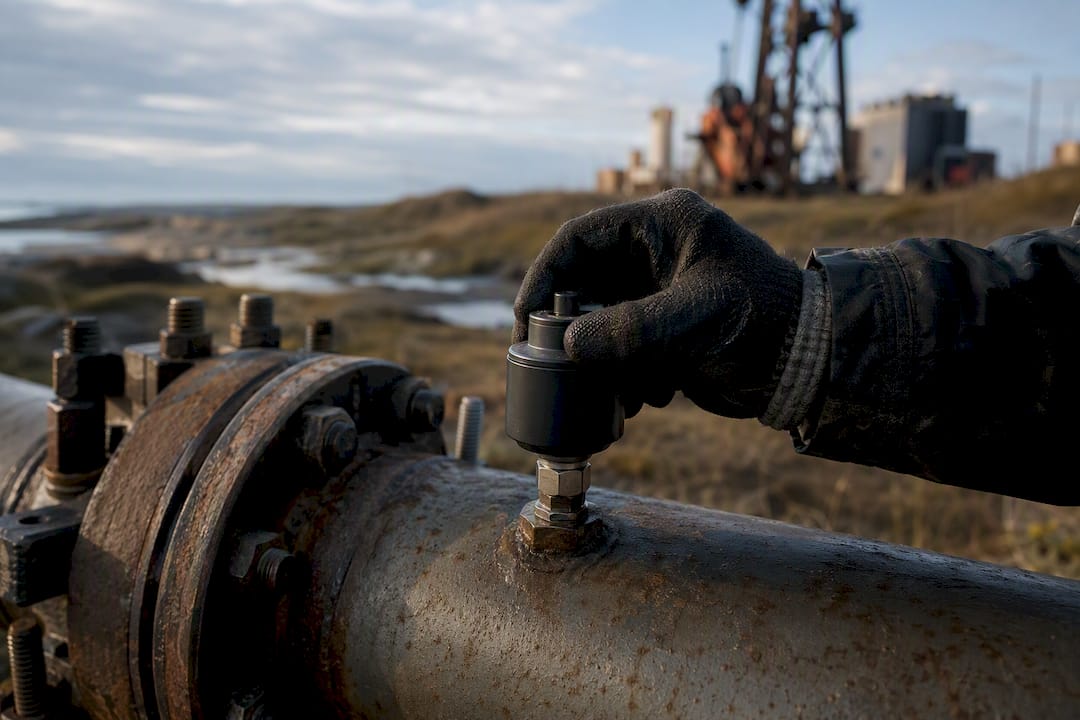
Contextual risk scoring goes beyond a raw CVSS number. A finding on an internet-facing engineering workstation and the same CVE on an air-gapped RTU that only a technician touches twice a year carry very different real-world risk. Score each finding against three inputs: safety and production criticality of the asset, whether the vulnerability appears on a known-exploited list, and how exposed the asset actually is to a plausible attack path.
Prioritization should follow the ONG-C2M2 model's Now/Next/Never structure rather than a flat 30/60/90 day patch SLA:
- Now covers actively exploited vulnerabilities on internet-exposed or safety-adjacent assets. These get emergency compensating controls within days, even if a full patch takes longer.
- Next covers high-severity findings on production-critical but non-exposed assets, worked into the next scheduled maintenance window.
- Never covers findings where the fix carries more operational risk than the vulnerability itself, formally documented as an accepted risk with a review date.
Remediation and mitigation rarely mean "patch immediately" in an OT environment. Compensating controls, network segmentation, virtual patching at the firewall layer, and application whitelisting on engineering workstations often carry less operational risk than an unplanned reboot of a control system. ISA/IEC 62443 lays out the segmentation and hardening controls that make this approach defensible to auditors and regulators alike.
Verification closes the loop. A finding marked "mitigated" needs evidence, whether that is a segmentation rule confirmed in a firewall audit or a patch confirmed installed on the next site visit. Track time-to-detect, time-to-mitigate, and percentage of inventory under active monitoring as your core KPIs, a theme covered further in the role of cyber risk in oil production.
Pro Tip: Build your risk score before you build your patch schedule. If a critical vulnerability sits on an asset with no realistic attack path, a compensating control now beats an emergency change window later.
An OT Patching and Mitigation Playbook for Constrained Sites
Patching a control system at a remote pad or an offshore platform is not a copy of your IT change process with longer lead times. It is a different discipline entirely, built around testing, staging, and documented risk acceptance.
- Test in a lab first. Replicate the target firmware or software version on a non-production device before pushing anything to a live asset, and use canary devices at a low-criticality site to catch issues before a fleet-wide rollout.
- Coordinate change windows with operations, not IT. A maintenance window on a producing well ties to workover schedules, weather at offshore platforms, and crew rotation, not a Tuesday-night IT patch cycle.
- Document every risk acceptance with an expiration date. A decision to defer a patch because the compensating control is adequate today should be revisited in 90 or 180 days, not left open indefinitely.
- Deploy compensating controls and verify them. Segmentation, virtual patching at the perimeter, and application whitelisting all reduce exposure, but each needs a follow-up check confirming the control is actually configured as intended, not just documented as planned.
- Treat firmware updates on embedded devices with extra caution. A failed firmware push on an RTU with no local IT support can mean a multi-day field visit to recover, so staged rollouts and rollback plans matter more here than almost anywhere else in the stack.
Pro Tip: Keep a "never patch live" list for the handful of safety loops where even a tested patch carries unacceptable downside. Document the compensating controls protecting each one and review that list quarterly.
Offshore-specific staging practices illustrate how weather windows and crew logistics reshape a patch calendar that would look routine onshore.
Locking Down the Supply Chain Before Vulnerabilities Arrive
Every new device that connects to your network is a vulnerability you have not assessed yet. Upstream operations run large subcontractor ecosystems, and a vendor's field laptop or a new IIoT sensor is frequently the weakest link in the chain, a pattern well documented in analyses of upstream cybersecurity.
- Require software bills of materials (SBOMs) and firmware-signing attestations in every procurement contract for control equipment.
- Route new devices and vendor laptops through a quarantine network segment for a pre-connection security inspection before granting production access.
- Write update and incident-notification SLAs directly into vendor contracts, not as a side agreement.
- Set a third-party assessment cadence, with a clear threshold for denying network integration when a vendor fails to meet baseline requirements.
NIST's supply chain security guidance backs this approach, and the energy sector supply chain guide breaks down how to write these clauses into existing vendor agreements without renegotiating every contract from scratch.
Governance That Turns Findings Into Action
A vulnerability management program only works if someone owns the decisions it produces. Operations engineers should lead remediation planning for OT assets, since they understand what a change actually does to a producing well or a control loop, while a vCISO or security team plays an advisory role and runs the automated intake and reporting layer.
- Run discovery sweeps at least quarterly, with continuous passive monitoring on critical segments.
- Review the risk register monthly, and revisit every accepted risk before its documented expiration date.
- Track four KPIs consistently: time-to-detect, time-to-mitigate, percentage of inventory under active monitoring, and the number of accepted risks past their review date.
- Feed every vulnerability finding into the incident response plan, so a newly disclosed CVE with active exploitation triggers the same escalation path as a live intrusion.
This governance model mirrors what cyber risk assessments for energy firms recommend for building a defensible risk register that satisfies both operations leadership and outside auditors.
A 30/60/90 Runbook for Upstream Vulnerability Management
You do not need a year-long program design phase to start reducing risk. A phased runbook gets meaningful protection in place within a single quarter.
- Days 1 to 30: Complete a full IT and OT asset inventory, physically isolate SIS from general network access, triage every open finding against known-exploited-vulnerability lists, and deploy emergency compensating controls on anything actively exploited.
- Days 31 to 60: Stand up staged testing and patching for non-critical sites, add SBOM and security-attestation requirements to procurement, and establish your first KPI baseline for time-to-detect and time-to-mitigate.
- Days 61 to 90: Automate vulnerability intake and reporting, formalize remediation plans with vendors who fell short of assessment thresholds, and put your KPIs into a dashboard leadership actually reviews.
Pro Tip: Do not wait for a perfect asset inventory before starting triage on known-exploited vulnerabilities. Work the highest-confidence risks in parallel with discovery, and refine as the inventory fills in.
vCISO services built for oilfield operations run exactly this kind of phased engagement, pairing outsourced advisory hours with the automated tooling needed to keep the runbook moving past day 90.
Where Conventional Vulnerability Management Advice Falls Short
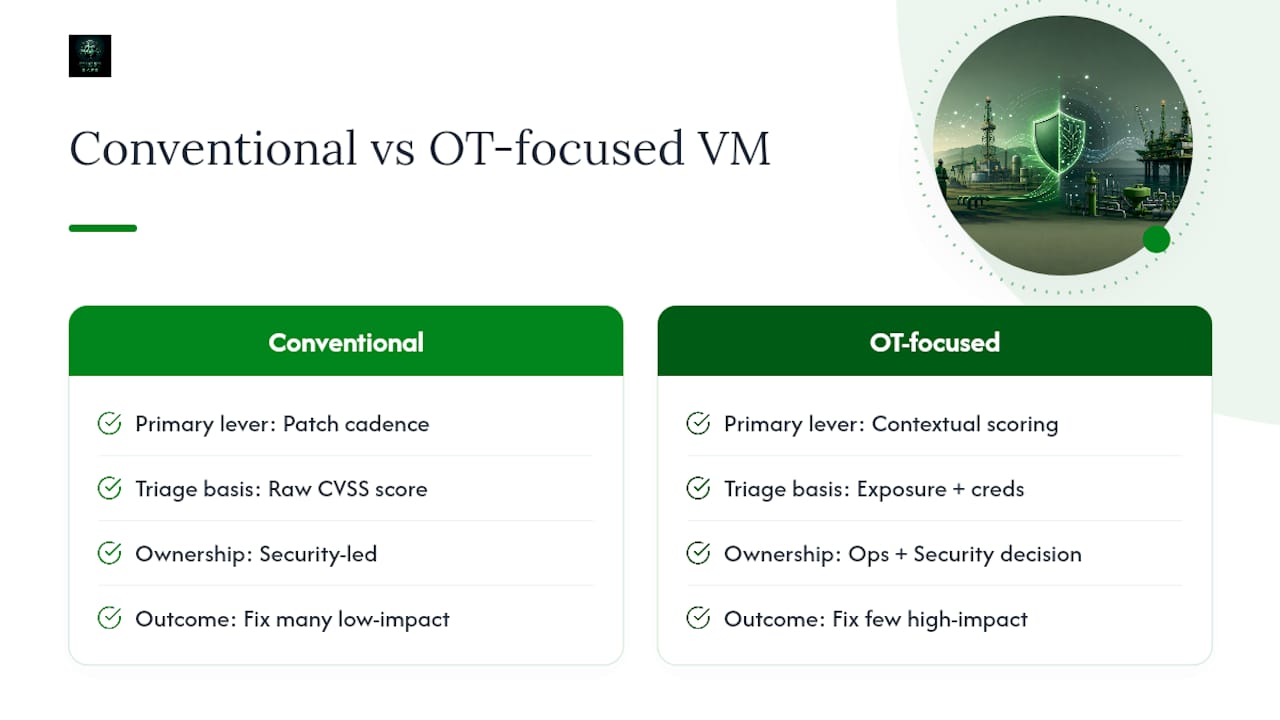
Most vulnerability management guidance still treats patch cadence as the main lever, and that assumption breaks down fast in upstream OT. The real lever is contextual risk scoring, and too few programs invest in it. A CVSS 9.8 finding on an isolated RTU with no network path to anything else is often less urgent than a CVSS 6.5 finding on an internet-facing engineering workstation with domain admin credentials cached, yet plenty of programs still triage by raw severity score alone.
The other gap is ownership. Security teams that try to run OT remediation without operations engineers in the room end up with plans that look sound on paper and fail the moment someone tries to execute them during a live production window. The SANS approach of treating remediation as an operational decision, not a security mandate, gets this right, and it is the piece most conventional advice skips.
If you take one thing from this article, prioritize contextual scoring over patch velocity. A slower program that fixes the right five things beats a faster one that fixes fifty things nobody needed fixed this quarter.
A Practical Path to Running Vulnerability Management Without a Full-Time CISO
Hiring a full-time CISO to run this program costs well into six figures before benefits, and most mid-market upstream operators do not need that headcount to get it done right. CisoSafe pairs hands-on vCISO advisory with an automated SaaS platform that handles vulnerability intake, penetration testing coordination, and compliance-ready reporting, so your team gets senior security judgment and continuous monitoring without the full-time salary line.
The practical outcome is a program that moves faster and documents itself as it goes. Findings get triaged and prioritized against your actual asset criticality, remediation plans get tracked to completion, and every accepted risk carries a paper trail an auditor can follow without a scramble. That documentation matters as much as the technical work itself when a regulator or an insurer asks how a decision got made. If your current vulnerability management program still runs on spreadsheets and a part-time security hire's best effort, CisoSafe's vCISO and compliance platform is built for exactly this gap. Request an assessment to see where your upstream program stands against SANS, ONG-C2M2, and IEC 62443 benchmarks, and get a prioritized roadmap instead of a generic findings report.
Standards Worth Consulting Next
These sources anchor the frameworks referenced throughout this guide, and each is worth bookmarking for your own program design.
- SANS Five ICS Cybersecurity Critical Controls, adapted for oil and gas subsegments
- ONG-C2M2 Version 1.1 for maturity model and prioritization
- ISA/IEC 62443 series for OT/ICS technical controls
- NIST guidance and CISA ICS-CERT resources for supply chain and incident data
Sources
- Prioritized Industrial Cyber Defense in Oil and Gas | SANS Institute
- Oil and Natural Gas Subsector Cybersecurity Capability Maturity Model Version 1.1
- ISA / IEC 62443 series of standards