
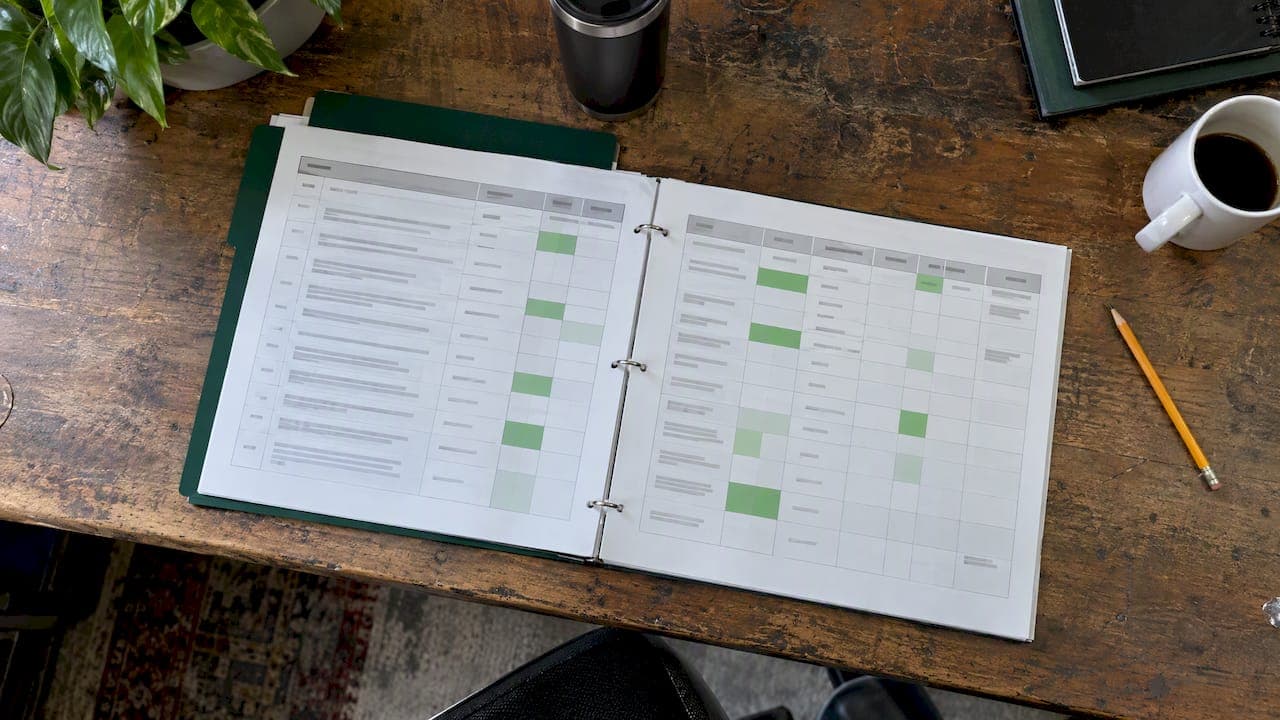
Security controls mapping is the work of linking the controls you actually run (multi-factor authentication, logging, vendor reviews, backup testing) to the requirements of each framework, law or contract that applies to you. Done well, you build one control set and prove it many times. Done badly, you get a spreadsheet that looks complete and falls apart the first time an auditor asks for evidence. This guide shows how to do it the first way, with a method, a worked example and the limits of a mapping you should know before you rely on one.
TL;DR
- A control map links each internal control to the framework requirements it supports, so one control can serve SOC 2, HIPAA, NIST CSF, CMMC and contract clauses at once.
- A link alone proves little. NIST warns that a simple link does not show whether two concepts are equivalent, overlapping or merely related, so record the relationship and the reason for every row.
- Partial coverage is normal. Mark it as partial, write down what is missing, and turn the gap into a remediation task.
- A mapping organizes your program. Auditors still ask for evidence that each control is implemented and working.
- NIST CSF 2.0 has six functions, not five. Govern was added in 2024, so check older crosswalks against the current version.
Table of Contents
- What security controls mapping means
- Why regulated organizations map their controls
- Relationship types: the part most maps skip
- How to map security controls, step by step
- A worked example: one control, three obligations
- Mapping to NIST CSF
- Handling partial and indirect coverage
- What auditors want beyond the map
- Choosing tools for mapping
- Common mistakes
- Our perspective: map the program you can defend
- Where CISOSafe fits
- FAQ
- Sources
What security controls mapping means
A control is a safeguard: a policy, a technical setting, a process or a piece of training. A framework requirement is a statement about what an organization must achieve. Mapping connects the two.
NIST describes mapping in its IR 8477 guidance on mapping between documentary standards as identifying relationships between concepts in different sources. A good mapping helps a reader see how meeting one source may help with another, and which parts of the other source remain unaddressed. That second half matters as much as the first. A map that only shows overlap hides your exposure.
You will see the same activity called a crosswalk, a control matrix, a common control framework or compliance mapping. The names differ. The job is the same: one set of controls, many obligations. If you want the wider compliance view, our guide to compliance mapping for risk leaders covers how mapping fits into the program around it.
Why regulated organizations map their controls
Most regulated firms face several obligations at once. A Houston law firm may carry client outsourcing guidelines, a cyber insurance questionnaire and a healthcare client's HIPAA business associate terms. An energy services contractor may answer to customer security addenda, NIST-based requirements and CMMC if it touches defense work. Each one asks about access control, incident response and vendor risk in slightly different words.
Without a map, each request starts a new project. Teams answer the same question five times, evidence lives in five folders, and the answers drift apart. With a map you get:
- Less duplicated work. Control mapping is commonly defined as aligning implemented controls with framework requirements to find overlap and reduce repeated effort, as one security standards glossary puts it.
- Faster questionnaires. Answers pull from one source of truth.
- Visible gaps. Requirements with no matching control show up as blank rows, not surprises.
- A clearer story for leadership. A managing partner or board member can see which obligations are covered, partly covered or open.
The gap-finding use is worth stressing. If you need a structured way to find what is missing once the map exists, see our explainer on security gap analysis.
Relationship types: the part most maps skip
The weakest control maps are two columns: control on the left, requirement on the right. They say "related" and nothing else. NIST IR 8477 warns against exactly this. A link does not tell the reader whether concepts are equivalent, overlapping, prerequisites, components or otherwise related, so the guidance asks authors to state what a relationship means rather than leave readers to guess.
NIST's OSCAL Control Mapping Model gives a useful vocabulary even if you never use the machine-readable format. It describes relationships such as equivalent-to, equal-to, subset-of, superset-of, intersects-with and no-relationship. In plain terms:
| Relationship | What it means for your map | What you do |
|---|---|---|
| Equivalent | The control satisfies the requirement in full | Link evidence and move on |
| Subset | Your control covers only part of the requirement | Record the missing part as a gap |
| Superset | Your control goes beyond the requirement | Note it, since it may cover other requirements too |
| Intersects | The two overlap but each has parts the other lacks | Document both sides of the overlap |
| No relationship | Nothing in your set addresses the requirement | Open a remediation item |
Pick one set of labels and use it everywhere. Consistency matters more than which words you choose.
How to map security controls, step by step
The NIST guidance points to a simple sequence: document the use case and assumptions, choose a relationship style, evaluate pairs of concepts and record each relationship. Here is how that plays out in a working program.
1. Write down the purpose and scope
State why the map exists. A map built to answer client questionnaires looks different from one built to prepare for a SOC 2 audit or a CMMC assessment. NIST IR 8477 says a mapping should document its purpose, use cases, scope, audience, assumptions and the meaning of its relationships so users do not have to guess what the crosswalk signifies. A short paragraph at the top of the workbook does this.
2. Choose your anchor
Pick the set you will map everything else to. Some teams use their own control catalog, written in plain language. Others anchor on a recognized framework such as NIST CSF. Either works. What fails is anchoring on whichever framework the last auditor mentioned and re-mapping each time.
3. Inventory the controls you really run
List what exists today, not what the policy binder says should exist. Include owner, system or scope, frequency and where evidence lives. A control with no owner and no evidence location is a draft, not a control.
4. Decide the relationship style
Choose your labels before you start (see the table above) and define each one in a sentence. Two analysts mapping the same control should reach the same label.
5. Evaluate pairs and record the reason
For each requirement, find the controls that touch it, select a relationship and write one sentence of rationale. NIST recommends recording the rationale for every relationship. Months later, the sentence is what lets a new analyst, or an auditor, understand why you called a control equivalent.
6. Check the reverse direction
NIST IR 8477 recommends examining the reverse direction even when you plan a one-way map. If your access review control maps to a requirement, ask what else that requirement expects. The reverse pass is where partial coverage tends to surface.
7. Turn gaps into work
Every subset or no-relationship row becomes a remediation task with an owner and a target quarter. NIST also notes that a phased approach can be appropriate, so you can map your highest-risk frameworks first and extend the map later.
A worked example: one control, three obligations
The example below is illustrative, not drawn from a real client. Suppose a mid-sized firm runs a control called "Multi-factor authentication on all remotely accessible systems." It gets mapped against three things: a customer contract clause requiring strong authentication for remote access, a framework requirement on access management, and a cyber insurance question about MFA for email and VPN.
| Obligation | Relationship | Rationale | Open item |
|---|---|---|---|
| Customer contract clause on remote access | Equivalent | MFA is enforced on VPN and remote desktop for every user | None |
| Framework access management requirement | Subset | Requirement also covers privileged accounts and periodic access reviews, which this control does not | Add quarterly privileged access review |
| Insurance questionnaire item on email MFA | Subset | MFA covers VPN but email is not yet enforced for contractors | Enforce MFA for contractor mailboxes |
One control, three answers, and two real tasks the firm would have missed if it had simply checked three boxes. That is the value of recording relationships instead of links.
Mapping to NIST CSF
Many teams anchor on the NIST Cybersecurity Framework because most other frameworks and customer requirements can be related to it. Two points keep a CSF-based map accurate.
Use the current structure. NIST's announcement of CSF 2.0 on February 26, 2024 added Govern to Identify, Protect, Detect, Respond and Recover. Govern covers cybersecurity strategy, enterprise risk and senior-leader decision-making. NIST still describes the five functions of CSF 1.1 as the primary pillars of a cybersecurity program, which is why you will see the "five pillars" phrase in older material. If your crosswalk has only five categories of functions, it predates 2.0 and needs review, particularly for governance controls such as board reporting and risk appetite.

Use the official references, with care. For CSF 2.0, NIST publishes informative references that connect Core elements to other documents. According to NIST SP 1347, you can view them through Excel downloads, the CSF 2.0 Reference Tool and the Online Informative References (OLIR) program. The same document notes that NIST does not test the correctness of mappings submitted by outside parties, and that reference data may be updated periodically. Treat any downloaded mapping as a starting point, date your copy and have someone who knows your environment review it.
NIST's CSF 2.0 Quick-Start Guides page also lists guides on organizational profiles, community profiles, supply-chain risk management and informative references. The organizational profile is a natural home for a map: it records your current outcomes, your target outcomes and the distance between them.
For federal-adjacent work, NIST IR 8170 explains that agencies can derive controls from multiple frameworks and that the OLIR catalog provides cross-framework mappings meant to show similarities and differences. Contractors who inherit federal requirements often face the same mix. Our guides on NIST IT security and the NIST risk management framework explain how those pieces connect, and the CMMC Level 2 requirements guide covers the 110 controls defense contractors must prove.
Handling partial and indirect coverage
Partial coverage is where mapping gets honest. A few rules keep it that way.
- Never round up. If a control covers part of a requirement, label it a subset and name what is missing. A requirement is not satisfied because a related control exists.
- Expect different depth. One standards glossary cautions that mapping a control to another framework does not establish equivalence: scope, depth and implementation requirements can differ, so each framework's own requirements still need evaluation.
- Write down assumptions. If the map assumes a control applies to all production systems, say so. When the scope changes, the map changes.
- Use compensating controls openly. If you meet an intent through a different mechanism, document the mechanism and the reasoning, then confirm with your assessor before the audit, not during it.
- Re-map on change. New systems, new vendors, a new version of a framework or a new contract all trigger a review.
For operational technology environments, such as those in oil and gas, indirect coverage is especially common because IT controls rarely transfer cleanly to plant systems. Our guides to OT cybersecurity and IEC 62443 compliance show where the gaps tend to appear.
What auditors want beyond the map
A control map is an organizing aid. It is not evidence. NIST SP 800-53A Rev. 5, the federal guide for assessing security and privacy controls, says assessment evidence must support objective determinations about whether controls are effective, not merely show that controls were mapped to a framework. It frames this around examination, interview and testing procedures suited to the assessment objective.
Translate that into what you prepare for each mapped control:
- Examine: the policy, the configuration screenshot or export, the ticket history, the access review sign-off.
- Interview: a named control owner who can explain how the control runs and what happens when it fails.
- Test: proof of operation over time, such as a restore test result, a phishing simulation report or a penetration test with remediation notes.
Auditors differ on how closely they read a crosswalk. Some use it to plan sampling and move on to evidence. Others challenge individual relationships. Plan for the stricter reviewer: rationale on every row, evidence links in the same workbook, and dates on everything. Our information security compliance guide goes deeper on audit-ready evidence habits.
Choosing tools for mapping
There are three practical options, and they suit different stages.
- Spreadsheet. Fine for one or two frameworks and a small control set. It breaks down when ownership, evidence and version history matter.
- Official reference data. The NIST CSF 2.0 Reference Tool, OLIR and the Cybersecurity and Privacy Reference Tool give authoritative starting relationships. For teams that want machine-readable output, OSCAL can represent mappings in XML, JSON or YAML without copying the source control text.
- A compliance platform. Once you manage several frameworks, a platform that keeps controls, mappings, evidence and tasks in one place stops the workbook from rotting. Look for versioned mappings, rationale fields, evidence attachments and board-ready reporting.
Whatever you pick, check that it lets you record the relationship type and the reason. A tool that only draws lines between boxes reproduces the weakness NIST warns about.
Common mistakes
- Mapping to policies instead of operating controls.
- Letting every framework have its own control wording, so the "common" set is not common.
- Importing a third-party crosswalk and treating it as verified.
- Forgetting version changes, such as CSF 2.0's new Govern function.
- Skipping owners. A map with no owners is a document nobody maintains.
- Mapping once for an audit and never again.
Our perspective: map the program you can defend
We see the same pattern in law firms and energy operators. Leadership asks for a crosswalk because an audit, a client or an insurer has asked for one. A team produces a tidy matrix in a few weeks. Then the first detailed review finds that half the rows rest on a policy nobody follows.

Our view is that the map should come after an honest look at what runs, not before. Start with a risk assessment, name the controls that operate today, then relate them to the obligations that matter to your revenue: the client outside counsel guidelines, the customer security addendum, the framework your regulator or contract names. A smaller, accurate map beats a sprawling one that nobody trusts.
We also push for three habits. First, a rationale on every relationship, written for a stranger. Second, an owner and an evidence location on every control. Third, a short quarterly review with leadership that looks at gaps, not at the percentage of green cells. For firms without a full-time security executive, this is the kind of ongoing strategic work a virtual CISO exists to run, and the reporting should be clear enough for a managing partner or operations lead to read without translation.
— vCISO
Where CISOSafe fits
If your team needs a defensible map without hiring a full-time security executive, our virtual CISO and compliance services cover risk assessments, policy and controls development, compliance program management and audit and certification readiness. Our AI-powered platform supports more than 50 frameworks, so one set of controls can be related to the standards your clients and regulators actually ask about, with reporting leadership can read. Pricing is scoped to the engagement, so start with a conversation about which frameworks and contracts you need to cover.
FAQ
What are control mappings?
Control mappings document how your implemented controls relate to the requirements of one or more frameworks, laws or contracts. A good mapping states the type of relationship (full, partial, none) and the reason, so readers know what the link actually means. It is used to reduce duplicate work and to find gaps.
What are the five pillars of NIST CSF?
NIST CSF 1.1 named five functions as the primary pillars of a cybersecurity program: Identify, Protect, Detect, Respond and Recover. CSF 2.0, released in February 2024, added a sixth function, Govern. Current assessments should use all six.
Does mapping a control to a framework mean I comply with it?
No. A mapping shows a relationship, and that relationship may be partial. Compliance depends on whether the control is implemented and effective, which assessors judge through examination, interviews and testing. Treat the map as the plan and the evidence as the proof.
Can I rely on a published crosswalk instead of building my own?
Use it as a starting point. NIST states that it does not test the correctness of non-NIST mappings submitted to its reference program, and reference data can change over time. Have someone who knows your systems review each relationship and record your own rationale.
Sources
- NIST IR 8477: Mapping Relationships Between Documentary Standards, Regulations, Frameworks and Guidelines
- NIST SP 1347: NIST Cybersecurity Framework 2.0 Informative References
- NIST IR 8170: Approaches for Federal Agencies to Use the Cybersecurity Framework
- NIST: Version 2.0 of the Cybersecurity Framework released
- NIST: The CSF 1.1 Five Functions
- NIST: CSF 2.0 Quick-Start Guides
- NIST OSCAL Control Mapping Model
- NIST SP 800-53A Rev. 5: Assessing Security and Privacy Controls
- Application Security Standards: Control Mapping