

Compliance mapping links every external requirement your organization faces to the internal control that satisfies it, the evidence that proves it, and the person accountable for it. Done right, it gives you a single, testable record instead of a stack of checklists that nobody can defend under audit pressure. That record connects a requirement source to a common control, ties in an evidence package, assigns an owner, and tracks test status over time.
The value shows up fast. Auditors stop asking you to rebuild the same proof for every framework. Leadership gets a gap dashboard instead of a vague assurance. Frameworks rooted in COSO's enterprise risk management guidance treat this kind of structured mapping as a prerequisite for real risk oversight, not a paperwork exercise, and it directly supports audit readiness when regulators or clients come calling.
Executives and audit committees consistently ask for three things from a mapping program:
- An evidence trail that proves a control operated, not just that it exists on paper.
- A gap dashboard showing which obligations lack a mapped control or current evidence.
- Clear control ownership so every requirement has a named accountable party, not a shared inbox.
Key Takeaways
A compliance map only delivers real value when it links every obligation to a testable control, current evidence, a named owner, and a documented test method.
| Point | Details |
|---|---|
| build the inventory | Catalog every applicable regulation, contract clause, and standard before mapping anything. |
| build the control library | Document reusable common controls and complete an initial pilot mapping across your top frameworks. |
| formalize governance | Stand up a dashboard, assign a regulatory watcher, and set exception escalation paths to leadership. |
| Measure continuously | Track percent mapped, percent with testable evidence, and exception age to catch decay early. |
| Consider vCISO support | CisoSafe pairs vCISO validation with AI-assisted mapping across fifty-plus frameworks for regulated mid-market organizations. |
Table of Contents
- What Is Compliance Mapping and How Does It Work?
- Why Does Compliance Mapping Matter to Your Program?
- What Should Every Compliance Mapping Record Include?
- How Do You Build a Compliance Map Step by Step?
- Should You Use Spreadsheets, GRC Platforms, or AI-Enabled RegTech?
- What Mapping Mistakes Create False Audit Confidence?
- How Do You Measure If Your Compliance Map Is Working?
- How Often Should You Update Your Compliance Map?
- A Sample Compliance Mapping Row You Can Adapt
- What Actually Goes Wrong in Real Mapping Projects
- How CisoSafe Supports Your Compliance Mapping Program
- Frequently Asked Questions About Compliance Mapping
- Sources
What Is Compliance Mapping and How Does It Work?
Compliance mapping is the discipline of connecting a regulatory or contractual obligation to the specific internal control, policy, and proof that satisfies it. Every row in a well-built map answers the same question: if an auditor challenged this requirement tomorrow, could you produce the control, the evidence, and the person responsible in under five minutes?
A few terms come up constantly, and getting them right prevents a lot of confusion later. An obligation is the source requirement itself, whether that's a statute, a contract clause, or an industry standard like SOC 2 or HIPAA. A requirement identifier is the specific citation or clause number you're tracking, since a single regulation can generate dozens of discrete obligations. A common control is a control designed once and reused across multiple obligations, which is where mapping efficiency actually comes from. An evidence package is the standardized set of artifacts (logs, screenshots, signed attestations, ticket exports) that proves a control ran during a given period. Scope defines which legal entity, environment, product line, or time window the control actually covers. An exception documents a known gap along with its remediation plan and expiration date.
The most important distinction to internalize: a mapping record is testable, and a checklist is not. A checklist asks "do you have a password policy?" A mapping record specifies which control satisfies which clause, what evidence proves it operated last quarter, and who signed off. That's the difference auditors care about, and it's why practical mapping guidance treats the map as a living record rather than a static document.
Mapping doesn't sit off to the side of your compliance program. It's the connective tissue between your obligation inventory and your enterprise risk management process. When COSO guidance talks about identifying, assessing, and prioritizing compliance risk, mapping is the mechanism that makes those risks visible in the first place.
Why Does Compliance Mapping Matter to Your Program?
A finished compliance map changes how your organization behaves under scrutiny. Instead of scrambling every time a customer sends a security questionnaire or a regulator opens an exam, you pull from a single source of truth that already has the answers organized by requirement.
The program-level benefits stack up quickly:
- Audit readiness: evidence is pre-packaged and linked to the exact control it supports, cutting audit prep time significantly.
- A single source of truth: no more conflicting spreadsheets between legal, IT, and compliance teams.
- Evidence reuse across frameworks: one access-control review can satisfy overlapping requirements in SOC 2, HIPAA, and PCI DSS.
- Faster responses to regulator and customer requests: you're answering from a map, not building an answer from scratch.
For senior leadership, mapping is also a governance story. Federal Reserve guidance on compliance risk management recommends that complex organizations run firmwide compliance programs with documented policies and independent oversight precisely because compliance risk crosses business lines and jurisdictions. A compliance map is the artifact that proves that oversight exists rather than just claiming it does.
Statistic callout: Regulatory guidance from the Federal Reserve specifically calls for documented compliance policies and independent testing at complex organizations, framing mapping-driven documentation as a supervisory expectation rather than a best practice. Firms that treat mapping as optional put themselves in a weaker position the moment an examiner asks how compliance risk is tracked across business lines.
Board and audit committee reporting improves too. A gap dashboard built from your map gives directors a defensible answer to "are we compliant?" instead of a reassuring but unverifiable "yes."
What Should Every Compliance Mapping Record Include?
A mapping record is only useful if it captures the right fields, in enough detail that someone outside the original project could pick it up and understand exactly what's being claimed.
At minimum, each row in your map needs:
- Requirement source and ID: the regulation, contract, or standard, plus the specific clause number.
- Requirement text: the actual language, not a paraphrase that drifts from the original intent.
- Applicability decision: does this requirement apply to your organization, and who decided that?
- Mapped control ID and description: the specific control, written operationally.
- Scope: which legal entity, environment, product, and time period this mapping covers.
- Evidence type and location: what proves the control ran, and where it's stored.
- Owner: the named individual accountable for the control, not a department.
- Test method: how and how often the control is verified.
- Status and exceptions: current state, plus any documented gaps with expiration dates.
The control description is where most maps quietly fail. "Access is reviewed periodically" is not testable. "IT Security reviews privileged access lists in the identity management system quarterly and documents removal of terminated employees within five business days" is testable, because an auditor can ask for the review record and check the timeline.
Scope disputes cause more audit findings than almost anything else in mapping work. A control that's valid for your U.S. entity's cloud environment doesn't automatically cover a European subsidiary or an on-premises legacy system. Practical guidance on obligation-to-control mapping stresses that a control's validity depends entirely on who, what, and when is actually in scope, and that ambiguity here is one of the most common sources of overstated coverage.
A common control library solves a lot of this by letting one well-documented control satisfy multiple obligations. Each entry in that library needs its own metadata: which frameworks it satisfies, its testing frequency, its owner, and the evidence type it produces. Build that library well, and mapping new frameworks becomes a matter of matching existing controls rather than starting over.
How Do You Build a Compliance Map Step by Step?
Building a durable compliance map is a project with clear phases, not a one-time spreadsheet exercise. Here's the sequence that holds up across regulated industries like legal services, energy, and healthcare.
- Scope the effort and build an obligation inventory. Identify every regulation, contract clause, and standard that applies to your organization, including cross-jurisdiction exposure.
- Define your control model. Decide how controls will be described, categorized, and versioned before you start mapping.
- Build a common control library. Document reusable controls with metadata so future frameworks can map against existing entries instead of duplicating effort.
- Map requirements to controls. Assign each obligation to a specific control, recording the applicability decision and scope.
- Define evidence packages. Specify exactly what artifact proves each control operated, and where it will live.
- Test and validate. Confirm controls actually operate as described, not just that they exist on paper.
- Operationalize monitoring and reporting. Set a cadence for ongoing testing, exception tracking, and governance reporting.
Each step needs a clear owner, and handoffs are where projects usually stall. The table below shows how responsibility typically breaks down.
| Role | Primary Responsibility | Key Handoff |
|---|---|---|
| Compliance team | Owns the obligation inventory and applicability decisions | Hands scoped requirements to control owners |
| Legal | Confirms regulatory interpretation and contract obligations | Provides applicability sign-off to compliance |
| IT/SecOps | Designs and operates technical controls | Supplies evidence artifacts to compliance |
| Process owners | Executes day-to-day control activities | Confirms control descriptions are accurate |
| Internal audit | Independently tests controls and validates evidence | Reports gaps back to governance |
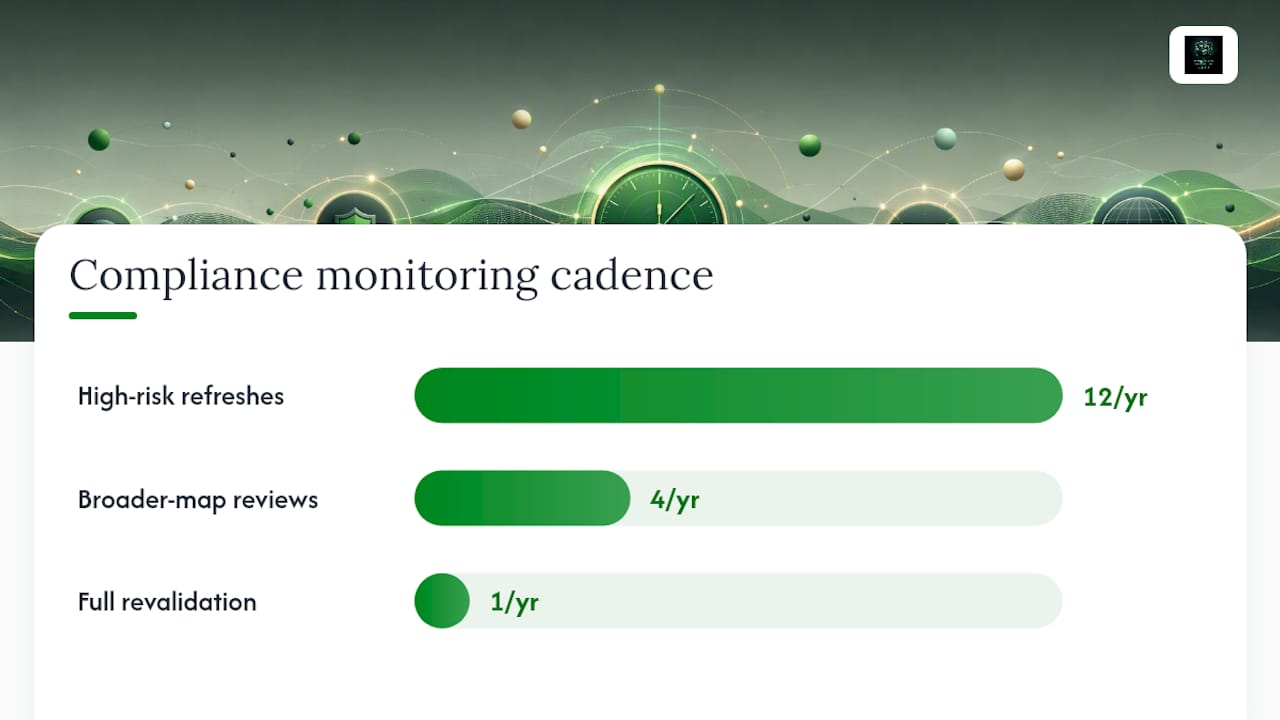
A realistic first build takes eight to twelve weeks for a mid-sized organization with two or three overlapping frameworks. After that initial push, plan for a recurring cadence: monthly evidence refreshes for high-risk controls, quarterly reviews for the broader map, and an annual full revalidation. Governance should include a lightweight approval step for any new exception, requiring sign-off from a compliance lead and, for anything material, a report up to senior management.
Pro Tip: Build the common control library before you start mapping individual frameworks. Teams that map framework by framework end up rebuilding the same access control review five separate times instead of writing it once and pointing five obligations at it.
Should You Use Spreadsheets, GRC Platforms, or AI-Enabled RegTech?
The right tool depends almost entirely on how many frameworks you're tracking and how much cross-jurisdiction complexity you carry, not on which platform has the flashiest demo.
Spreadsheets work as a prototype or for organizations tracking one or two frameworks with a small control set.
- Fast to start, no procurement cycle, and everyone already knows how to use them.
- Break down quickly past a few hundred rows, with no built-in version control or workflow.
- Evidence storage is manual and easy to lose track of during staff turnover.
GRC platforms bring structure, workflow, and reporting to organizations managing multiple frameworks across business units.
- Structured mapping fields enforce consistency and reduce the risk of an incomplete scope decision slipping through.
- Built-in workflow routes exceptions and approvals to the right owner automatically.
- Setup and licensing cost more, and the platform is only as good as the data discipline behind it.
AI-enabled RegTech adds automated ingestion of regulatory text and suggested mappings to existing controls, speeding up the front end of the process considerably. These tools can extract requirement language from dense regulatory documents and propose candidate control matches, cutting down the manual reading burden significantly. The catch is that suggested mappings still need human validation. An AI model can misread scope or context, and treating an unvalidated suggestion as a finished mapping is how false assurance creeps into a program.
The decision usually comes down to three questions: how many frameworks are you tracking, how many legal entities or jurisdictions does your organization span, and does your team have the bandwidth to maintain a spreadsheet's worth of manual updates every quarter? Organizations juggling frameworks like SOC 2, HIPAA, and CMMC simultaneously, across overlapping report types, almost always outgrow spreadsheets within the first year.
CisoSafe's approach blends hands-on vCISO advisory with an AI-assisted SaaS platform built for this exact middle ground. Instead of forcing regulated mid-market organizations to choose between a bare spreadsheet and an enterprise GRC contract they don't need, the platform automates compliance intake and reporting across more than fifty frameworks while a vCISO validates the mappings that matter most.
What Mapping Mistakes Create False Audit Confidence?
The most damaging failure in compliance mapping isn't a missing control. It's a map that shows every cell green while the underlying control never actually operated the way the description claims. That gap between "the control exists" and "the control operates" is where audit findings and, worse, real security incidents originate.
Scope errors are the second-biggest source of false assurance. A control validated for your primary business unit gets silently assumed to cover a newly acquired subsidiary, a different product line, or a cloud environment nobody documented. When the applicability language is vague, the map overstates coverage in ways that surface only when an auditor or regulator digs into specifics.
A few practices consistently prevent both problems:
- Build and maintain a common control library so the same well-tested control isn't redocumented five different ways.
- Define evidence requirements when the control is created, not months later when an audit is already underway.
- Specify a concrete test method for every control, including frequency and who performs it.
- Give every exception a lifecycle: a documented gap, an owner, a remediation date, and an expiration.
Pro Tip: When one control satisfies multiple obligations, design the evidence package around the strictest requirement in the group, not the loosest. If your access review evidence needs to satisfy both a monthly SOC 2 clause and a quarterly HIPAA clause, capture it monthly. Reusing evidence only works if it's credible against the toughest standard it's mapped to.
How Do You Measure If Your Compliance Map Is Working?
A map that never gets measured tends to decay quietly until an audit finding exposes it. A handful of core metrics keep the program honest and give leadership a real read on program health.
- Percent of requirements mapped: the baseline coverage metric, tracked against your full obligation inventory.
- Percent with testable evidence: mapped is not the same as proven; this metric catches the difference.
- Exception age: how long known gaps have sat unresolved, and whether they're trending down.
- Remediation closure time: how quickly identified gaps actually get fixed once flagged.
- Control failure rate: how often tested controls fail to operate as described.
- Coverage by business unit or legal entity: where mapping is strong and where it's thin.
Executives generally want a heat map showing coverage and risk by business unit, while operational teams need a granular gap list they can work from daily. Trend charts matter more than snapshots here, since a static coverage percentage tells you far less than whether that percentage is climbing or slipping quarter over quarter.
Statistic callout: The IMF's technical guidance on compliance improvement plans recommends a standardized identify, rate, treat, and measure methodology specifically because ad hoc treatment of gaps produces inconsistent results across teams. A structured plan turns a mapping gap into a tracked, prioritized workflow instead of an item that sits in someone's inbox indefinitely.
Testing frequency should track risk level, not calendar convenience. High-risk obligations tied to data breach notification or financial reporting deserve continuous monitoring rather than an annual spot check. Lower-risk administrative requirements can reasonably sit on a quarterly or annual review cycle. Feed these outputs into your broader enterprise risk management process so mapping gaps show up in the same risk register leadership already reviews, rather than living in a compliance-only silo.
Well-organized evidence also pays off outside of audits. When a customer sends a security questionnaire or a prospective client's legal team requests SOC 2 proof, a mature map lets you answer in hours instead of the days it takes to hunt down artifacts from scratch.
How Often Should You Update Your Compliance Map?
Regulations, contracts, and business environments change constantly, and a map built once and never revisited becomes a liability rather than an asset within a year or two.
Match your update cadence to the risk level of the obligation. High-risk laws and regulations, particularly ones tied to data breach notification, financial controls, or safety, deserve continuous monitoring or at minimum a monthly review. Internal policies typically hold up on a quarterly review cycle. Broader industry standards and frameworks that change infrequently, like ISO certifications, are usually fine on an annual review.
The change-notification workflow itself needs to be lightweight enough that people actually follow it:
- Regulatory watch: someone is assigned to monitor changes in applicable law, standards, or contract terms.
- Applicability assessment: when a change surfaces, determine whether it affects your existing map.
- Mapping update: revise the affected requirement, control, or scope fields.
- Evidence refresh: confirm the evidence package still supports the updated requirement.
- Governance reporting: flag material changes to senior management or the board.
Exceptions need an escalation path too. A minor gap with a clear remediation timeline might only need compliance team sign-off. A significant control failure tied to a regulated obligation, especially one involving legal data compliance requirements, should escalate to senior leadership or the audit committee, with a documented remediation plan and deadline.
For teams trying to integrate this into daily work rather than a quarterly fire drill, a short checklist helps: assign a named regulatory watcher for each major framework, build applicability review into your change management process for any new product or system, and require evidence refresh sign-off before closing out any mapping update.
A Sample Compliance Mapping Row You Can Adapt
A single well-built row shows exactly what a complete mapping record looks like in practice. Here's a realistic example based on a SOC 2 access control requirement.
| Field | Example Entry |
|---|---|
| Requirement source & ID | SOC 2 Trust Services Criteria |
| Requirement excerpt | Logical access to systems is restricted to authorized users |
| Applicability decision | Applies; approved by Compliance Lead, reviewed annually |
| Control ID & description | IT Security reviews privileged access lists quarterly and documents removal of terminated employees in a timely manner |
| Scope | U.S. production environment, all customer-facing applications |
| Evidence (type & location) | Access review export and sign-off, stored in GRC platform evidence repository |
| Owner | IT Security Manager |
| Test method | Internal audit samples 25% of monthly reviews quarterly |
| Last tested date | Update on each test cycle |
| Status | Operating effectively |
| Exception note | None currently open |
To adapt this row to a different requirement, swap the source citation, rewrite the control description to match the actual operational process, and confirm the scope fields reflect your real environment rather than copying the example. Store evidence references as links or file paths pointing to your actual repository, whether that's a GRC platform's evidence module or a controlled document management system, so anyone reviewing the map can pull the artifact directly.
Exporting this into a spreadsheet is as simple as replicating the column headers above. Moving it into a GRC platform typically means mapping these same fields to the platform's native schema, which most modern tools support through a CSV import.
What Actually Goes Wrong in Real Mapping Projects
Most compliance leaders come into a mapping project underestimating how much of the work is organizational rather than technical. The hard part is rarely deciding what field goes in which column. It's getting a control owner in another department to actually document how their process runs, instead of describing what the policy says it should do.

The clients who get the most value from mapping tend to share one trait: they treat the first pass as intentionally incomplete. They build the obligation inventory, map what they can with confidence, and flag the rest as open exceptions rather than forcing a green checkmark on something nobody actually validated. That discipline is what prevents the illusion of coverage from becoming a real audit finding six months later.
A few patterns show up repeatedly across regulated mid-market organizations working through this for the first time:
- Consolidating overlapping controls across frameworks typically cuts the number of distinct controls a team has to maintain and test, since a well-designed access control review can satisfy multiple obligations at once.
- Teams that document evidence requirements at the same time they write the control description spend far less time scrambling before an audit than teams that treat evidence as an afterthought.
- Organizations that bring in outside expertise, whether a vCISO or dedicated compliance consultant, during the initial scoping phase tend to avoid the scope disputes that otherwise surface mid-project and force a restart.
Bringing in external expertise makes the most sense at two specific points: when your organization is mapping more than two or three frameworks for the first time, or when internal disagreement about scope and applicability is stalling progress. A vCISO with cross-industry mapping experience can usually resolve an applicability dispute in a single working session that might otherwise consume weeks of internal debate.
How CisoSafe Supports Your Compliance Mapping Program
Building and maintaining a compliance map without help from a dedicated team is possible, but most mid-market organizations in regulated industries end up spending more internal hours on it than the exercise is worth. CisoSafe combines hands-on vCISO advisory with an AI-enabled SaaS platform built specifically for organizations juggling frameworks like SOC 2, HIPAA, PCI DSS, and CMMC at the same time.
The platform automates compliance intake, suggests candidate mappings across more than fifty frameworks, and generates the professional reporting auditors expect, while your assigned vCISO validates scope decisions and control descriptions so nothing gets rubber stamped without review. For a law firm, energy operator, or healthcare organization managing overlapping obligations across multiple business units, that combination typically means faster audit readiness, one shared control library instead of five redundant spreadsheets, and evidence packages that are ready before the auditor asks for them.
If your team is starting a mapping project from scratch or trying to untangle a spreadsheet that's outgrown its usefulness, request a vCISO consultation with CisoSafe to scope a pilot mapping engagement and see how the platform handles your specific framework mix.
Frequently Asked Questions About Compliance Mapping
What is the difference between compliance mapping and a compliance checklist?
A checklist confirms a policy exists. A compliance map links that policy to a specific control, records the evidence proving the control operated, names an accountable owner, and defines a test method, making it verifiable rather than just descriptive.
How long does it take to build an initial compliance map?
A mid-sized organization tracking two or three overlapping frameworks can typically complete a first working map in eight to twelve weeks, assuming clear ownership and dedicated time from compliance, legal, and IT stakeholders.
Can AI tools fully automate compliance mapping?
AI-assisted RegTech can extract requirement language and suggest candidate mappings, which speeds up the initial pass significantly. Every suggested mapping still needs human validation of scope, control description, and evidence adequacy before it goes into production.
How often should a compliance map be reviewed?
High-risk obligations tied to data breach notification or financial controls deserve continuous or monthly monitoring. Internal policies typically hold up on a quarterly cycle, while stable industry standards can reasonably sit on an annual review.
What is a common control library, and why does it matter for mapping?
A common control library is a set of well-documented, reusable controls that satisfy multiple obligations at once. It's what lets one access review process satisfy overlapping SOC 2, HIPAA, and PCI DSS requirements instead of forcing separate controls for each framework.
Sources
A handful of sources are worth keeping close as you build or refine your program, each useful for a different piece of the puzzle.
- SR 08-8 / CA 08-11: Compliance Risk Management Programs and Oversight at Large Banking Organizations
- Applying ERM to compliance risk — COSO guidance
- Compliance Risk Management: Developing Compliance Improvement Plans (IMF, 2022)
- Compliance mapping connects obligations to controls, evidence, and ownership