

Secure multi-tenant architecture rests on one principle: never trust a single layer to enforce tenant boundaries. Bind tenant context the moment a request authenticates, enforce that scoping again at the database with row-level security or composite keys, prefix every cache and storage key with tenant ID, and route authorization decisions through a policy engine you can audit. Multi-tenant security fails when teams treat tenant isolation as a single checkpoint instead of a chain that has to hold at every link. Everything that follows explains how to build that chain and prove it works.
TL;DR:
- Ensuring tenant context binds at authentication and propagates through all async paths prevents cross-tenant data leakage and impersonation.
- Data-layer patterns like composite-key lookups and database enforcement are critical to prevent IDOR and BOLA vulnerabilities.
- Caching, session, and object storage need tenant-specific prefixes, validation, and short TTLs to avoid undetected data bleed.
- Regular automated deny-case tests and adversarial penetration testing are essential for proving that tenant isolation controls hold under pressure.
- Moving from quick middleware fixes to database enforcement and siloed infrastructure should follow a phased plan with rigorous verification at each stage.
Table of Contents
- What Are the Key Cross-Tenant Risks in Shared Environments?
- How Do You Choose an Isolation Model: Silo, Pool, or Bridge?
- How Should You Identify and Propagate Tenant Context?
- What Data-Layer Patterns Actually Prevent IDOR and BOLA?
- How Do You Isolate Caches, Sessions, and Object Storage?
- What Authorization Architecture Do Multi-Tenant APIs Need?
- What Controls Belong in Tenant Onboarding and Offboarding?
- How Do You Prove Tenant Isolation Actually Works?
- How Do Rate Limits and Resource Isolation Contain Blast Radius?
- What Encryption and Key-Management Patterns Support Isolation?
- How Do OWASP and NIST Standards Map to Real Controls?
- What's the Prioritized Rollout Plan for Multi-Tenant Security?
- How CisoSafe Helps Regulated Teams Close Isolation Gaps
- Why Most Teams Get Multi-Tenant Security Backwards
- Ready to Verify Your Own Tenant Isolation Controls?
- Sources
What Are the Key Cross-Tenant Risks in Shared Environments?
Multi tenancy security risks cluster around a handful of failure modes that show up in almost every SaaS platform sooner or later. OWASP's cheat sheet series names the primary ones: cross-tenant data leakage, tenant impersonation, broken tenant isolation, and IDOR (insecure direct object reference, sometimes called BOLA for broken object-level authorization).
These aren't abstract categories. They show up as specific, repeatable mistakes:
- API enumeration: an endpoint accepts a resource ID without confirming it belongs to the caller's tenant, letting an attacker walk sequential IDs to pull other customers' records.
- Shared cache without prefixing: two tenants hit a Redis instance using the same cache key pattern, and one tenant's session or invoice data bleeds into another's response.
- Lost context in background jobs: a queued task inherits no tenant identifier, processes the wrong tenant's data, or writes results to the wrong customer's storage bucket.
- Noisy neighbor: one tenant's batch job or traffic spike degrades performance or availability for every other tenant on shared compute.
The business consequences scale with the failure. A leaked record triggers breach notification obligations under HIPAA or state law; a pattern of broken isolation can void SOC 2 attestations and, for a law firm or energy operator, become a client-facing trust event that costs the account.
How Do You Choose an Isolation Model: Silo, Pool, or Bridge?
Isolation model selection is a risk and cost decision, not a purely technical one. Three patterns dominate secure multi-tenant architecture, and each trades operational overhead against blast radius.
- Silo: each tenant gets fully separate infrastructure (separate databases, sometimes separate compute). Blast radius from a breach is limited to one tenant, and compliance evidence is easiest to produce, but you pay for it in operational cost and slower feature rollout across tenants.
- Schema or pool (shared tables): tenants share infrastructure and often a single database, distinguished by a schema or a tenant_id column. This is the cheapest to run and scale, but it puts all isolation weight on application and database logic. One missed WHERE clause becomes a platform-wide incident.
- Bridge: a hybrid where most services run pooled but specific high-risk components (a compliance-sensitive data store, for instance) run siloed.
Most regulated platforms land on a cell-based hybrid: pooled infrastructure for low-risk tenants, dedicated cells or silos for tenants with strict compliance mandates like HIPAA or CMMC, all managed under one control plane so operations doesn't multiply linearly with tenant count.
How Should You Identify and Propagate Tenant Context?
Tenant context has to come from somewhere the client cannot manipulate. OWASP's guidance is explicit here: derive tenant identity from authenticated, signed tokens or trusted ingress headers, never from a request parameter or body field the caller controls.
Four practices make it durable across a real service mesh:
- Bind tenant context in middleware. Establish it once, at the edge, in an interceptor or middleware layer, then read it from request context everywhere downstream. Don't re-derive it in each handler.
- Use cryptographically unguessable tenant IDs. Sequential integers invite enumeration attacks; UUIDs or similarly opaque identifiers close that door.
- Propagate context through async paths deliberately. Background jobs, message queues, and webhooks don't inherit HTTP request context automatically. Attach tenant claims to the message payload itself, signed if possible, and validate on the consumer side.
- Treat tenant context drift as a first-class bug class. This is the failure mode practitioner write-ups flag most often: context gets lost between the API layer and a queued job, and the job runs with the wrong tenant, or no tenant at all.
Pro Tip: Add a canary test that deliberately omits tenant context on a background job in staging. If the job still completes without erroring, your async layer is not enforcing tenant scoping, it's just trusting whatever it receives.
What Data-Layer Patterns Actually Prevent IDOR and BOLA?
Data-layer isolation is where multi-tenant data segregation either holds or collapses, because it's the last line of defense after every application check. OWASP recommends performing authorization at the data access layer itself, using composite keys of tenant_id plus resource_id rather than filtering results after a broader fetch.
Four patterns hold up under real audit pressure:
- Composite-key lookups. Query by (tenant_id, resource_id) together, so a record simply doesn't exist for the wrong tenant, rather than fetching by resource_id and filtering afterward.
- Database-native enforcement. Postgres row-level security (RLS) policies, or dedicated databases and schemas for high-risk tenants, enforce scoping even if application code has a bug. Practitioner guidance treats DB-level enforcement plus deny-case CI testing as the highest-leverage defense available.
- 404 over 403. Return "not found" instead of "forbidden" for cross-tenant lookup attempts. A 403 confirms the resource exists; a 404 conceals it entirely.
- Never rely solely on controller-level checks. A single missed check in one endpoint out of hundreds is how breaches happen. Tenant-scoped repositories or DAOs that enforce the tenant condition at the API-to-database boundary prevent that single miss from becoming platform-wide leakage.
The pattern that matters most for audit purposes: write an automated deny-case test for every resource type, one that asserts tenant B cannot read tenant A's record, and block CI on failure. That single test class catches more real-world regressions than any amount of manual code review.
How Do You Isolate Caches, Sessions, and Object Storage?
Shared environment security breaks down fastest in caches, because caching is often bolted on after the data model is designed, without tenant scoping baked in from day one. The fix is mechanical but has to be applied everywhere.
- Prefix every cache key with tenant ID. No exceptions, including for "internal" or "system" keys that seem tenant-agnostic today.
- Validate tenant ownership on retrieval, not just on write. A cache poisoning bug that writes under the wrong prefix once is still caught if reads verify ownership.
- Use separate cache instances or namespaces for high-sensitivity tenants. A healthcare or legal client under HIPAA may warrant a dedicated Redis namespace rather than sharing a pool with lower-risk tenants.
- Prefix object storage paths by tenant and issue signed URLs that embed tenant context, checked at generation and again at access time.
- Set short, deliberate TTLs. A stale cache entry that outlives a tenant's session or offboarding is a leakage vector waiting for the next request.
Cache and session isolation rarely gets the same audit scrutiny as the database, which is exactly why it's a common place for cross-tenant leakage to survive undetected for months.
What Authorization Architecture Do Multi-Tenant APIs Need?
API security in a multi-tenant SaaS platform needs a decision point separate from your business logic. AWS's prescriptive guidance for multi-tenant authorization warns that custom, hand-rolled authorization logic scattered across microservices is error-prone and hard to audit, and recommends separating the policy decision point (PDP) from the policy enforcement point (PEP).
- PDP/PEP separation means every service asks a central (or per-service) decision engine "can this tenant's user perform this action on this resource?" instead of embedding that logic inline. The PEP enforces the answer; the PDP owns the policy.
- ABAC versus RBAC. Role-based access control works for coarse permissions (admin, member, viewer). Attribute-based access control handles finer-grained, tenant-specific rules, like a resource tagged to a specific department or client matter. Most regulated platforms end up running a hybrid.
- Engine choices that work in practice: Open Policy Agent (OPA) with Rego policies, or Amazon Verified Permissions, both give you externalized, versioned policy that isn't buried in application code.
- Per-tenant policy stores matter when tenants need custom rules (a law firm with matter-level restrictions, for example); a shared store with tenant-scoped conditions works fine for simpler, uniform permission models.
Pro Tip: Log every authorization decision, not just denials. When an auditor asks "prove tenant X could never see tenant Y's data," a decision log beats a design document every time.
Externalized policy engines double as your audit trail. AWS notes this reduces logic drift that creeps in when authorization rules are duplicated across a dozen services and only some of them get updated.
What Controls Belong in Tenant Onboarding and Offboarding?
Tenant lifecycle management is where isolation either gets built in from the start or gets bolted on after an incident.
- Provision tenant-scoped credentials and keys at creation, tied to a specific isolation tier and resource quota, never reused from a template account.
- Automate complete deletion at offboarding across every store: primary database, caches, backups, search indices, and log retention systems, timed to your legal and contractual retention requirements.
- Rotate tenant-specific keys on a schedule and immediately on any suspected compromise, without waiting for a broader incident review.
- Suspend before you delete. Suspension freezes access instantly and reversibly, which makes it the right first move during an active incident; deletion is a deliberate, audited, and irreversible final step.
How Do You Prove Tenant Isolation Actually Works?
Tenant isolation controls only count if you can demonstrate they hold under pressure, which means logging, testing, and adversarial verification, not just design documents.
- Log tenant context on every action, including timestamp, tenant_id, user_id, resource_id, action, and outcome. This log is your evidence for both incident response and compliance audits.
- Block CI on deny-case tests. Every new endpoint gets an automated test proving that a different tenant's credentials cannot retrieve its data, plus enumeration and fuzz checks against sequential or predictable IDs.
- Schedule focused penetration tests specifically targeting cross-tenant escape vectors: shared cache poisoning, IDOR through composite-key gaps, and async context loss, rather than a generic external pen test that never touches multi-tenancy at all.
- Alert on anomalous cross-tenant patterns, like a service account suddenly touching resources across multiple tenant IDs in a short window, or cache hit patterns that don't match the requesting tenant's own key prefix.
Third-party penetration tests carry more weight with auditors and clients than internal testing alone, precisely because they're adversarial and independent.
How Do Rate Limits and Resource Isolation Contain Blast Radius?
Operational controls exist for the moment your other defenses fail or a tenant's usage pattern threatens the whole platform.
- Per-tenant rate limits and quotas stop one tenant's traffic spike or misbehaving integration from degrading service for everyone else, the classic noisy-neighbor problem.
- Resource isolation through dedicated pods, cells, or namespaces on shared clusters keeps compute-level failures contained to the tenants sharing that segment, not the entire platform.
- Automated, auditable tenant suspension needs to be fast enough to execute during an active incident, not a multi-step manual process that takes an engineer twenty minutes to complete under pressure.
- Tie alerting directly to automated throttles. An anomaly detector that only pages a human is slower than one that also triggers a temporary rate-limit reduction while the human responds.
What Encryption and Key-Management Patterns Support Isolation?
Tenant-level encryption strengthens isolation but adds real operational weight, so the decision should track your actual threat model and compliance obligations, not a blanket policy.
- Encrypt in transit and at rest by default, for every tenant, with no exceptions carved out for "internal" or trial accounts.
- Consider per-tenant customer-managed keys (CMKs) specifically for tenants under strict frameworks like HIPAA or CMMC, where a client or regulator expects cryptographic separation, not just logical separation.
- Rotate keys on a schedule and control who can invoke key usage, ideally through an HSM or managed key service rather than application-level key storage.
- Log every key-usage event. This becomes forensic evidence if you ever need to prove exactly which tenant's data a key touched and when.
Per-tenant keys aren't free: they multiply operational complexity fast at scale, so reserve them for tenants whose risk profile or contract actually requires that level of separation.
How Do OWASP and NIST Standards Map to Real Controls?
Governance frameworks matter less as checkboxes and more as a shared vocabulary for proving to auditors and clients that your controls are deliberate, not accidental.
- OWASP's cheat sheet ties directly to implementation: tenant context binding maps to its middleware guidance, cache key prefixing maps to its shared-resource recommendations, and DB-layer authorization maps to its data-access guidance.
- NIST SP 800-53 SC-39 requires separate execution domains for processes, with SC-39(2) extending that to threads, which is the formal control language behind container and compute isolation decisions.
- Cloud.gov's customer separation model is a public example of mapping kernel-level container isolation to those same NIST boundary and process-isolation controls.
- AWS's prescriptive guidance for PDP/PEP architecture gives auditors a recognizable pattern rather than a bespoke, hard-to-explain in-house authorization scheme.
Auditors will expect specific evidence: tenant-scoped logs, RLS policy configuration exports, and recent penetration test reports covering cross-tenant vectors specifically.
What's the Prioritized Rollout Plan for Multi-Tenant Security?
Sequencing matters more than any single control. Here's a phased plan that respects engineering capacity while closing the highest-risk gaps first.
- Quick wins (weeks): middleware tenant binding, cache key prefixing across every Redis or Memcached instance, and switching cross-tenant lookup failures from 403 to 404.
- Medium-term (one to two quarters): roll out database RLS or composite-key enforcement across all data access paths, and migrate API authorization to a PDP/PEP pattern using OPA or a managed policy engine.
- Long-term (ongoing): migrate your highest-risk tenants to cell or silo isolation, implement per-tenant encryption keys where compliance demands it, and lock in a recurring penetration test cadence targeting cross-tenant escape vectors specifically.
| Phase | Core Actions | Verification Step |
|---|---|---|
| Quick wins | Tenant binding, cache prefixing, 404 responses | Deny-case unit tests in CI |
| Medium term | DB RLS/composite keys, PDP rollout | Cross-tenant fuzz and enumeration tests |
| Long term | Cell/silo migration, per-tenant keys | Scheduled third-party penetration tests |
Each phase needs its own verification step before you move to the next; skipping straight to cell migration without deny-case tests in place just moves the same bugs to more expensive infrastructure.
How CisoSafe Helps Regulated Teams Close Isolation Gaps
A vCISO engagement typically finds tenant-context drift and caching misconfigurations that internal teams miss, precisely because those teams are too close to the code to spot where a background job silently drops tenant scope. That's the value of an outside review: a fresh set of eyes tracing the request path from ingress to database to cache and back.
Automated penetration testing and compliance intake shorten the verification cycle dramatically compared to scheduling a traditional consultancy engagement every time you need evidence for an auditor. CisoSafe's platform is built to run those cross-tenant escape tests on a recurring basis and produce reporting that's already formatted for SOC 2, HIPAA, or CMMC audit evidence, instead of a generic pen test writeup you have to translate yourself.
Teams that use the security template library alongside user access review checklists tend to move through audit prep faster, because the evidence collection is already structured the way an assessor expects to see it.

Why Most Teams Get Multi-Tenant Security Backwards
Most engineering teams treat tenant isolation as an architecture decision made once, at design time, and then largely forgotten. That's backwards. The research behind this guide points to a different reality: isolation degrades continuously as services get added, as background jobs multiply, and as new engineers who weren't in the room for the original design decisions write code that quietly assumes single-tenant behavior.
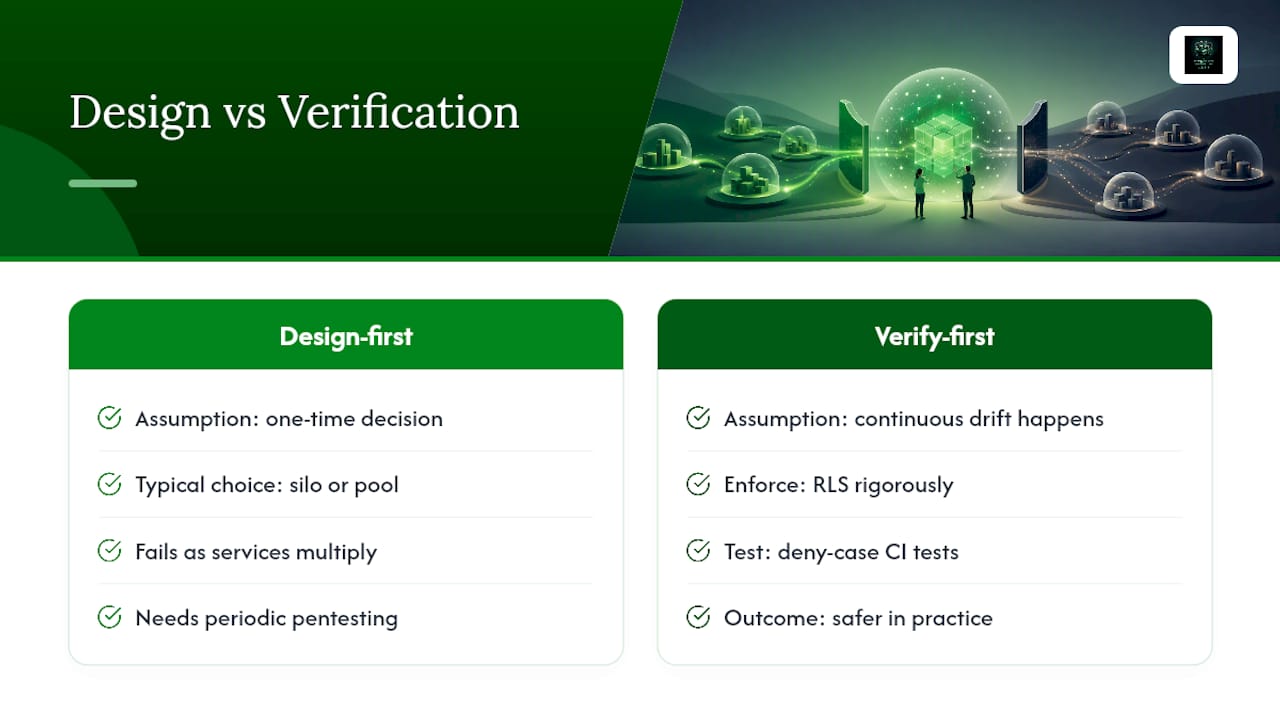
The conventional advice, "pick silo or pool and move on," undersells how much ongoing verification matters more than the initial choice. A pooled architecture with rigorous RLS enforcement and deny-case CI tests can be more secure in practice than a siloed one lacking recent penetration testing. Isolation model is a starting condition, not a guarantee.
If you take one thing from this guide, prioritize the deny-case test over the architecture diagram. A test that proves tenant B cannot read tenant A's data will catch the regression that your design review never anticipated. Standards like NIST SC-39 and frameworks like OWASP's cheat sheet give you the vocabulary, but the test suite is what actually keeps you honest six months after launch, when nobody remembers the original design intent.
— vCISO
Ready to Verify Your Own Tenant Isolation Controls?
Reading a checklist and knowing your platform actually meets it are two different things, and that gap is exactly where CisoSafe works. CisoSafe combines hands-on vCISO advisory (security assessments, risk roadmaps, policy development) with a SaaS platform that automates penetration testing and compliance reporting across more than 50 frameworks, so regulated teams get audit-ready evidence without staffing a full-time security department.
Building every control in this guide in-house, from PDP rollout to recurring cross-tenant pen tests, takes months a small security team often doesn't have. Engaging CisoSafe makes sense the moment you need independent verification for an auditor, a client, or your own leadership, rather than another internal design review. If your platform serves law firms, energy operators, or other regulated clients, a focused tenant-isolation review is the fastest way to find out where your current architecture actually stands. Visit CisoSafe to schedule an assessment and get a prioritized remediation roadmap built around your specific tenant model.
Sources
- Multi Tenant Security - OWASP Cheat Sheet Series
- AWS prescriptive guidance - Multi-tenant SaaS authorization and API access control
- NIST SP 800-53 - SC-39 process isolation
- Cloud.gov customer separation documentation
- Multi-tenancy security patterns