

The single most effective way to reduce oil gas third-party vendor security risk is to centralize vendor risk governance under one accountable owner, replace annual questionnaires with continuous telemetry, and write technical guardrails directly into vendor contracts. Everything else, tiering, monitoring dashboards, incident playbooks, supports that one structural shift.
Start this week with three moves:
- Build a single vendor inventory across IT and OT, including subcontractors with remote access.
- Tier vendors by operational consequence, not contract size, and flag anyone touching SCADA, DCS, or field devices as critical.
- Add an emergency incident-notification clause (24 to 72 hours) to every critical-tier contract before renewal.
Gartner reports that 40% of compliance leaders say between 11% and 40% of their vendors qualify as high-risk. That concentration is exactly why governance needs one owner, not five departments guessing independently. API's NIST profile for oil and gas third-party collaboration gives you the reference architecture to build on.
Key Takeaways
Reducing oil gas third-party vendor security risk depends on centralizing governance, replacing annual reviews with continuous telemetry, and enforcing technical guardrails directly in vendor contracts.
| Point | Details |
|---|---|
| Centralize governance | Assign one vendor-risk council with named owners across procurement, technical, risk, and legal roles. |
| Tier by consequence | Rank vendors by operational access and system criticality, not contract value. |
| Contract for control | Require SBOM delivery, audit rights, and fixed incident-notification windows before signature. |
| Monitor continuously | Replace annual questionnaires with real-time telemetry on credentials, vulnerabilities, and exposed services. |
| Use CisoSafe for execution | CisoSafe's vCISO advisory and SaaS platform automate vendor intake, monitoring, and reporting for regulated energy operators. |
Table of Contents
- What Does Oil Gas Third-Party Vendor Security Actually Require?
- How Do You Manage a Vendor Through Its Entire Lifecycle?
- Which Controls Matter Most for Vendors With OT Access?
- What Contract Language Should Procurement Require?
- Who Should Own Vendor Risk Decisions?
- How CisoSafe Supports This Program in Practice
- Where the Conventional Playbook Falls Short
- Get a Vendor Risk Program Built for Oil and Gas Operations
- Sources
What Does Oil Gas Third-Party Vendor Security Actually Require?
Vendor security compliance in oil and gas is not a procurement checklist you run once a year. It is an operational discipline that treats every contractor, integrator, and software vendor as a potential entry point into control systems that run wells, pipelines, and processing units. The industry term for this discipline is third-party risk management (TPRM), and it looks fundamentally different here than in retail or finance because a compromised vendor can shut down physical operations, not just leak data.
A sector-aligned TPRM framework needs five pillars working together, not five separate initiatives.
- Criticality mapping. Rank every vendor by what they can touch, not what they get paid. A drilling automation contractor with SCADA access outranks a marketing agency with an NDA, regardless of invoice size.
- Secure-by-contract onboarding. Security requirements get written into the contract before signature, not bolted on afterward as a favor.
- Technical guardrails and architecture. Segmentation, brokered access, and least-privilege controls that assume the vendor's own environment will eventually be breached.
- Continuous monitoring. Real-time telemetry on exposed services, credential leaks, and vulnerability signals instead of a point-in-time questionnaire.
- Joint resilience planning. Incident response exercises run with your critical suppliers, not just internally.
SLB's framework for managing energy's cyber supply chain risk backs this structure directly, recommending operational-consequence scoring, mandatory contract controls, SBOM visibility, and continuous telemetry over static assessments. Pair that with CISA's energy sector guidance, which pushes continuous assessment and C2M2 mappings for critical infrastructure operators, and you have a defensible framework regulators and auditors both recognize.
Pro Tip: Map your vendor tiers against the systems they touch, not the departments they work with. A field-service contractor who logs into a single HMI terminal is a different risk category than one with domain admin credentials across your historian.
Cybersecurity in the energy sector increasingly hinges on this convergence question: your IT team secures email and ERP, but your OT environment runs turbines and compressor stations, and vendors routinely cross that boundary without either team fully tracking it; understanding commercial camera cybersecurity basics for businesses can offer insights into securing physical and IoT devices connected to OT networks.
How Do You Manage a Vendor Through Its Entire Lifecycle?
Third-party vendor assessments fail most often because they happen once, at onboarding, and never again. IBM's TPRM lifecycle model identifies, assesses, mitigates, monitors, and offboards, and each stage needs its own concrete checklist.
Identify and tier:
- Pull vendor data from procurement systems, IT asset inventories, and OT network scans, then normalize it into one register with a named business owner per vendor.
- Score risk by access level and operational consequence, not spend, and map nth-party dependencies. A subcontractor your Tier 1 integrator hires can carry the same OT access without ever appearing in your contract.
Contract before go-live:
- Require a software bill of materials (SBOM) for any software touching your network.
- Grant audit rights and require cooperation with forensic investigations.
- Set patch SLAs tied to severity, not vendor convenience.
- Define exactly how access gets revoked, and test that mechanism before signature.
Onboard with technical controls: network segmentation, just-in-time access instead of standing credentials, full session logging, defined maintenance windows, and signed update verification so a compromised vendor update channel can't push malicious code straight into your environment.
Monitor continuously: watch for exposed services, leaked credentials tied to vendor domains, vulnerability telemetry, and SBOM-driven dependency alerts, with defined thresholds that trigger automatic escalation rather than waiting for the next quarterly review.
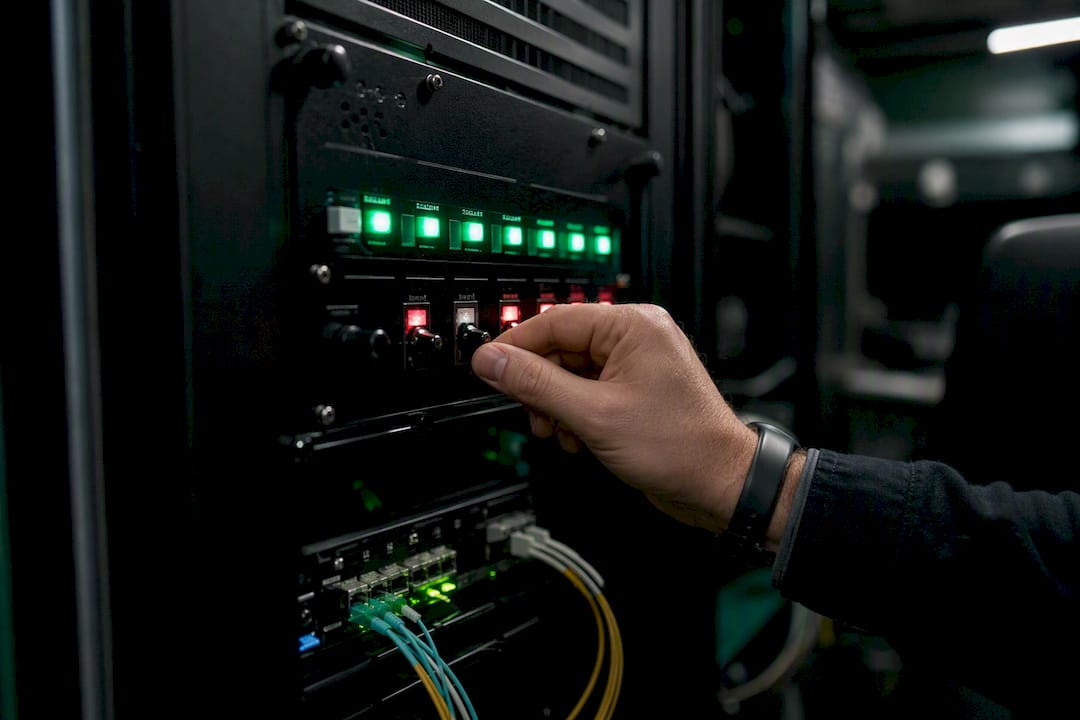
Offboard completely: revoke all access, confirm certificate and key rotation, and retain audit artifacts for the compliance window your framework requires.
Which Controls Matter Most for Vendors With OT Access?
A vendor who only touches your invoicing system and one who can log into a remote terminal unit carry entirely different consequence profiles. IT security assumes you can patch fast and reboot; OT environments often can't tolerate either, which means the controls for OT-facing vendors need to be stricter and more explicit in the contract, not looser because "it's just a maintenance vendor."
Guardrails that belong in every OT vendor agreement:
- Segmented, brokered access with no direct routes from vendor networks into control system zones.
- Unidirectional gateways for one-way data flows where the vendor only needs to pull telemetry, not push commands.
- Just-in-time sessions with time-boxed credentials and full session recording.
- Signed, verified updates with a tested rollback plan before any patch touches a live system.
- Pre-staged "kill switch" procedures, revoking accounts, rotating keys, and blocking update channels, tested before you need them.
Red flags include vendors requesting persistent VPN access "for convenience," resistance to session logging, or update mechanisms that bypass your change management process entirely. Any of those should trigger a mitigation plan before renewal, not after an incident.
Pro Tip: Run at least one tabletop exercise a year that specifically scripts a vendor-originated OT incident, credential theft at an integrator, a malicious firmware update, and time how long it takes your team to execute the kill switch procedure end to end.
Preventing oil gas breaches that originate through OT-connected vendors depends less on detection tools and more on whether your access architecture makes lateral movement structurally difficult in the first place.
What Contract Language Should Procurement Require?
Oil gas contractor security starts at the negotiating table, and the clauses you skip now become the gaps an attacker finds later. FDIC's third-party risk guidance, while written for banks, lays out risk categories (reputational, transactional, compliance) that translate directly to energy operators and support the same audit-rights and reporting requirements.
Non-negotiable clauses for any critical-tier vendor:
- Incident notification within a fixed window (24 to 72 hours from discovery).
- Audit rights and mandatory cooperation with forensic investigations.
- Indemnity provisions and termination for cause tied to security failures.
- Documented access revocation mechanics, not a vague promise to "remove access promptly."
Technical annex requirements should specify SBOM delivery on every release, patch timelines scaled to severity, MFA and just-in-time access for any remote connection, full session logging, and encryption standards for data in transit and at rest.
| Requirement Category | What to Specify |
|---|---|
| Incident response | Notification window, forensic cooperation, named point of contact |
| Access controls | MFA, just-in-time sessions, logging retention period |
| Patch management | Severity-based SLA, signed update verification |
| Assessment cadence | Frequency of independent audits, evidence format required |
| Exception handling | Documented risk acceptance with a hard expiry date |
Set MTTA and MTTR targets for vendor-originated issues in the SLA itself, and require proof of independent audits or attestations on a fixed cadence, not "upon request."
Who Should Own Vendor Risk Decisions?
Managing vendor risks fails when four departments each own a slice and nobody owns the outcome. A vendor-risk council fixes that: a procurement owner who controls contract terms, a technical owner (usually from IT or OT security) who validates architecture, a risk owner who tracks the register and tiering, and legal counsel who signs off on liability language.
That council needs explicit decision rights, not just meeting attendance.
- Go/no-go authority for onboarding any critical-tier vendor.
- Exception approval, with every exception logged and given an expiration date.
- Authority to suspend vendor access immediately on a credible threat signal.
- A fixed renewal and review cadence, tied to tier, not a blanket annual cycle.
Feed vendor risk signals into executive reporting on a regular cycle so budget decisions reflect actual exposure, not the loudest department's request. That connection between technical telemetry and boardroom visibility is often the missing link in cybersecurity governance for energy operators.
How CisoSafe Supports This Program in Practice
Running this program manually across dozens of vendors, tiers, and contracts stretches most internal teams thin. CISOSafe pairs vCISO advisory for governance design with a SaaS platform that automates vendor intake, continuous telemetry, and compliance reporting for regulated energy operators.
- Faster vendor risk visibility through automated intake instead of manual spreadsheet tracking.
- Prebuilt OT control templates and incident playbooks mapped to NIST and API profiles.
- Continuous monitoring and SBOM tracking that replaces annual questionnaires with ongoing signal.
- Advisory support for building the vendor-risk council and decision rights structure covered above.
That combination fits teams who need governance and automation together rather than piecing both together internally, which is a common gap explored in energy company third-party risk guidance.
Where the Conventional Playbook Falls Short
Most vendor security advice in oil and gas still treats third-party risk as a procurement problem: send a questionnaire, collect a signature, file it away until renewal. That approach made sense when vendors mostly touched back-office systems. It doesn't hold up once you account for how many contractors now have some form of remote access into control systems, historian databases, or field devices.
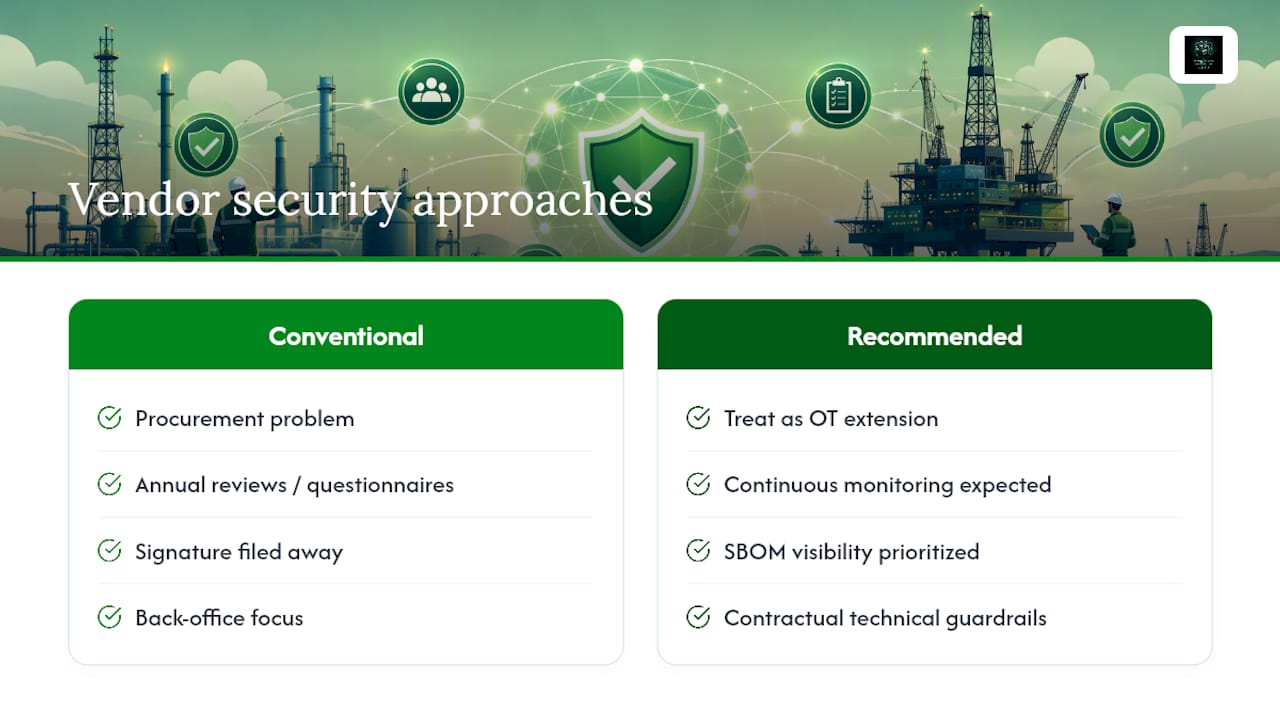
The gap isn't awareness, most security managers know continuous monitoring beats annual reviews. The gap is treating vendors as an IT compliance exercise instead of an extension of the OT environment itself. A vendor with SCADA access should be governed with the same rigor as an internal engineer with the same access, not with a lighter-touch process because they're technically outside the organization.
What the research actually supports is uncomfortable for teams that like static checklists: SBOM visibility and contractual technical guardrails matter more than the volume of questions on an assessment form. If you can only fix one thing this year, fix your contract templates for critical-tier vendors. Everything else, tooling, monitoring, tabletop exercises, works better once the contract actually requires it.
— vCISO
Get a Vendor Risk Program Built for Oil and Gas Operations
If the checklist above feels like a lot to build and maintain internally, that's because it is, most operators don't have a dedicated third-party risk team, let alone one fluent in both OT architecture and compliance frameworks. CISOSafe was built for exactly this gap: a Houston-based vCISO firm combined with a SaaS platform, so you get governance expertise and automated telemetry in one engagement instead of assembling both from scratch.
CISOSafe's vCISO advisory helps you stand up the vendor-risk council, write the contract annexes, and map your program to frameworks like SOC 2, CMMC, and API's NIST profile, while the SaaS portal automates vendor intake, continuous monitoring, and reporting so your team isn't chasing spreadsheets every quarter. If you're responsible for oilfield vendor security and need this operational rather than theoretical, start a vendor risk assessment with CISOSafe and see where your current program has gaps.
Sources
- A framework for managing energy’s cyber supply chain risk | SLB
- Energy sector | CISA
- Gartner: Third-Party Risk Management (TPRM) guidance