

PCI DSS compliance is defined as the mandatory set of security controls that any organization processing credit card payments must implement to protect cardholder data. For energy retail operations, this obligation carries extra weight. Your payment systems sit alongside operational technology that connects directly to grid infrastructure, meaning a breach can threaten far more than a customer's card number. Energy retail IT systems expose operational technology to cyber risk, making PCI DSS compliance a grid security issue, not just a payment security issue. Violations carry fines from $5,000 to $100,000 per incident, and that range does not include the reputational damage that follows a breach.
What are the core PCI DSS 4.0 requirements for energy retail payment systems?
PCI DSS 4.0 is the current version of the Payment Card Industry Data Security Standard, published by the PCI Security Standards Council and enforceable across all card-processing environments. For energy retail operations, the 4.0 update introduced several controls that go beyond what earlier versions required.
The most operationally significant changes include:
- Multi-factor authentication (MFA): MFA must cover all access to the Cardholder Data Environment (CDE), not just administrator accounts. Every technician, vendor, or remote user touching payment systems needs MFA.
- Script inventory and approval: Every script running on a payment web page must be inventoried, reviewed, and formally approved. This targets the growing threat of web skimming attacks on fuel payment portals.
- Quarterly ASV scans: External vulnerability scans must be conducted every quarter by an Approved Scanning Vendor (ASV). Annual penetration testing and ongoing network segmentation validation after major changes are also required.
- Customized implementation options: PCI DSS 4.0 allows organizations to substitute a defined control with a custom approach, provided they document the equivalent security outcome. This matters for energy retailers with legacy point-of-sale (POS) systems that cannot always meet prescriptive technical requirements.
- Risk analysis documentation: Each control that relies on a frequency-based activity, such as log reviews or vulnerability scans, now requires a documented risk analysis explaining why that frequency is appropriate.
Pro Tip: Map every CDE access point before you begin your MFA rollout. Energy retail environments often have undocumented vendor remote access sessions that surface only during a gap assessment, and those gaps are exactly what auditors look for first.
How can energy retail operations integrate PCI DSS with existing cybersecurity frameworks?
Integrating PCI DSS with NIST CSF 2.0 reduces overhead by letting existing security controls satisfy compliance requirements simultaneously. For energy retailers already operating under NERC CIP or other operational technology frameworks, this integration is not optional. It is the only practical path to compliance without doubling your security budget.
Here is how to structure that integration:
-
Map PCI DSS requirements to NIST CSF 2.0 Protect functions. The NIST CSF Protect category covers access control, data security, and protective technology. Most PCI DSS 4.0 network security requirements align directly with these functions. Documenting that mapping eliminates redundant controls and gives auditors a clear evidence trail.
-
Build a centralized control library. Instead of managing PCI DSS, NERC CIP, and state energy regulations as separate programs, create one control library where each control maps to multiple frameworks. This approach reduces the total number of controls you need to manage and makes cross-framework audits faster.
-
Deploy centralized monitoring across all store locations. Multi-location energy retailers face a specific challenge: each site generates its own security events, but reviewing them manually is not feasible. Centralized security information and event management (SIEM) platforms aggregate logs from every location and trigger automated alerts when anomalies appear.
-
Establish continuous risk management cycles. PCI DSS 4.0 expects ongoing risk analysis, not annual snapshots. Aligning this with NIST CSF's continuous improvement function means your risk posture updates in real time as your environment changes.
The practical benefit of this approach is scale. An energy retailer operating 50 convenience store locations cannot afford a separate compliance program at each site. A unified framework integration lets your security team manage compliance centrally while maintaining site-level visibility.
What are the practical steps to implement PCI DSS compliance in energy retail stores?
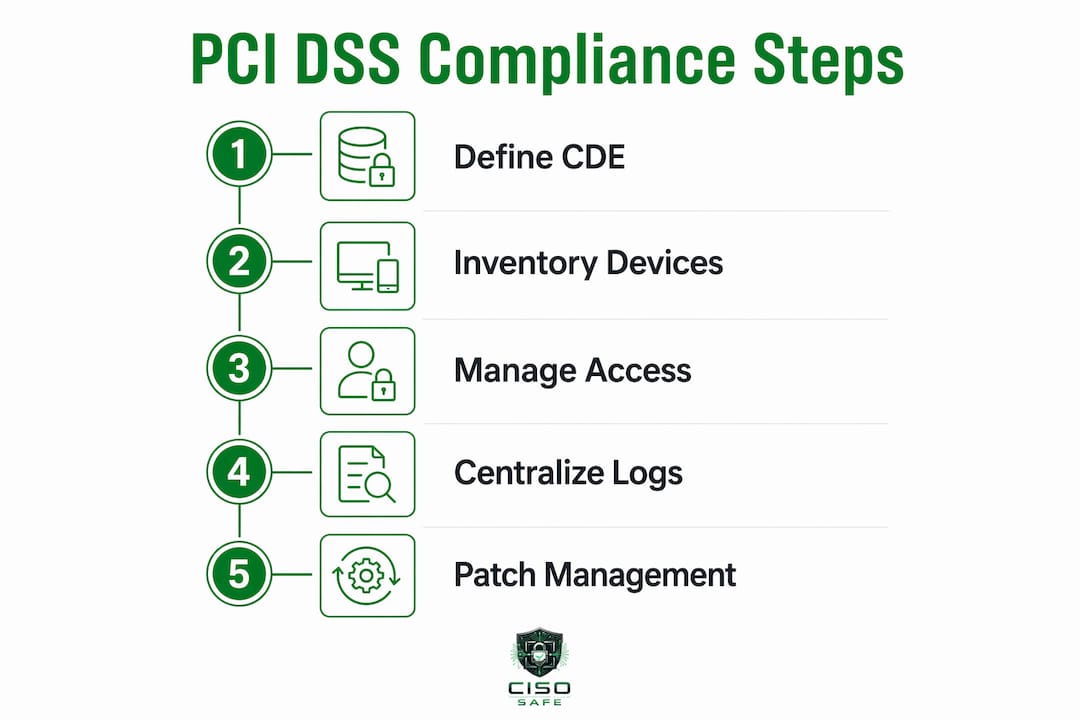
Execution is where most energy retailers stall. The requirements are clear on paper, but translating them into daily operations across multiple sites requires a structured process.
Step 1: Define your cardholder data environment
Scope definition is the single most important step in any PCI DSS program. Your CDE includes every system that stores, processes, or transmits cardholder data, plus every system connected to it. In energy retail, this typically covers POS terminals, fuel dispensers with card readers, back-office servers, and any network segment that touches those systems. Narrow scope aggressively. Every system you include adds audit burden.
Step 2: Inventory all devices and payment page scripts
Create a complete inventory of every device in your CDE, including serial numbers, locations, and responsible owners. For web-based payment portals, document every script running on those pages. Script management is now a formal PCI DSS 4.0 requirement, and missing a single third-party script is a common audit finding.

Step 3: Manage vendor and third-party access
Energy retailers rely heavily on third-party vendors for POS maintenance, fuel management systems, and network support. Each vendor with CDE access is a compliance risk. Require every vendor to provide their own PCI DSS compliance documentation, and enforce time-limited, monitored access sessions. Never allow persistent remote access credentials.
Step 4: Centralize logs and automate reviews
Manual log review across multiple retail sites is insufficient for maintaining audit integrity. Centralize all logs into a SIEM platform and configure automated alerting for critical events. Verify that system clocks across all sites are synchronized using Network Time Protocol (NTP). Time discrepancies in logs are a frequent audit failure point.
Step 5: Manage patches and document exceptions
| Activity | Frequency | Documentation Required |
|---|---|---|
| Critical patch deployment | Within 30 days of release | Change ticket with risk notes |
| Non-critical patch deployment | Within 90 days of release | Change ticket |
| POS exception tracking | Per device, per location | Formal risk sign-off |
| ASV vulnerability scan | Quarterly | Scan report with remediation |
| Penetration testing | Annually | Full test report |
| Network segmentation validation | After major changes | Segmentation test results |
POS systems in energy retail are frequently missed in patch cycles. When a patch cannot be applied, document the exception formally with a risk acceptance sign-off from a named executive. Undocumented exceptions are automatic audit failures.
Pro Tip: Run a gap assessment against PCI DSS before you begin remediation. It tells you exactly where your highest-risk gaps are so you spend budget on what matters most, not on controls you already have.
What are common pitfalls in PCI DSS compliance for energy retail?
Energy retail environments have specific failure patterns that generic retail compliance guides do not address. Knowing them in advance saves significant remediation cost.
-
Surveillance cameras capturing card data. Physical security cameras that capture PIN entry or card data violate PCI DSS Requirement 9.4. This is one of the most common compliance failures in fuel retail environments, where cameras are positioned to monitor both the forecourt and the payment terminal simultaneously. Audit every camera angle before your assessment.
-
Undocumented POS patch exceptions. Older POS systems at fuel stations often cannot accept current patches without a full hardware replacement. The compliance failure is not the unpatched system. The failure is the missing exception documentation with a formal risk sign-off per location.
-
Manual log reviews at scale. A retailer with 20 or more locations cannot rely on staff to manually review security logs at each site. Automated platforms with centralized aggregation are the only practical solution.
-
Seasonal operation gaps. Energy retailers with seasonal locations, such as marina fuel docks or ski resort convenience stores, often let network segmentation lapse during off-season closures. PCI DSS requires segmentation validation after major network changes, and reopening a seasonal site qualifies as one.
-
Incomplete MFA coverage. MFA gaps are the most common finding in PCI DSS 4.0 audits. Vendors, contractors, and remote monitoring systems all need MFA for CDE access, not just internal staff.
"The most expensive compliance failures are the ones that were known risks but never documented. A written risk acceptance is not an admission of weakness. It is evidence of a mature security program."
Key takeaways
Achieving PCI DSS compliance in energy retail operations requires scoped CDE definition, continuous monitoring, and integration with broader cybersecurity frameworks to protect both payment data and operational infrastructure.
| Point | Details |
|---|---|
| Scope your CDE first | Define every system touching cardholder data before implementing any control. |
| MFA covers all CDE access | PCI DSS 4.0 requires MFA for every user, not just administrators, accessing the CDE. |
| Integrate with NIST CSF 2.0 | Mapping PCI DSS controls to existing frameworks reduces redundant work and audit burden. |
| Document every exception | Undocumented POS patch exceptions are automatic audit failures in energy retail environments. |
| Automate log management | Centralized SIEM with NTP synchronization is the only scalable solution for multi-location retailers. |
Why energy retail compliance demands a different mindset
I have worked with energy retailers who treated PCI DSS as a checkbox exercise, something to clear once a year before the QSA visit. That approach fails consistently, and it fails expensively. The reason is structural. Energy retail is the only sector where a payment terminal sits on the same network segment as equipment that controls physical fuel delivery. A compromised POS system is not just a financial liability. It is a potential safety incident.
What I have found actually works is treating PCI DSS as a continuous operational discipline rather than an annual audit event. The retailers who maintain clean compliance records are the ones who run quarterly internal reviews, keep their CDE scope documentation current after every network change, and hold vendors accountable for their own compliance posture. They also invest in staff training at the store level, because the technician who installs a new fuel dispenser needs to understand why camera placement matters and why they cannot plug a personal device into the POS network.
The other shift I advocate for is executive ownership. Compliance programs that live only in the IT department stall when they need budget or cross-functional cooperation. When the CFO and COO understand that a PCI DSS violation carries fines up to $100,000 per incident and can trigger card brand termination, the conversation about compliance investment changes immediately. PCI DSS compliance in energy retail operations is a business continuity issue. Frame it that way from the start.
— vCISO
How CisoSafe helps energy retailers achieve PCI DSS compliance
Energy retail operations face a compliance challenge that most generalist cybersecurity firms are not equipped to handle. The intersection of payment security, operational technology, and multi-location management requires specialized expertise.
CisoSafe delivers virtual CISO services built specifically for regulated industries like energy retail. The CisoSafe platform combines hands-on security assessments, PCI DSS gap analysis, policy development, and automated compliance reporting into a single program. Your team gets audit-ready documentation, continuous control monitoring, and direct access to experienced security advisors without the cost of a full-time CISO. If your energy retail operation needs a clear path to PCI DSS 4.0 compliance, CisoSafe provides the structure, tools, and expertise to get there.
FAQ
What is PCI DSS 4.0 and does it apply to energy retailers?
PCI DSS 4.0 is the current version of the Payment Card Industry Data Security Standard and applies to every organization that processes, stores, or transmits credit card data. Energy retailers operating fuel stations or convenience stores with card payment terminals are fully subject to its requirements.
How often do energy retailers need vulnerability scans and penetration tests?
PCI DSS 4.0 requires quarterly external vulnerability scans by an Approved Scanning Vendor and annual penetration testing. Network segmentation must also be validated after any major infrastructure change.
What fines apply for PCI DSS non-compliance?
Fines for PCI DSS violations or breaches range from $5,000 to $100,000 per incident. Card brands can also suspend a retailer's ability to process card payments, which is a direct operational threat for fuel retailers.
Can energy retailers use existing security frameworks to meet PCI DSS requirements?
Yes. Integrating PCI DSS with NIST CSF 2.0 allows energy retailers to map existing controls to compliance requirements, reducing redundant work and lowering the total cost of compliance.
What is the biggest compliance risk specific to fuel retail environments?
Surveillance camera placement is one of the most commonly overlooked risks. Cameras positioned to capture PIN entry or card data violate PCI DSS Requirement 9.4 and are a frequent cause of compliance failure during physical security audits.