

Qualifying for cyber insurance now comes down to five controls: enforced multi-factor authentication (MFA), endpoint detection and response (EDR) or managed detection and response (MDR), immutable or offline backups with tested restores, a dated and exercised incident response plan, and email security controls like DMARC. Underwriters verify these with screenshots, logs, and scan results, not checkbox answers, and applications typically take 60 to 90 days to prepare. Start gathering proof now, before you fill out a single form.
TL;DR:
- Most cyber insurance applications for 2026 require verified enforcement of MFA on all critical access points, including legacy authentication paths.
- Underwriters now cross-check responses with external scans, making honest documentation of controls like backups, patch management, and IR testing essential.
- Builders of proof packets should include screenshots, reports, and logs for MFA policies, EDR coverage, backup tests, and vendor attestations to ensure swift approval.
- Achieving insurance readiness typically takes 60 to 90 days, with the highest priority on MFA, backup immutability, and enterprise patching early in the process.
- Engaging a vCISO or using automated assessment tools significantly accelerates remediation, proof collection, and increases the likelihood of policy approval.
Table of Contents
- What Are the Core Cyber Insurance Requirements for 2026?
- Why Do Cyber Insurance Applications Get Denied?
- What Documents Do Cyber Insurers Actually Accept as Proof?
- How Long Does It Take to Become Insurance-Ready?
- How Do Industry and Contract Rules Affect Coverage Limits?
- How a vCISO Engagement Closes the Gap Before You Apply
- A vCISO's Take on Getting Insurance-Ready
- Get Insurance-Ready Without Hiring a Full-Time CISO
- Sources
- FAQ
What Are the Core Cyber Insurance Requirements for 2026?
Carriers no longer take your word for it. By 2026, most questionnaires function as security audits, and underwriters cross-check answers against external attack-surface scans before issuing a quote, according to InsurableIT's breakdown of the 12 controls carriers ask about. Here's what "passing" actually looks like for each control.
- MFA everywhere, not just email. Insurers want MFA enforced (not merely enabled) on email, VPN and remote access, and every admin and backup console. A tenant with MFA "on" but an unblocked legacy authentication path still fails, since that path lets attackers bypass it entirely.
- EDR or MDR on every endpoint and server. Traditional antivirus doesn't satisfy this control. Underwriters expect active detection and response coverage across all endpoints, with a report showing device counts and last-seen telemetry.
- Backups that survive a ransomware event. Immutable or offline backups following the 3-2-1 pattern, with documented restore tests and a stated recovery time objective (RTO), are close to mandatory according to Cyvatar's 2026 controls checklist.
- A dated, exercised incident response (IR) plan. Named roles, a tabletop exercise within the last 12 months, and documented remediation notes from that exercise.
- Email security stack. DMARC, SPF, and DKIM configured correctly, plus Safe Links and Safe Attachments, and anti-impersonation protection for executives.
- Patch and vulnerability management. A stated cadence for critical, high, and medium CVEs, not an ad hoc "we get to it eventually" answer.
- Privileged access management (PAM). Separate admin accounts from daily-use accounts, with just-in-time or time-boxed elevated access.
- Logging and monitoring. A defined retention window and a named person or team who reviews alerts.
- Security awareness training. Annual training plus phishing simulations, with completion records by employee.
- Vendor risk management. SOC 2 reports or equivalent from critical vendors, and a documented offboarding process for departing vendors.
Pro Tip: If your organization runs on Microsoft 365, check Conditional Access, Defender, and Purview settings before buying new tools. A large share of these controls can be satisfied through configuration alone, according to InsurableIT's analysis of M365 environments.
Why Do Cyber Insurance Applications Get Denied?
Insurers treat your application as a legal representation, similar to a warranty. Misstate a control and you risk more than a declined claim. In at least one documented case, an insurer sought to void coverage entirely over application misstatements after a breach exposed the gap between what was claimed and what was actually running.
Carriers verify answers through external attack-surface scans, follow-up questions, and direct evidence requests. The most common failure points show up in the same places every time:
- MFA "enabled" on paper but not enforced across every remote access point.
- Backups technically offline but reachable from the same credentials an attacker already compromised.
- End-of-life or unpatched systems still running in production.
- No documented IR test in the past year, or an IR plan that exists but has never been rehearsed.
If a control is partial, say so. A remediation timeline reads as honest diligence. An overstatement discovered after a claim reads as fraud, and that's the difference between a paid claim and a rescinded policy.
What Documents Do Cyber Insurers Actually Accept as Proof?
Underwriters increasingly favor evidence over assertions, and providing it upfront speeds approval while reducing denial risk at claim time, according to Cyvatar. Build a proof packet before you touch the application form.
- Conditional Access policy screenshots showing MFA enforcement rules, not just a policy name.
- EDR/MDR coverage report listing total endpoints, protected endpoints, and last-seen timestamps.
- Backup restore logs with dates, showing a successful test restore, not just a backup completion notice.
- The IR plan itself, dated, with named roles and the date of the last tabletop exercise.
- Training completion records by employee name and date, including phishing simulation results.
- Vendor SOC 2 reports or equivalent attestations for your critical third parties.
Attach the summary versions to the application itself. Keep the underlying raw logs and full reports on hand for underwriter inspection or claims review. Name files with a consistent convention like 2026-02-EDR-Coverage-Report.pdf so nothing goes missing when a carrier asks for a specific artifact six months later. A medium-risk SMB with 50 employees can typically satisfy a first-pass underwriting review with these six items alone.
How Long Does It Take to Become Insurance-Ready?
Most SMBs can move from "not ready" to "insurable" in roughly 60 to 90 days if they sequence the work correctly, a timeline that matches MoneyGeek's underwriting research.
- Days 1 to 7: Enforce MFA across every account and confirm your backups are genuinely immutable or offline.
- Days 7 to 30: Deploy EDR or MDR across all endpoints and patch every critical vulnerability.
- Days 30 to 90: Run an IR tabletop exercise, collect your proof packet, and complete the questionnaire.
If budget or staffing is tight, prioritize by risk, not by ease. MFA and backup immutability cost the least and close the biggest gaps first.
Insurers may discount premiums by up to 20 percent for additional controls like advanced threat hunting or phishing simulation programs beyond the baseline, according to MoneyGeek's underwriting data. That discount alone often covers the cost of the added control within a year or two.
How Do Industry and Contract Rules Affect Coverage Limits?
Regulated industries face stricter baselines and higher expected limits. Healthcare organizations bound by HIPAA and retailers handling card data under PCI-DSS both face insurer expectations for tighter access controls and encryption, on top of the standard checklist. Law firms sit in a similar spot: a weak security posture can create malpractice exposure on top of a denied claim, since client-data protection failures increasingly draw regulatory and bar scrutiny.
- Small professional services firms often carry lower base limits than firms holding regulated client or patient data.
- Clients and contractors increasingly write minimum cyber coverage into vendor contracts, pushing limits higher regardless of your own risk appetite.
- Ransomware sub-limits and regulatory defense endorsements are worth adding when your base policy caps ransom payments below your actual exposure.
How a vCISO Engagement Closes the Gap Before You Apply
A structured vCISO engagement typically starts with a gap assessment against the controls carriers ask about, then builds a remediation roadmap ranked by insurance impact and cost. That roadmap feeds directly into the tabletop exercise and evidence package underwriters expect to see.
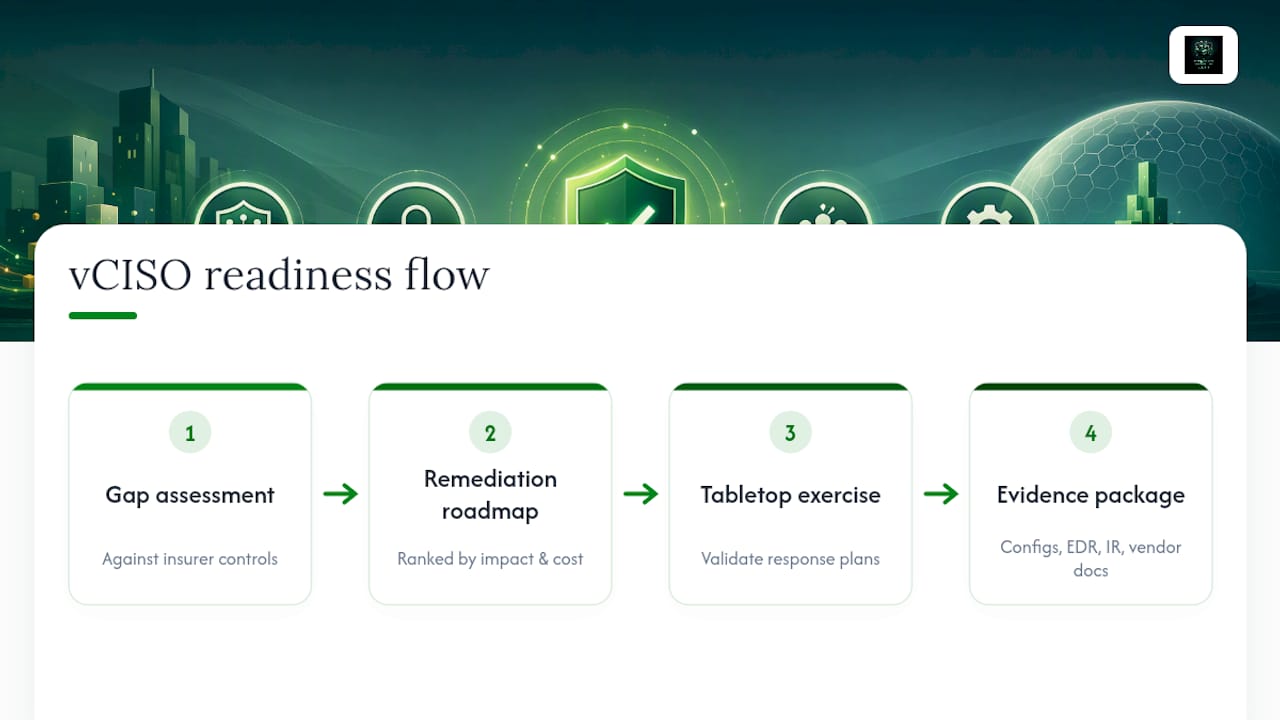
The deliverables that come out of this process, Conditional Access configurations, EDR deployment reports, tested IR plans, and vendor risk documentation, are the same artifacts carriers accept as proof. For regulated organizations juggling compliance frameworks alongside insurance readiness, having one coordinated plan instead of two separate ones saves real time. It also means you're not scrambling to produce evidence the week before a renewal deadline.
A vCISO's Take on Getting Insurance-Ready
Honesty on the application matters more than perfection in your environment. Insurers reward documented progress, not inflated claims. Start today: enforce MFA everywhere, confirm your backups actually restore, and schedule your IR tabletop this quarter.
— vCISO
Get Insurance-Ready Without Hiring a Full-Time CISO
Some providers give regulated SMBs a faster, lower-cost path to insurance readiness than building an internal security team or hiring a full-time CISO. Instead of piecing together audits, policy documents, and tabletop exercises on your own, some firms combine vCISO engagements with AI-powered SaaS platforms that automate penetration testing, compliance intake, and evidence reporting across multiple frameworks.
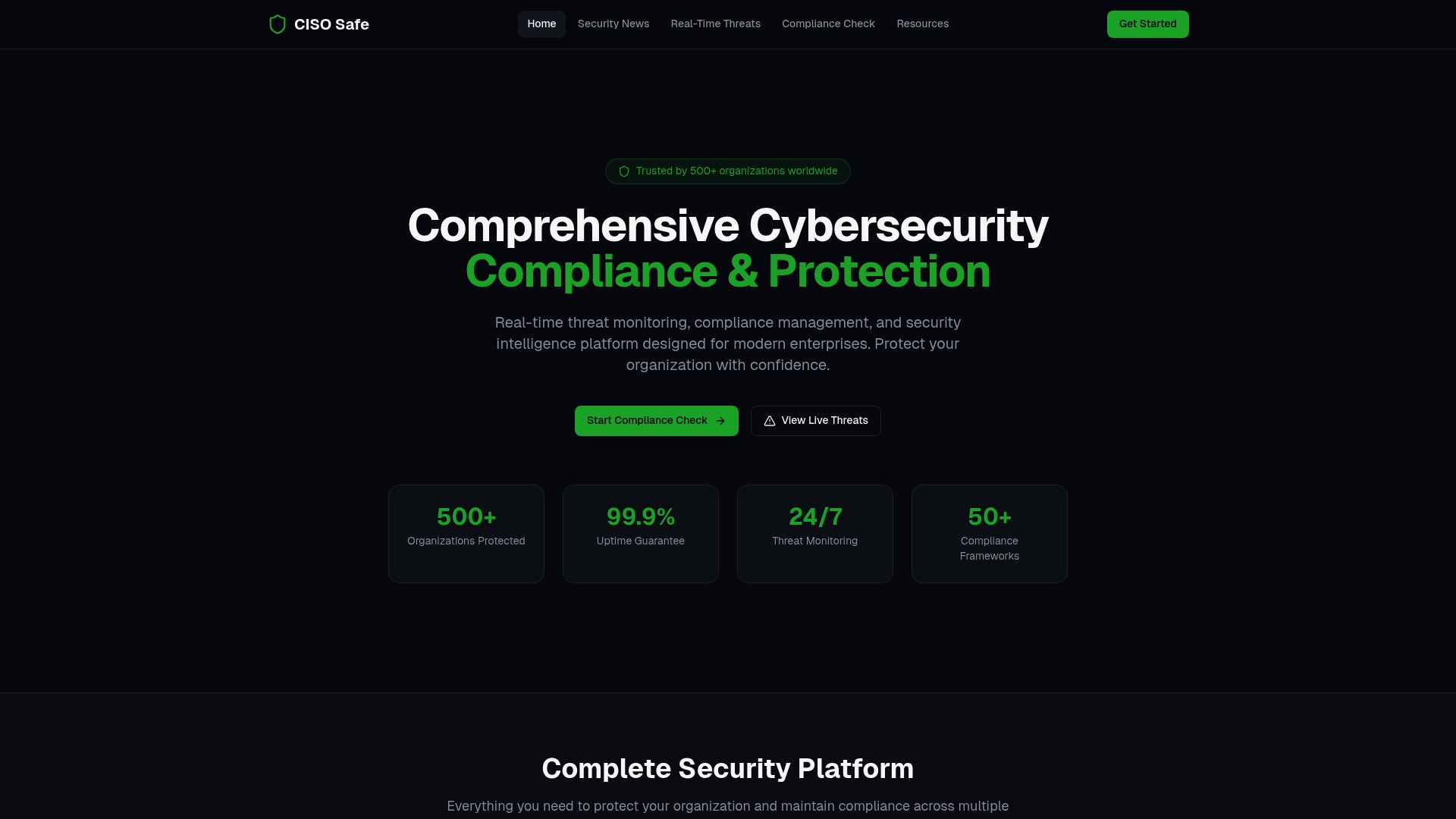
That combination maps directly to what insurers ask for. Such assessments typically identify control gaps against insurer checklists, and the resulting documentation, policies, remediation roadmaps, and tabletop exercise records become the proof packet underwriters review. For firms juggling vendor risk obligations alongside insurance applications, having one team handle both cuts weeks off the process. If your organization also handles AI-driven workflows, a readiness assessment from a partner like Sonance AI can help identify related exposure before it becomes an underwriting surprise.
Visit CisoSafe's website to schedule a readiness assessment and see where your organization stands against current insurer requirements.
Sources
For further reading: the FTC's cyber insurance guide, MoneyGeek's requirements breakdown, and a sample Beazley application form showing real underwriter questions.
- Cyber insurance requirements (MoneyGeek)
- Cyber Insurance Requirements 2026: The 12 Controls Every Carrier Asks About | InsurableIT
- Cyber Insurance Security Requirements: The 2026 Controls Checklist | Cyvatar
FAQ
How Much Does Cyber Insurance Cost?
Cost varies by industry, revenue, and control maturity, but organizations that document additional controls like phishing simulations can see premium discounts of up to 20 percent, according to MoneyGeek.
What Does Cyber Insurance Not Cover?
Policies typically exclude prior known incidents, acts of war, and losses tied to unpatched systems or misrepresented controls; the FTC recommends reading exclusions carefully before buying.
What Does Cyber Insurance Actually Cover?
Most policies combine first-party coverage (your own breach costs, like forensics and notification) with third-party coverage (claims from affected clients or partners), per FTC guidance.
Is Cyber Insurance a Requirement?
Cyber insurance isn't legally mandated for most businesses, but many contracts, especially with larger clients or in regulated industries, now require proof of coverage as a condition of doing business.
How Can a vCISO Help With Cyber Insurance Applications?
A vCISO engagement builds the evidence package, from Conditional Access screenshots to tested incident response plans, that underwriters expect, which is the fastest route to a clean application for most SMBs.