

A tabletop exercise is a facilitated, discussion-based simulation that tests people, process, and communication. One properly run session of sufficient length should surface decision-making gaps and produce a prioritized after-action report with named owners. It is not a technical test. No one touches a keyboard, no controls get scanned, and no systems go offline.
The session works when it ends with three things: gaps you didn't know you had, an assigned owner for each one, and a completed after-action report (AAR) delivered within 48 hours. Both the CISA Tabletop Exercise Packages and NIST SP 800-61 provide ready-to-use structures for exactly this.
- Format: Discussion-based, not hands-on technical testing.
- Output: Documented gaps plus assigned owners and deadlines.
- Speed: AAR delivered within 48 hours to keep momentum.
- Templates: CISA and NIST reference materials, plus CisoSafe's NIST-aligned incident response plan template, remove the blank-page problem.
Key Takeaways
A useful incident response tabletop combines one measurable objective, a cross-functional seat list, a communication inject, and an after-action report with owners and deadlines delivered within 48 hours.
| Point | Details |
|---|---|
| Define one objective | Write a single measurable goal before planning any scenario details. |
| Test people, not tools | Tabletops validate decisions and communication, not technical controls. |
| Prioritize comms injects | Removing email or chat forces teams to prove out-of-band escalation works. |
| Close the loop fast | Deliver the AAR within 48 hours and assign a named owner to every finding. |
| Consider vCISO facilitation | CisoSafe runs initial exercises using NIST-aligned templates and hands off a sustainable program. |
Table of Contents
- What an Incident Response Tabletop Tests (and What It Doesn't)
- How Do You Set Objectives and Scope Before Planning?
- Who Should Be in the Room, and What Role Do They Play?
- How Do You Design Scenarios and Injects That Actually Work?
- Running the Session: Agenda, Ground Rules, and Timing
- Turning the Session Into an After-Action Report
- Copy-Ready Scenarios for Your Next Tabletop
- How Often Should You Run Tabletop Exercises?
- How CisoSafe Supports Tabletop Readiness
- Getting the Environment and Participants Ready Before Session Day
- Building Realistic Threats Into Your Scenarios
- Turning Findings Into Measurable Improvements
- Matching the Exercise to Your Organization's Maturity and Industry
- Weaving Legal and Regulatory Requirements Into the Scenario
- Author Perspective: What Actually Changes Readiness
- Run Your Next Tabletop With a Team That Facilitates for a Living
- Authoritative Downloads and Templates Worth Bookmarking
- Sources
What an Incident Response Tabletop Tests (and What It Doesn't)
A tabletop tests decision authority, escalation timing, and communication under pressure. It doesn't test firewall rules, patch levels, or whether your EDR agent actually catches the malware. Confusing the two wastes a room full of senior people's time.
Run a tabletop when you need to know whether your legal, IT, communications, and executive teams agree on who calls the ransom decision or who tells customers about a breach. This is discussion-based practice, not technical validation, a distinction worth repeating because it's the most common source of misplaced expectations.
- Use a tabletop to test decision rights, not detection rules.
- Use a penetration test or red team exercise to validate technical controls.
- Common mismatch: leadership expects "proof the network is secure" from a session that was only ever designed to test the incident response plan and the org chart behind it.
- Another mismatch: running a tabletop with no incident response plan to reference, which turns the session into a brainstorm instead of a test.
How Do You Set Objectives and Scope Before Planning?
Every tabletop needs exactly one measurable objective, written down before you send a single invite. Vague goals like "improve our security posture" produce vague findings nobody can act on.
Two usable templates: "Determine whether the incident commander and legal counsel can agree on a ransom payment decision within 30 minutes of the injection." Or: "Verify that the communications team can draft and approve a customer notification within two hours of confirmed data exposure."
- Define the one objective in a single sentence with a measurable action and a time bound.
- Set scope: which systems, business units, and third parties are in play, and which are explicitly out of scope.
- Decide whether internal-only communications, external customer notification, or both are being tested.
- Choose two to three metrics before the session, not after.
Pro Tip: Write the objective on the whiteboard or the first slide and read it aloud before the scenario starts. It keeps the room from drifting into a general security discussion.
Useful metrics include time-to-decision on key inject points, percentage of designated responders who acknowledge a simulated alert within a target window, and the closure rate of corrective actions from the prior exercise. According to NetWitness's practitioner reporting, the real payoff of a tabletop comes from turning findings into owned, tracked fixes rather than hypothetical improvements.
Who Should Be in the Room, and What Role Do They Play?
The seat list matters more than the scenario. A tabletop with only IT staff in the room tests nothing about legal exposure, customer communication, or executive decision authority, which is where most real incidents actually get stuck.
- Facilitator: Runs the session, injects scenario updates, and never solves problems for the group.
- Scribe: Documents decisions, timestamps, and gaps in real time, separate from the facilitator.
- Decision-makers: Legal, IT/security leadership, communications, HR, and a business unit leader with actual authority to say yes or no.
- Observers: Compliance, audit, or board liaisons who watch but don't influence the discussion.
Invite key vendors (managed security provider, cyber insurance broker, outside counsel) for at least the injects that touch them directly. For remote participants, use video with cameras on. A phone-only participant tends to disengage exactly when the discussion gets useful.
Pro Tip: Assign the scribe role to someone who is not also a decision-maker in the scenario. Trying to do both means either the notes suffer or the decisions do.
How Do You Design Scenarios and Injects That Actually Work?
Anchor every scenario to your real environment. "A threat actor gains access through a phishing email that mimics your actual vendor invoicing process" produces sharper findings than a generic "hackers attack the network" prompt, because participants have to reason about your actual controls, not an abstract one.
Sequence injects to force decisions at specific points, not just narrate events.
- Opening inject: Establish the initial detection (a SIEM alert, a user report, a vendor notification).
- Escalation inject: Introduce new information that changes the risk calculus, such as confirmed data exfiltration.
- Communication inject: Remove or degrade a primary channel, such as email or the ticketing system, forcing the team to fall back to phone trees or an out-of-band messaging tool.
- Resolution inject: Present a decision point with a hard deadline, such as a regulator notification window closing in two hours.
Comms injects are the highest-value part of the exercise because they expose whether your escalation plan survives losing the tools everyone assumes will be available. Measure them against concrete targets, not gut feel.
| Inject type | What it forces | Measurable target |
|---|---|---|
| Opening detection | Initial triage and incident declaration | Time to formal incident declaration |
| Escalation | Reassessment of severity and stakeholders | Time to notify executive sponsor |
| Communication loss | Out-of-band notification via phone tree or backup channel | Percent of responders acknowledging within 15 minutes |
| Resolution deadline | Final decision under time pressure | Decision made before the stated deadline |
Running the Session: Agenda, Ground Rules, and Timing
Boston University's facilitator materials recommend a 90 to 120 minute session length, and that window holds up in practice. Shorter sessions rarely get past the opening inject; longer ones lose the room's attention.
A workable agenda: 10 minutes for objective and ground rules, 20 minutes for the opening inject and initial discussion, 30 minutes for escalation and communication injects, 20 minutes for the resolution inject, and 20 to 30 minutes for an immediate hot wash.
- Ground rule one: the facilitator never proposes a solution, only asks open-ended questions.
- Ground rule two: focus on decisions and roles, not on debating technical minutiae.
- Ground rule three: no blame. The goal is finding the gap, not the person who caused it.
CoSN's facilitation guidance is explicit that facilitators who jump in with answers undercut the exercise's value. Remote sessions work fine with cameras on and a shared screen for injects; in-person sessions need a whiteboard and printed inject cards as backup if the projector fails.
Pro Tip: Record the session audio only, not video, if you need a reference for the AAR. It's less intrusive and participants speak more freely.
Turning the Session Into an After-Action Report
The hot wash happens immediately, while the room is still assembled. Ask three questions: what worked, what didn't, and what surprised you. Capture answers verbatim in the scribe's notes.
The BU facilitator guide stresses producing the AAR fast, within 48 hours, because momentum and context fade quickly after that.
- Executive summary: objective, scope, and top three findings in plain language.
- Findings table: each gap, its severity, and the evidence from the session.
- Priority and owner: who fixes it and by what date.
- Follow-up plan: how and when the fix gets verified.
A partner resource like CertiCerts' incident investigation template offers a comparable structure for tracking corrective actions if you need a format built for cross-functional investigation teams.
Prose sentence anchor: The AAR only has value if every finding has a named owner and a due date. Findings without owners get repeated in next year's tabletop.
| Point | Details |
|---|---|
| Speed matters | Deliver the AAR within 48 hours to preserve momentum and context. |
| Owners, not opinions | Every finding needs a named owner and a due date, not a general recommendation. |
Copy-Ready Scenarios for Your Next Tabletop
Four scenarios cover most regulated organizations' highest-probability incidents. Each one should force a specific decision, not just generate discussion.
- Ransomware: Who has authority to approve a ransom payment, has anyone validated that backups actually restore, and who calls the cyber insurer first?
- Business email compromise (BEC): How fast can the team contact the bank to halt a fraudulent wire, and who approves the internal notification to affected employees?
- Vendor or supply-chain compromise: What contractual triggers require the vendor to notify you, and who owns escalating with that vendor's security team directly?
- PHI or sensitive data exposure: What is the exact threshold that triggers regulator notification, and who confirms that threshold has been crossed?
- For ransomware, test whether the incident commander and finance can reach a payment decision inside your objective's time bound.
- For BEC, test whether the notification to the bank happens before or after internal legal sign-off, and which one should come first.
- For vendor compromise, test whether anyone actually knows where the contractual notification clause lives.
- For PHI exposure, test whether the team can name the specific regulatory deadline (state or federal) without looking it up mid-exercise.
How Often Should You Run Tabletop Exercises?
Run a tabletop exercise annually at minimum. Regulated organizations, high-risk industries, or any organization that just underwent a major infrastructure change should run one each quarter.
Track three program metrics over time: corrective-action closure rate, reduction in time-to-decision across repeat scenarios, and the percentage of business units that have completed at least one tabletop in the past year. Design every retest around confirming a specific prior fix actually worked, not around running a brand-new scenario for its own sake.
How CisoSafe Supports Tabletop Readiness
CisoSafe built a NIST-aligned incident response plan template and facilitator slide decks specifically so organizers aren't starting from a blank page every cycle. Regulated companies without a full-time CISO often need someone to run the first session and then hand off a program the internal team can sustain.
- NIST-aligned incident response plan template and ready-to-use facilitator materials.
- vCISO-led facilitation for the initial exercise, with a defined handoff plan for future sessions.
- Support translating AAR findings into a tracked remediation roadmap tied to audit requirements.
Getting the Environment and Participants Ready Before Session Day
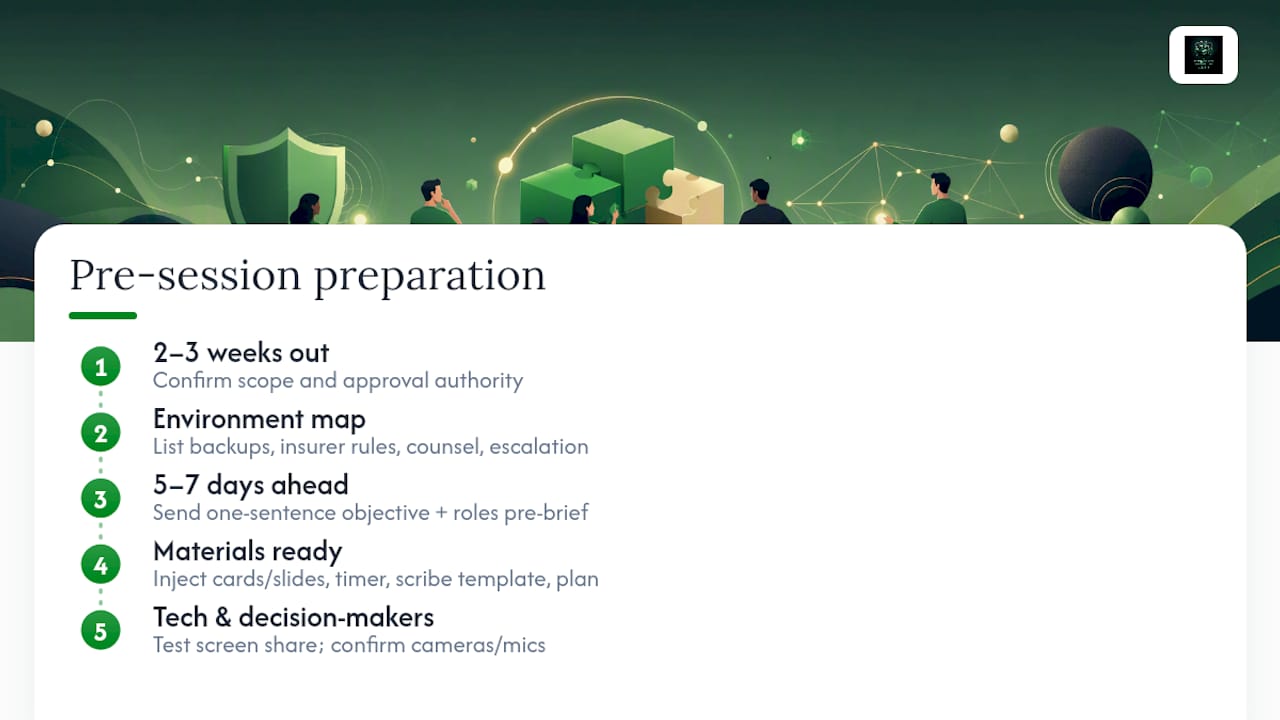
Preparation determines whether the 90-minute session produces sharp findings or a vague discussion. Start two to three weeks out by confirming the scope decisions made earlier: which systems, business units, and third parties are actually in play, and who has the authority to approve that scope.
Build or update a simple environment map before the session, not during it. This doesn't require technical testing. It means listing your actual backup systems, your cyber insurance carrier's notification requirements, your outside counsel's contact process, and your current incident response plan's escalation chain. If any of these don't exist or are out of date, the tabletop will surface that gap anyway, but you'll get more value testing decisions against a plan that's at least current.
Send a short pre-brief to every invited participant, ideally five to seven days ahead. The pre-brief should state the session objective in one sentence, list the roles each person will play, and set expectations that this is discussion-based and not a pass-or-fail technical audit. Participants who walk in cold tend to spend the first 20 minutes figuring out what's being asked of them instead of engaging with the scenario.
Prepare physical or digital materials in advance: inject cards or slides, a timer visible to the room, a scribe template ready to fill in, and a printed or shared copy of the current incident response plan for reference. If running remotely, test screen sharing and confirm every decision-maker has a working camera and microphone before the day arrives. A facilitator scrambling with technology in the first ten minutes loses the room's attention before the scenario even starts.
Building Realistic Threats Into Your Scenarios
Generic scenarios produce generic findings. The strongest tabletop sessions borrow from real, current threat patterns rather than inventing a hypothetical attacker from scratch.
MITRE ATT&CK offers a practical reference for this. Rather than writing a vague "attacker gains access" opening inject, pull a specific technique category, such as phishing for initial access or valid account abuse for lateral movement, and describe the scenario in those terms. This gives technical participants something concrete to react to and keeps the discussion grounded instead of speculative.
Threat intelligence doesn't need to be exotic to be useful. If your organization has seen a recent phishing campaign targeting your industry, or your cyber insurer has flagged a rise in vendor-compromise claims among similar companies, build the scenario around that pattern. Real incidents reported in your sector carry more credibility in the room than an invented attack, and participants tend to take the exercise more seriously when the scenario clearly reflects something that could actually happen to them this year.
Rotate scenario types across your annual or quarterly cadence so you're not testing the same attack pattern repeatedly. A reasonable rotation covers ransomware, business email compromise, a vendor or supply-chain event, and a data exposure scenario relevant to your regulatory obligations. Each rotation should also incorporate whatever threat pattern has been most active against your industry in the preceding months, keeping the scenario library current rather than static year over year.
Turning Findings Into Measurable Improvements
Capturing a lesson learned is easy. Converting it into a tracked, verifiable improvement is where most tabletop programs actually fail.
Structure every finding from the hot wash and AAR with four fields: what happened, why it happened, what the fix is, and how you'll verify the fix worked. That fourth field is the one organizations skip most often, and it's the one that turns a lesson into a measurable outcome rather than a good intention.
Assign a single owner and a due date to every finding, never a committee. A finding assigned to "the IT team" rarely gets closed; a finding assigned to a named person with a calendar deadline usually does. Track these in the same system you use for audit findings or compliance remediation, so leadership sees tabletop follow-through alongside other risk work rather than in a separate, easily forgotten spreadsheet.
Verify fixes at the next tabletop rather than taking a status update at face value. If last year's exercise found that the communications team couldn't draft a customer notification within two hours, this year's retest should include a comms inject that tests exactly that timeline again. If the time improves, you have a measurable improvement. If it doesn't, you have a finding that was marked closed prematurely, which is itself useful information about your remediation process.
Matching the Exercise to Your Organization's Maturity and Industry
A first-time tabletop program and a mature one need different designs, and running the wrong version wastes the room's time either way.
Organizations running their first exercise should keep the scenario simple and the objective narrow. Test one decision point, such as who has authority to declare an incident, rather than trying to exercise an entire incident response plan end to end. A single-objective session that succeeds builds internal buy-in for a more demanding one next cycle. Organizations with two or three exercises behind them can layer in multiple decision points, additional stakeholders, and a communication inject that forces a fallback channel.
Industry shapes scenario selection as much as maturity does. A law firm's highest-risk scenario likely involves client confidentiality exposure and attorney-client privilege questions during a breach, while an oil and gas or energy operator needs scenarios that account for operational technology and ICS environments alongside standard IT systems, a distinction worth building into scenario selection from the start, as covered in CisoSafe's guidance on incident response in energy operations. A healthcare organization's scenario library should weight toward PHI exposure and regulator notification timing given HIPAA's specific requirements.
Reassess your maturity level annually. An organization that has closed its major findings from the past two cycles is ready for a more demanding scenario, more aggressive time bounds, and a broader set of stakeholders in the room.
Weaving Legal and Regulatory Requirements Into the Scenario
Every regulated organization's tabletop needs at least one decision point tied directly to a real legal or regulatory deadline, not a generic "notify appropriate parties" inject.

Identify your specific notification obligations before you write the scenario. HIPAA covered entities and business associates face defined breach notification timelines; companies handling payment card data have contractual obligations under PCI DSS; publicly traded companies face SEC disclosure timing rules for material incidents. Build the scenario's resolution inject around the actual deadline your organization faces, and have legal counsel in the room confirm whether the group's proposed timeline would actually satisfy it.
Include outside counsel or in-house legal as a decision-maker, not an observer, whenever a scenario touches breach notification, regulatory reporting, or litigation hold requirements. Their presence during the exercise, rather than a post-session review, tests whether the legal and technical teams can actually coordinate on a live deadline instead of assuming they will.
Document any regulatory or contractual gap the exercise surfaces as its own finding in the AAR, separate from technical or process findings. A finding that says "the team was unsure whether a 60-day or 72-hour notification window applied" points directly at a policy document that needs updating before the next real incident, not just the next exercise.
Author Perspective: What Actually Changes Readiness
Most tabletop failures trace back to one habit: facilitators solving problems instead of asking questions. The second most common gap is skipping the pre-brief and watching participants spend half the session figuring out their role instead of testing it. Pick one scenario from this guide and run it this quarter.
— vCISO
Run Your Next Tabletop With a Team That Facilitates for a Living
Building a scenario from scratch, recruiting the right seats, and turning a hot wash into a tracked remediation plan takes real facilitation experience, not just a template. CisoSafe's vCISO team runs the initial exercise for you, using a NIST-aligned incident response plan and prebuilt scenario decks, then hands off a program your internal team can run on its own going forward.
Clients typically walk away with a completed AAR with named owners, a remediation roadmap tied to their compliance framework, and documentation that holds up during an audit or a regulator inquiry. That last part matters most for law firms, healthcare organizations, and energy operators facing SOC 2, HIPAA, or CMMC obligations, where "we ran a tabletop" needs to be backed by a paper trail, not a memory of the meeting. Explore CisoSafe's vCISO and compliance services to schedule a facilitated exercise or request the incident response plan template your team can use immediately.
Authoritative Downloads and Templates Worth Bookmarking
- CISA Tabletop Exercise Packages for no-cost scenario modules and slide decks.
- NIST SP 800-61 for incident response lifecycle alignment.
- CisoSafe's security template library for audit-ready downloads.
Sources
- CISA Tabletop Exercise Packages
- NIST SP 800-61 Revision 2: Computer Security Incident Handling Guide
- Facilitating a Tabletop Incident Response Exercise | CoSN
- Incident Response Tabletop Exercises facilitator guide (Boston University)
- Tabletop Exercises: Expose Incident Response Gaps (NetWitness)