

Component risk is the exposure created by an individual part, subsystem, or dependency whose failure, degradation, or compromise can trigger a system-level loss. That part might be a capacitor rated for the wrong temperature range, a firmware library nobody updated in three years, or a sole-source supplier one shipping delay away from stopping your production line. Any practical program has to work through five moves in order: identify the components, assess criticality, treat the highest-risk items, monitor results, and govern the whole cycle so it doesn't quietly stop happening after quarter one.
That component focus matters because failures rarely stay contained. A single unpatched software dependency or an out-of-spec part inherits its risk upward through every system that touches it, a phenomenon known as transitive risk. Component-driven risk assessments exist precisely because top-down, system-only reviews tend to miss that inherited exposure.
The core components of any component-focused framework are:
- Identification — build and maintain an authoritative inventory (BOM, SBOM, asset register).
- Assessment — score likelihood, impact, and criticality for every listed component.
- Mitigation — apply design, process, supplier, or operational controls to the worst offenders.
- Monitoring and reporting — track KPIs and feed field data back into the assessment.
- Governance — assign clear ownership so decisions actually get made and enforced.
Key Takeaways
Effective component risk management requires identifying every component through an accurate inventory, scoring criticality consistently, applying matched controls, and monitoring results in a governed feedback loop.
| Point | Details |
|---|---|
| Build a living inventory | Maintain BOM and SBOM records as version-controlled documents, not annual spreadsheets. |
| Screen before deep analysis | Use rapid criticality scoring to find the small subset of components worth a full FMEA. |
| Match controls to criticality | Choose design, process, supplier, or operational controls based on cost versus risk reduction. |
| Assign real ownership | Every open item in the risk register needs a named owner and a deadline, not just a score. |
| Investigate root cause | Replacing a failed part without root-cause analysis usually leaves the true risk in place. |
Table of Contents
- Identification and Scoping: Building a Reliable Component Inventory
- Assessment and Measurement: Ranking Components by Criticality
- Mitigation and Control Strategies for Component Risk
- Monitoring, Reporting, and the KPIs That Keep Component Risk Visible
- Governance and Roles: Who Actually Owns Component Risk
- How to Run a Component Risk Assessment Step by Step
- Methodologies and Tools: FMEA, SBOM, and Data-Driven Models
- A vCISO's View: Applying Component Risk to Cyber and Supply-Chain Exposure
- Fitting Component Risk into Your Broader Risk Management Program
- Common Challenges and Pitfalls in Managing Component Risk
- Regulatory and Compliance Pressures on Component Risk
- Get Expert Help Building Your Component Risk Program
- What the Evidence Actually Supports
- Sources
Identification and Scoping: Building a Reliable Component Inventory
Before you can rank component risk, you need to know what components exist, and that requires a scoping decision most teams skip. Do you track risk at the function level (power delivery), the part level (a specific capacitor), or the system level (the whole assembly)? Function-level scoping catches design intent; part-level scoping catches supply and quality issues. Most mature programs run both, layered.
Build the inventory with these methods, roughly in order of maturity:
- Bill of materials (BOM) for hardware, listing every physical part, manufacturer, and part number.
- Software bill of materials (SBOM) for code, capturing direct and transitive dependencies, since component analysis for software depends entirely on inventory accuracy.
- Asset registry that ties components to the systems and business processes they support.
- Scoping diagrams that visualize dependency chains, especially where third-party or open-source components sit several layers deep.
Supplier mapping belongs here too. A component inventory that lists parts but not the vendors, sub-vendors, and geographic concentration behind them will miss the disruption risk that actually bites.
Pro Tip: Treat your SBOM and BOM as living documents tied to version control, not static spreadsheets refreshed once a year. A component inventory that's six months stale is functionally worthless during an incident.
Before moving to assessment, confirm your inventory answers three questions: What components exist? Who owns each one? What upstream dependencies feed into it?
Assessment and Measurement: Ranking Components by Criticality
Not every component deserves equal attention, and trying to give equal attention to all of them is how risk programs stall. Assessment exists to sort the inventory into a short list of things worth fixing now.
Most teams use one of these approaches, often combined:
- Qualitative scoring (high/medium/low likelihood and impact) works fast for early screening and needs no special training.
- Semi-quantitative scoring assigns numeric weights to likelihood and impact so components can be ranked and compared across categories.
- Mission-profile weighting adjusts scores based on how critical a component is to a specific operating context, since a part failing in a redundant subsystem matters less than the same part in a single point of failure.
- FMEA/RPN scoring multiplies severity, occurrence, and detectability into a risk priority number, a method that ASQ's guidance frames as most effective when applied early in design, not retrofitted after a failure.
- Fuzzy-set and data-driven models improve early discrimination for projects mixing brand-new components with proven, reused ones, according to recent MDPI research.
Numeric precision has limits. An RPN of 84 versus 81 rarely reflects a meaningful real-world difference, so treat scores as ranking tools, not physical laws. Record every output, including the reasoning behind the score, in a risk register rather than a one-off spreadsheet that disappears after the review meeting.
Mitigation and Control Strategies for Component Risk
Reducing component risk means choosing the right control family for the specific failure mode you found in assessment, not applying a generic fix across the board. Four categories cover most situations.
Design controls change the component or its environment before failure can occur:
- Derating parts below their maximum rated specifications
- Building in redundancy for single points of failure
- Maintaining an approved alternative-parts list for obsolescence risk
Process controls catch defects before they ship:
- DFMEA-driven design changes that address failure modes at the source
- Manufacturing quality assurance checkpoints
- Incoming inspection for parts arriving from external suppliers
Supply-chain controls address the vendor side of component risk:
- Dual or multi-sourcing for critical parts
- Approved vendor lists with qualification criteria
- Contract clauses covering notification of design changes or discontinuation
Operational controls compensate when you can't eliminate the risk outright:
- Continuous monitoring for early warning signs
- Patch management for software components
- Documented workarounds for known limitations
Choosing among these isn't about picking the best control family for project risk. It's about matching control cost to the component's criticality score from the previous step.
Monitoring, Reporting, and the KPIs That Keep Component Risk Visible
A risk register that nobody revisits becomes a historical document, not a management tool. Monitoring keeps component risk current and forces prioritization decisions to happen on a schedule instead of only after an incident.
Track a small set of KPIs that actually change behavior:
- Open critical items — the count of high-criticality components without a completed treatment.
- Remediation backlog age — how long items sit open, which reveals whether mitigation is keeping pace with identification.
- Mean time to remediate (MTTR) — the average time from flagged risk to closed control.
- Field-failure correlation — how often real-world failures match components flagged as high risk, which validates or challenges your scoring model.
A data-driven component risk matrix that folds in supplier concentration and lead-time data can sharpen these KPIs further by prioritizing components most exposed to supply disruption, not just design failure.
Dashboards should split by audience. Engineers need part-level detail and failure-mode context. Program managers need backlog trends and remediation velocity. Executives need a handful of numbers tied to business impact, not a wall of component-level noise. Real-time visibility into this data is exactly where risk mitigation software earns its keep, automating the data pull instead of relying on quarterly manual updates.

Close the loop by feeding field-failure data back into your assessment model and into procurement decisions. If a supplier's parts keep showing up in your failure log, that belongs in your next sourcing decision, not just your risk register.
Governance and Roles: Who Actually Owns Component Risk
Component risk programs fail more often from unclear ownership than from bad methodology. Someone has to be accountable for each component, and someone else has to be able to say no when the risk is too high.
- Assign a role map. A component owner tracks day-to-day status, an engineering owner validates technical fixes, procurement owns supplier relationships, a risk owner maintains the register, and an executive sponsor breaks ties on resourcing.
- Apply the three lines of defense. Engineering and operations teams (first line) manage risk directly. Risk and compliance functions (second line) set standards and check the work. Internal audit (third line) independently verifies the whole system is functioning, not just documented.
- Build in decision gates. Design approval, supplier selection, and go/no-go milestones should each require a documented component risk sign-off, not an informal nod in a hallway conversation.
- Align with existing standards instead of duplicating them. ISO 31000 provides the enterprise risk principles; NIST SP 800-30 provides the assessment methodology for information systems. Component governance should plug into these frameworks, not create a parallel one that competes for attention. The RMF explained covers how this integration typically works in practice.
Governance done well is boring. Meetings happen on schedule, decisions get logged, and nobody has to reconstruct who approved what six months later.
How to Run a Component Risk Assessment Step by Step
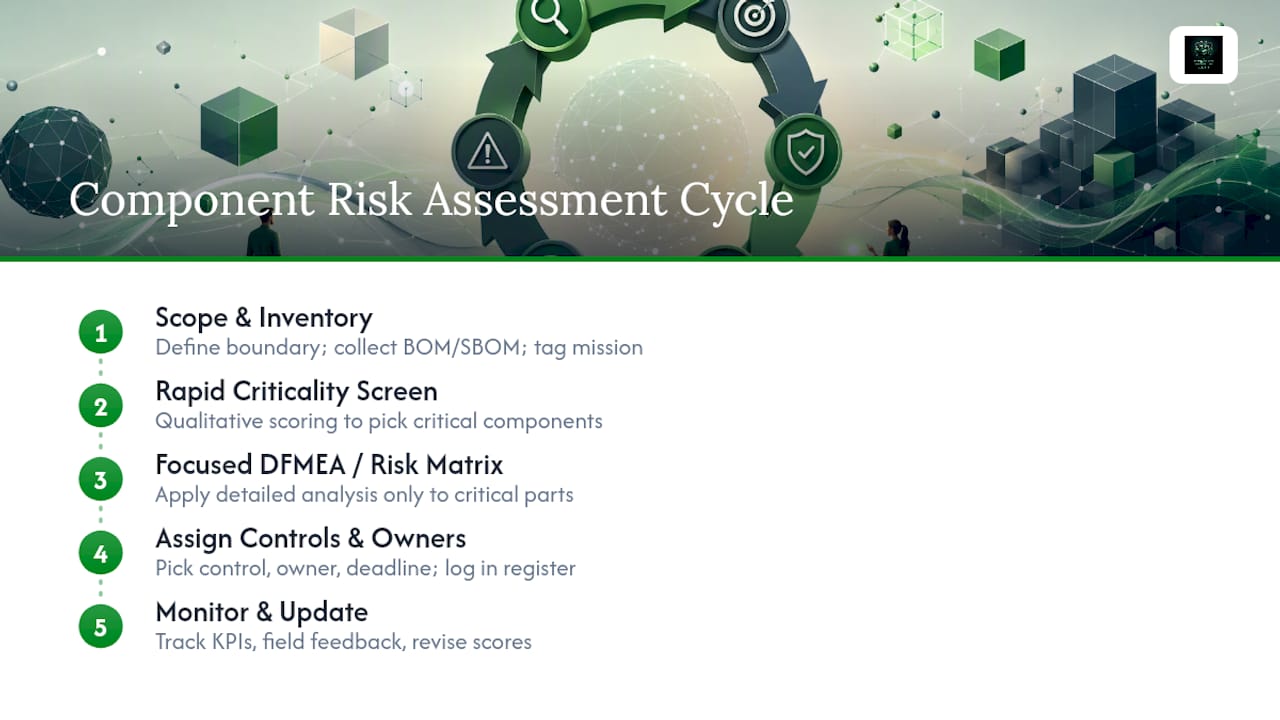
You don't need a twelve-month program to get real value from component risk analysis. A five-step cycle, run consistently, will outperform an elaborate framework that only gets used once.
Step 1: Scope and inventory with a mission profile. Define the system boundary and pull together your BOM, SBOM, or asset registry. Tag each component with the mission context it operates in, since the same part carries different risk in a redundant subsystem versus a single point of failure.
Step 2: Run a rapid criticality screen. Apply qualitative or semi-quantitative scoring across the full inventory to separate the handful of genuinely critical components from the long tail that doesn't need deep analysis yet. This step should take hours or days, not weeks.
Step 3: Focus DFMEA or a risk matrix on the critical subset. Reserve detailed failure-mode analysis for the components that survived screening. Combining a mission-profile screen with DFMEA has been shown to cut analysis duration roughly in half while catching the redesign issues that matter, according to reliability engineering research on integrating FIDES with DFMEA.
Step 4: Assign controls, owners, and deadlines. For each critical component, pick a control from the design, process, supplier, or operational families covered earlier. Log the component, its score, the chosen control, the owner, and the deadline directly in the risk register. An unowned action item is not a mitigation plan; it's a hope.
Step 5: Monitor, capture field feedback, and update priorities. Track your KPIs, watch for field failures that contradict your risk model, and revise scores as new information arrives. Component risk isn't static, so your register shouldn't be either.
Pro Tip: Run steps 1 and 2 as a standing quarterly cadence even when nothing seems to have changed. New suppliers, firmware updates, and part obsolescence notices shift criticality quietly, and a program that only reassesses after an incident is always managing yesterday's risk.
Once the cycle runs a few times, most teams find they can convert the outputs into a broader roadmap for security risk prioritization that leadership can actually act on.
Methodologies and Tools: FMEA, SBOM, and Data-Driven Models
Different methods solve different problems, and picking the wrong one for the stage you're in wastes real budget.
- FMEA and DFMEA work best during design, before parts are locked in. They force a structured walk through failure modes, rank them by severity, occurrence, and detectability, and document the corrective action. The ASQ guidance on FMEA is explicit that starting late in the process sharply reduces return on the effort, since design changes get expensive once tooling and manufacturing commitments are made.
- SBOM and dependency analysis solve a different problem: software components inherit risk from libraries several layers removed from what a developer directly imported. OWASP's guidance on component analysis makes clear that transitive-dependency mapping is not optional if you want to catch inherited vulnerabilities and license conflicts.
- Component risk matrices and data-driven models add supply-chain context, like supplier concentration and lead time, that classic FMEA never accounted for.
Combine methods rather than picking one and forcing every problem through it. Use FMEA for design-stage physical risk, SBOM analysis for software inheritance, and a risk matrix for supply-chain exposure, then feed all three into the same register.
One caution belongs in every methodology conversation: precision can be a trap. Reliability researcher Kirk Gray describes what he calls the component failure myth, the assumption that summing historical part failure rates produces a reliable prediction of field performance.
Many field failures trace back to design choices, assembly defects, firmware bugs, or environmental stress rather than intrinsic wear-out of the part itself. Adding up component failure rates without investigating root cause routinely produces confident-sounding numbers that don't match what actually breaks in the field.
That's the argument behind the component failure myth: a scoring model is only as good as the root-cause thinking behind it. Treat every method here as a tool for prioritization and investigation, not a substitute for asking why something actually failed.
A vCISO's View: Applying Component Risk to Cyber and Supply-Chain Exposure
A vCISO walking into a new engagement typically runs the same sequence regardless of industry: discovery first, criticality screening second, remediation roadmap third. Discovery means pulling together the SBOM, the vendor list, and whatever asset inventory already exists, then reconciling the gaps between what's documented and what's actually running in production.
The artifacts that come out of that work tend to look like this:
- An SBOM extract flagging outdated or unsupported libraries with known vulnerabilities
- A risk register snippet ranking the top ten components by criticality and exposure
- A remediation roadmap sequencing fixes by risk reduction per unit of effort, not just severity
A non-proprietary example: a mid-market energy operator's software stack often reveals a handful of end-of-life libraries buried in a monitoring dashboard nobody thinks of as "critical infrastructure." The screening step is what surfaces that gap, since raw severity scores alone won't flag a component that's quietly become a single point of failure for operational visibility.
Pro Tip: Ask your team which components have no documented owner. That gap, more than any severity score, tends to predict where the next incident will start.
Working with a firm like CisoSafe means this sequence gets run with structured tooling and reporting behind it instead of a one-time consulting engagement that goes stale.
Fitting Component Risk into Your Broader Risk Management Program
Component risk analysis only pays off if its outputs actually reach enterprise risk decisions, not just an engineering spreadsheet. The connective tissue is the risk register: when component-level scores roll up using consistent criteria, executives can see how a specific part or dependency contributes to business-level exposure, whether that's revenue, compliance standing, or reputational risk.
Practically, this means mapping component-level likelihood and impact scales to the same scale used in your enterprise risk register, so a "high" at the component level means the same thing as a "high" in the boardroom. It also means component risk owners report into the same governance structure as other risk domains, typically through the second line described earlier, so component findings surface during the same review cycles as financial or operational risk.
Frameworks like ISO 31000 and NIST SP 800-30 are built to support this rollup, since both treat component-level and system-level assessment as complementary inputs rather than competing methods. The failure mode to avoid is running component risk as an isolated technical exercise that never reaches the people making budget and strategy decisions. If your component register never gets referenced in an enterprise risk committee meeting, the integration hasn't actually happened yet, no matter how good the underlying analysis is.
Common Challenges and Pitfalls in Managing Component Risk
The most common failure mode isn't a missed component. It's an inventory that goes stale within months and quietly stops reflecting reality.
Inventory decay happens when BOMs, SBOMs, and asset registers are treated as one-time projects instead of living documents. New dependencies, supplier changes, and firmware updates accumulate faster than most teams update their records.
Scoring theater is the second trap: teams build elaborate numeric models, then treat the output as precise fact rather than a ranking aid. A component scored at 82 isn't meaningfully riskier than one scored at 79, and treating small numeric gaps as decisive leads to wasted remediation effort.
Ownership gaps stall action even when assessment is solid. A risk register full of correctly scored, unowned action items produces the appearance of progress without any actual risk reduction.
Root-cause skipping is subtler but costly: swapping a failed part for an identical replacement without investigating why it failed, the exact pattern the component failure myth warns against, guarantees the same failure recurs.
Siloed methods round out the list. Teams that run FMEA for hardware and SBOM analysis for software but never reconcile the two miss risk that crosses the hardware/software boundary, which is increasingly where component risk actually lives.
Each of these pitfalls shares a root cause: treating component risk management as a project with an end date instead of an operating discipline.
Regulatory and Compliance Pressures on Component Risk
Component-level risk documentation is no longer optional in regulated industries. It's often the specific artifact an auditor asks for.
Payment environments fall under PCI DSS's risk assessment guidance, which includes formal templates for component-level assessment within cardholder data environments, meaning a generic system-wide risk statement won't satisfy an assessor looking for component-specific analysis.
Healthcare organizations under HIPAA and defense contractors under CMMC face similar expectations: both frameworks require evidence that risk was assessed down to the asset and component level, not just described in aggregate. SOC 2 audits increasingly ask for SBOM-level detail when a vendor's software touches sensitive data, reflecting how software supply-chain risk has become a compliance question, not just an engineering one.
The practical implication is that your component risk register should be built compliance-ready from the start, meaning traceable scoring criteria, documented ownership, and a timestamp trail showing when assessments happened and what changed. Retrofitting that structure right before an audit is far more expensive than building it into your standing process. Organizations juggling multiple frameworks, SOC 2 alongside HIPAA or CMMC, benefit from a single component risk methodology that maps to each framework's specific evidence requirements rather than running parallel assessments for every regulation.
Get Expert Help Building Your Component Risk Program
Running the full cycle, inventory, assessment, mitigation, monitoring, and governance, takes sustained attention that most internal teams don't have spare capacity for, especially in regulated industries where the compliance stakes are high. CisoSafe provides vCISO services and an AI-powered compliance platform built specifically for law firms, energy operators, and other regulated mid-market organizations that need this rigor without hiring a full-time CISO. That includes security assessments, automated compliance intake across more than 50 frameworks, and remediation roadmaps that turn component-level findings into prioritized action, backed by reporting your leadership team can actually use in a board meeting.
What the Evidence Actually Supports
Most component risk advice overcorrects toward either pure engineering rigor or pure compliance checkbox work, and both miss the point. The evidence supports a narrower claim: component risk management works when identification, scoring, and ownership operate as one continuous loop, not when any single method gets treated as sufficient on its own.
The conventional advice oversells precision. Numeric RPN scores and elaborate fuzzy models feel authoritative, but the component failure myth is a real trap: a confident number built on incomplete root-cause data is worse than an honest qualitative estimate, because it stops people from asking why something actually failed.
If you're starting from nothing, prioritize the inventory before the scoring model. A rough criticality ranking on a complete, accurate SBOM and BOM beats a sophisticated FMEA run against a component list that's missing a third of your actual dependencies. Get the inventory right first. Everything downstream depends on it.
Sources
- FMEA overview and guidance — ASQ
- Component driven risk management methods — NCSC
- Component Analysis — OWASP