

An AI-enabled cybersecurity and compliance risk assessment uses machine learning to accelerate document review, evidence correlation, and control mapping, while human analysts still own every risk decision. It is not an evaluation of AI model safety or bias in a product. Regulated SMBs in law, healthcare, energy, and oil and gas should use one: done correctly, it delivers a prioritized risk register, clear compliance mapping, and board ready reporting in weeks instead of months.
TL;DR:
- Human oversight remains essential to validate AI-generated findings, especially for compliance mappings that can hallucinate or lack provenance.
- Assessments should start with a clear risk model and acceptance criteria established upfront to ensure scoring accuracy and auditability.
- Integrating AI speeds up document review and evidence correlation, but ongoing human review and provenance tracking are crucial to avoid errors and ensure traceability.
- Cross-functional participation from leadership, legal, operations, and security teams enhances assessment quality and prevents gaps that could cause audit failures.
- Costs and scope vary significantly based on whether operational technology is included, with tailored assessments offering rapid, board-ready reports for regulated SMBs.
Table of Contents
- What Does an AI Risk Assessment Cover?
- How the Assessment Process Maps to NIST SP 800-30
- What AI Adds, and Where It Falls Short
- How to Evaluate a vCISO or AI-Enabled Assessment Provider
- Timeline, Deliverables, and What Drives the Cost
- Turning Findings into Governance Action
- Keeping the Assessment Current Between Engagements
- Key AI-Specific Risks Worth Assessing Separately
- Mitigation Strategies for AI-Introduced Risk
- Tools and Technologies Behind a Modern Assessment
- Who Needs a Seat at the Table
- What AI Risk Assessments Look Like in Practice
- What Boards Consistently Get Wrong About These Assessments
- How CisoSafe Delivers AI-Enabled Assessments Without the Full-Time CISO Price Tag
- Sources
- FAQ
What Does an AI Risk Assessment Cover?
An AI-enabled cybersecurity and compliance risk assessment evaluates your organization's security posture and regulatory exposure. It is not an assessment of whether an AI model is safe, fair, or biased. That distinction matters because the phrase gets used both ways online, and confusing them means budgeting for the wrong deliverable entirely.
The assessment pulls from several inputs at once: your asset inventory, current policies, system logs, vulnerability scan and penetration test results, and third-party vendor data. AI tools ingest and correlate this material fast, but the analysis still separates into two distinct disciplines. Risk analysis identifies threats and vulnerabilities, then scores them by likelihood and impact. Risk management takes that scored list and decides what gets fixed first, by whom, and on what budget.
Both disciplines trace back to established anchors. The HHS HIPAA risk analysis guidance makes risk analysis the mandatory first step under the Security Rule, without prescribing one fixed methodology. The typical inputs include:
- A current asset and data inventory, including where protected or sensitive information lives
- Existing security policies and access controls
- Logs, scan results, and recent penetration test findings
- Third-party and vendor risk data
- Prior incident history and remediation records
How the Assessment Process Maps to NIST SP 800-30
NIST SP 800-30 frames risk assessment as a repeatable cycle rather than a one-time report, and that cycle is what separates a defensible assessment from a glorified vulnerability scan. It breaks into four stages.
- Prepare. Define scope, identify stakeholders, gather artifacts, and set the risk model and acceptance criteria before any testing starts.
- Assess. Combine automated ingestion and correlation of scan data with hands-on technical testing, then map findings against known adversary tactics and techniques.
- Report. Produce a prioritized risk register, an executive summary, a mapping to NIST CSF 2.0 and CPG 2.0 outcomes, and a remediation roadmap with owners and timelines.
- Maintain. Set a reassessment cadence and define the triggers, such as incidents or major system changes, that force an update outside that schedule.
NIST SP 800-30 also notes the methodology should scale to the level of complexity involved, whether you're assessing a single system or the whole organization.
Pro Tip: Ask any assessment provider to show you the risk model and acceptance criteria they used before you look at their findings. If those weren't defined up front, the scoring underneath the report is guesswork dressed up as data.
What AI Adds, and Where It Falls Short
AI genuinely changes the economics of an assessment. NIST's own draft guidance, SP 1353 ipd, documents practical use cases: ingesting governance documents, drafting current-state CSF profiles, and mapping artifacts to framework outcomes using structured prompts. Work that once took analysts weeks now compresses into hours.
That speed comes with real limits. AI output can lack provenance, meaning you can't always trace a conclusion back to the exact log line or policy clause that generated it. Models can hallucinate compliance mappings that sound authoritative but don't hold up. And no model has full context on your evidence set unless a human feeds it correctly.
That's why NIST's guidance treats AI as a drafting assistant, not a decision-maker, and insists on retaining source identifiers for every generated artifact. Operational guardrails that make this auditable:
- Use only approved, vetted AI tools with logged prompts and outputs
- Track provenance so every finding traces back to its source document or scan
- Require human subject-matter expert sign-off before any finding reaches the risk register
- Document where AI drafted content versus where a human authored it directly
A regulator or auditor will ask how a conclusion was reached. "The AI said so" is not an answer that survives a HIPAA audit or an SEC inquiry.
How to Evaluate a vCISO or AI-Enabled Assessment Provider
Choosing who runs your assessment matters as much as the methodology itself. Start with sector experience: a provider that has worked inside law firms, healthcare systems, or energy operators understands the specific evidence auditors in those industries expect. Multi-framework fluency across SOC 2, HIPAA, and CMMC saves you from paying for three separate assessments that could have been one coordinated effort.
Ask providers directly:
- What does a sample deliverable look like, beyond a slide deck?
- How is the audit trail maintained for AI-assisted findings?
- What specific AI tools are used, and where in the process?
- What is the human review policy before a finding is finalized?
Pro Tip: If a vendor can't produce a redacted sample risk register on request, that's a preview of what you'll get after signing. Insist on seeing one before you commit budget.
Watch for red flags: vague claims about "AI-powered" without specifics on tooling or oversight, no clear mapping to the frameworks you actually need, no evidence retention policy, or an inability to show how a penetration test finding was independently validated rather than just scanner output relabeled as a manual test.
Timeline, Deliverables, and What Drives the Cost
Most engagements fall into a predictable rhythm. A quick-scan assessment, useful for a board update or a merger due-diligence window, typically runs a few weeks. A full assessment with a remediation roadmap runs several weeks to a few months depending on scope. After that, an ongoing vCISO retainer keeps the assessment current on a set cadence rather than letting it go stale for another year.
Expect these deliverables from a well-run engagement:
- An executive summary written for leadership, not engineers
- A prioritized risk register ranked by likelihood and impact
- A mapping of findings to CPG 2.0 and CSF 2.0 outcomes
- A remediation roadmap with owners and target dates
- A board-ready slide deck
- A technical appendix for your IT and security team
Cost mainly moves with scope. Assessing IT alone costs less than assessing IT and operational technology together, which matters enormously for oil and gas and energy operators running industrial control systems. Number of sites, depth of third-party penetration testing, and how much evidence collection integrates with existing SIEM or monitoring tools all push the price up or down from there.
Turning Findings into Governance Action
A risk register that sits in a shared drive protects nobody. It becomes useful once mapped to specific governance frameworks that leadership and regulators recognize. CISA's CPG 2.0 provides a prioritized subset of high-impact practices aligned with CSF 2.0, including a GOVERN function and worksheets that translate technical findings into cost, impact, and complexity language executives can act on.
- Map each risk register item to a specific CPG 2.0 measurable action, not a vague "improve security" bucket
- For healthcare organizations, treat the documented risk analysis as the artifact OCR will request first in any HIPAA investigation
- For public companies, tie assessment timelines and documented processes to the SEC's disclosure requirements, since materiality decisions rely on having a repeatable process to point to
CISA also recommends third-party validation such as penetration tests and tabletop exercises as part of a credible governance story, not a one-time checkbox.
Keeping the Assessment Current Between Engagements
An assessment frozen at one point in time ages fast. NIST SP 800-30 treats reassessment as continuous, not annual by default, and several triggers should force an update outside the regular cadence.
- A confirmed security incident or near miss
- A merger, acquisition, or major vendor change
- A significant new system deployment or cloud migration
- Changes to operational technology environments in energy or industrial settings
Feed results from penetration tests, vulnerability scans, SIEM alerts, and incident response tabletop drills straight back into the risk register rather than filing them separately. AI can automate re-ingestion of this data as it accumulates, refreshing correlations quickly, but every automated update still needs a human validation step so the audit trail for a maturity assessment stays intact and traceable.
Key AI-Specific Risks Worth Assessing Separately
When AI tools sit inside your assessment workflow, the assessment itself needs to account for risks the AI introduces, not just the risks it helps you find. Bias is one: if a model was trained heavily on certain industry patterns, it may under-flag risks common in less-represented sectors like specialized oil and gas control systems, giving you false confidence in an area that actually needs scrutiny.
Transparency is another. Many AI tools function as a closed box, generating a mapping or a risk score without showing the reasoning path that produced it. That opacity becomes a real problem the moment an auditor or regulator asks how a specific conclusion was reached, since "the model produced it" satisfies nobody reviewing a HIPAA or SEC filing.
Model robustness matters too. An AI tool trained on one set of frameworks may perform well against SOC 2 language but stumble on the specific phrasing used in CMMC or sector-specific energy regulations, producing mappings that look complete but miss nuance a human reviewer would catch immediately.
Data quality risk compounds all of this. If the AI ingests outdated policies or incomplete log exports, every downstream correlation inherits that gap silently, and a stakeholder reading the final report has no way to know the input was flawed unless the provenance is tracked and disclosed.
Treat these as line items in the assessment itself: note which AI tools were used, what training or configuration assumptions might skew results, and where a human reviewer specifically checked for bias or robustness gaps before signing off on a finding.

Mitigation Strategies for AI-Introduced Risk
Mitigating these risks starts with tool governance, not after-the-fact correction. Maintain an approved list of AI tools cleared for use in assessments, and require documented reasoning for adding a new one.
Require human sign-off at defined checkpoints rather than at the very end. A subject-matter expert reviewing draft findings midway through catches a skewed mapping before it propagates into the final risk register, instead of after the report is already written.
Build provenance tracking into the workflow from day one. Every AI-generated finding should carry a citation back to the source document, log entry, or scan result that produced it, matching the retention practice NIST's SP 1353 ipd recommends.
Run periodic calibration checks comparing AI-generated risk scores against a manual sample. If the two diverge meaningfully on a subset of findings, that's a signal to retrain, reconfigure, or add a stricter review step before trusting the tool's output on similar cases going forward.
Finally, document the AI usage itself as part of the assessment record: which tool, which version, what data it touched, and who reviewed the output. That documentation becomes the evidence trail an auditor or regulator will eventually ask to see.
Tools and Technologies Behind a Modern Assessment
Most AI-enabled assessments run on a layered stack rather than a single tool. Document ingestion engines pull in policies, contracts, and prior audit reports, converting unstructured text into something a model can search and correlate quickly.
Correlation and mapping engines take that ingested material and align it against framework language, whether that's CSF 2.0 outcome categories or specific CMMC practices, producing draft mappings a human then verifies. Vulnerability scanners and automated penetration testing platforms supply the technical evidence layer, feeding raw findings into the same pipeline so the report reflects both governance gaps and technical exposure.
Governance, risk, and compliance (GRC) platforms typically sit on top, tracking the risk register, remediation status, and evidence retention over time rather than treating the assessment as a single static document. A secure multi-tenant SaaS portal that handles compliance intake and automated reporting, like the one CisoSafe operates, lets a security leader see updated risk scores without waiting for the next scheduled engagement.
SIEM integration closes the loop, since ongoing alerts and log data give the assessment fresh signal between formal reassessment cycles rather than relying purely on a point-in-time snapshot. The specific combination varies by organization size and sector, but the pattern holds: ingestion, correlation, technical testing, and ongoing monitoring, stitched together rather than run as isolated tools.

Who Needs a Seat at the Table
An assessment run entirely inside the IT department misses risks that only surface with input from other functions. Effective risk assessments require cross-functional participation, and skipping that step is one of the more common reasons audits fail later.
Leadership, typically the CEO or managing partner at an SMB, sets risk tolerance and approves the budget for remediation. Legal counsel reviews regulatory exposure and contract language, particularly for law firms and healthcare organizations handling client or patient data under strict confidentiality obligations.
Operations leadership brings context on which systems actually run the business day to day, since a technically minor vulnerability on a critical operational system can outrank a severe one on a rarely used tool. IT and security staff supply the technical detail: system architecture, existing controls, and historical incident data.
A vCISO or external security lead typically coordinates the whole process, translating technical findings into business language for the board while making sure the assessment stays aligned with the frameworks the organization actually needs, whether that's SOC 2, HIPAA, or CMMC. Third-party auditors or penetration testers, when engaged, provide the independent validation that CISA's CPG guidance recommends rather than relying solely on internal self-assessment.
Missing any one of these roles doesn't just weaken the assessment. It creates a specific, documentable gap that shows up the moment an auditor asks who reviewed a given finding and gets no clear answer.
What AI Risk Assessments Look Like in Practice
A regional law firm handling sensitive litigation data commissioned an assessment after a near-miss phishing incident exposed gaps in its access controls, illustrating practical implementation like those seen in AI w kancelarii prawnej: wdrożenie i zgodność — SzopaLabs. The AI-assisted intake process ingested the firm's existing policies and prior audit findings within days, letting the vCISO team focus their time on interviewing partners about actual data handling practices rather than manually cataloging documents.
An energy operator managing both corporate IT and operational technology used a phased assessment, scoping the AI-assisted document review to governance and IT systems first, then bringing in specialized OT testing separately given the different risk model industrial control systems require. The combined risk register mapped cleanly to CPG 2.0 actions, giving the board a single prioritized list instead of two disconnected reports.
A healthcare practice preparing for a HIPAA compliance review used the AI-assisted mapping to accelerate documentation of its risk analysis, then had a human reviewer verify every mapping against actual system configurations before submission. That verification step caught two instances where the AI had mapped a control to the wrong HIPAA safeguard category, an error that would have looked fine on paper but failed under real audit scrutiny.
Each case shares a pattern: AI compressed the early, labor-intensive phase, and human review caught what the tool alone would have missed.
What Boards Consistently Get Wrong About These Assessments
The most common pitfall isn't a bad tool. It's over-relying on AI output without cross-functional input, then presenting a technically accurate but incomplete picture to leadership. A second pitfall: never documenting the assessment criteria itself, which leaves nothing for an auditor to evaluate except conclusions with no visible reasoning behind them.
What leadership actually needs isn't a longer report. It's a short list of prioritized, measurable actions with a clear cost-to-risk-reduction ratio and evidence a regulator would accept without a follow-up request.
— vCISO
How CisoSafe Delivers AI-Enabled Assessments Without the Full-Time CISO Price Tag
CisoSafe pairs hands-on vCISO expertise with an AI-enabled SaaS platform that automates document intake, correlates evidence, and drafts framework mappings, then puts a human security lead in front of every finding before it reaches your board. That combination gives regulated SMBs the depth of a large consultancy at a fraction of the cost and timeline of hiring a full-time CISO.
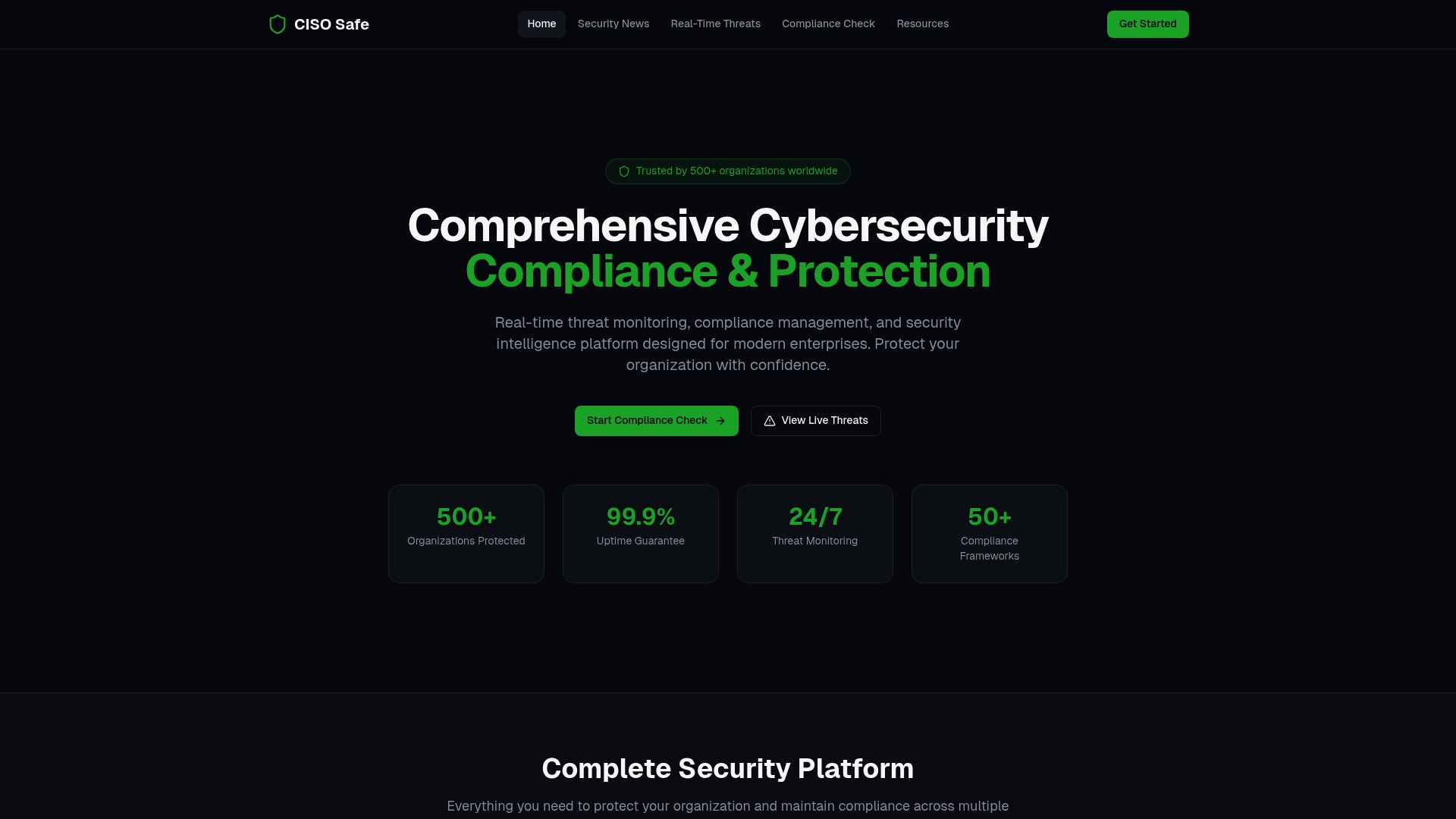
For law firms, healthcare practices, and energy operators juggling SOC 2, HIPAA, or CMMC requirements simultaneously, that multi-framework fluency means one coordinated assessment instead of three disconnected ones, backed by board-ready reporting your leadership can actually use in a meeting. If you're weighing whether to build this in-house, hire a consultancy, or bring in a dedicated partner, start with CisoSafe's service overview to see how the vCISO and platform components fit together for your specific sector.
Sources
- HHS HIPAA risk analysis guidance
- SEC cybersecurity disclosure requirements (2023)
- Cross-Sector Cybersecurity Performance Goals, Version 2.0
FAQ
What Is an AI Risk Assessment in Cybersecurity?
It's a cybersecurity and compliance evaluation where AI tools accelerate document review, evidence correlation, and framework mapping, while human analysts validate every finding. It is distinct from an evaluation of AI model safety or bias.
How Long Does an AI-Enabled Risk Assessment Take?
A quick-scan assessment typically runs a few weeks, while a full assessment with a remediation roadmap runs several weeks to a few months depending on scope. Ongoing vCISO retainers keep findings current between formal reassessments.
Does an AI Risk Assessment Satisfy HIPAA Requirements?
It can, provided the documented risk analysis meets the standard set by the HHS HIPAA risk analysis guidance, which requires assessing likelihood and impact without prescribing one fixed methodology. Human review of AI-generated mappings is essential for audit defensibility.
How Much Does an AI-Enabled Risk Assessment Cost With CisoSafe?
Pricing depends on scope, including whether IT and operational technology are both in scope, and current rates are available directly from CisoSafe. CisoSafe combines vCISO services with an AI-enabled platform to keep costs below what a full-time CISO or traditional consultancy typically charges.
What's the Difference Between Risk Analysis and Risk Management?
Risk analysis identifies threats and vulnerabilities and scores them by likelihood and impact. Risk management takes that scored output and decides what gets remediated first, by whom, and on what timeline.