

For security and compliance leaders at regulated SMBs, that shift is the difference between guessing at a budget and defending one in front of a board or an auditor.
The main business payoff comes down to three things:
- Prioritization — you fund the controls that reduce the biggest dollar exposure first, not the loudest alarm.
- Cost-benefit clarity — you can compare what a control costs against what it actually saves in expected loss.
- Compliance reporting — SOC 2, HIPAA, PCI DSS, and CMMC assessors increasingly expect risk language that ties back to business impact, not just checklists.
The FAIR model paired with Monte Carlo simulation is the most established way to get there, and a vCISO engagement (CisoSafe included) is a practical way to run it without hiring a full-time quantification specialist.
Key Takeaways
Quantitative risk assessment works because it replaces ordinal risk scores with dollarized, probabilistic ranges that boards, auditors, and finance teams can actually act on.
| Point | Details |
|---|---|
| FAIR is the standard | Decompose risk into Loss Event Frequency and Loss Magnitude for defensible, repeatable modeling. |
| Monte Carlo produces ranges | Simulations generate probability distributions instead of a single misleadingly precise number. |
| Hybrid staging works best | Quantify three to five high-impact scenarios; keep qualitative scoring for the rest. |
| Validation is not optional | Sensitivity analysis and benchmark cross-checks catch weak assumptions before a board sees them. |
| CisoSafe pairs vCISO with automation | A scoped FAIR pilot combines SME elicitation and SaaS modeling into audit-ready reporting. |
Table of Contents
- What Quantitative Risk Assessment Looks Like in Practice
- Quantitative vs. Qualitative: When Each Makes Sense
- How to Scope and Launch a First Quantitative Assessment
- Running FAIR at Regulated SMB Scale With vCISO and Automation
- Turning Quantified Results Into Budget Decisions and Audit Evidence
- Pitfalls, Limitations, and Practical Adoption Tips
- Quantitative Risk Assessment Across Industry Contexts
- Fitting Quantitative Risk Into Enterprise Risk Management
- Tools and Software for Running Quantitative Risk Models
- Validating a Quantitative Risk Model Before You Trust It
- Methodologies Beyond FAIR Worth Knowing
- Why Vendors Like CisoSafe Accelerate CRQ Adoption
- Pilot a FAIR-Based Assessment Built for Regulated SMBs
- Sources
What Quantitative Risk Assessment Looks Like in Practice
FAIR decomposes risk into two components: Loss Event Frequency (LEF), how often a bad event is likely to happen, and Loss Magnitude (LM), how much it costs when it does. Multiply a distribution of one by a distribution of the other, run it through a Monte Carlo simulation, and you get a range of probable outcomes rather than a single guess.
The output typically looks like this:
- A probability — the chance a loss event occurs within a given period.
- A frequency — how many times per year the event is expected to occur.
- An annualized loss exposure (ALE) range — expressed in dollars, usually with a low, likely, and high estimate.
Cyber risk quantification reports outcomes as probabilities of exceeding certain dollar thresholds within 12 months, rather than as static scores. That is the core distinction between quantification and an ordinal 1-to-5 scale. A "4 out of 5" risk rating tells you nothing about whether the exposure is $10,000 or $10 million. FAIR-based modeling tells you both the likelihood and the size, which is what a bank, insurer, or auditor actually wants to see.
Quantitative vs. Qualitative: When Each Makes Sense
Not every risk needs a full FAIR model, and pretending otherwise wastes analyst time on scenarios that do not move the budget needle. Full quantification earns its cost when you need to defend a number to someone outside the security team.
Reach for quantitative methods when you face:
- A board or investor asking "how much could this cost us?" in dollar terms.
- A cyber insurance renewal that hinges on demonstrated loss modeling.
- A regulatory disclosure requirement (increasingly common under SEC cybersecurity rules) that expects materiality language.
- A capital request competing against other business priorities for the same budget line.
For everything else, a hybrid approach works better. Academic research on qualitative and quantitative methods recommends starting qualitative, then quantifying only the three to five scenarios with the highest potential impact. That keeps the analysis affordable while giving you defensible numbers exactly where they matter. When internal loss history is thin, industry benchmarks and structured SME elicitation fill the gap credibly.
How to Scope and Launch a First Quantitative Assessment
A first FAIR-based assessment fails most often because the scope is too broad. Narrow it before you touch a model.
- Anchor scope to critical assets and regulatory drivers. Pick the systems holding regulated data, patient records, client trust accounts, or operational control systems, and tie the scope directly to whichever framework applies (SOC 2, HIPAA, PCI DSS, CMMC).
- Choose your model and granularity. FAIR is the recommended default. Start with one to three scenarios (a ransomware event, a third-party breach, an insider data leak) rather than trying to model your entire environment at once.
- Assemble your data. Pull internal incident history and logs where available, supplement with industry loss benchmarks, and run structured interviews with SMEs to fill gaps. Document every assumption as you go.
- Set acceptance criteria up front. Decide what a usable deliverable looks like: a dollarized exposure range, a ranked mitigation list, and a board-ready summary slide.
Pro Tip: Before you model anything, write down what decision the output needs to support. A number built to justify a $200,000 firewall upgrade needs different granularity than one built for an SEC disclosure filing.
Running FAIR at Regulated SMB Scale With vCISO and Automation
Most regulated SMBs do not have a full-time quantitative risk analyst on staff, and hiring one is rarely justified by the workload. A vCISO engagement fills that gap by handling the parts that resist automation: scoping the right scenarios, running SME elicitation sessions, and translating model output into language a board actually understands.
Two FAIR extensions matter here. FAIR-CAM maps specific controls to the risk factors they influence, so you can see exactly how a new MFA rollout shifts your loss event frequency. FAIR-MAM decomposes loss magnitude into categories like response cost, regulatory fines, and reputational damage, which lines up well with the materiality tests auditors and regulators actually use.
A workable workflow looks like this:
- Scope the scenario and regulatory driver with the vCISO.
- Collect internal data, benchmarks, and SME input through structured intake.
- Run the model, using Monte Carlo simulation to produce a loss range rather than a single figure.
- Interpret the range against risk appetite and compliance thresholds.
- Recommend prioritized mitigations with an ROI calculation attached.
CisoSafe's platform automates the repetitive modeling and evidence-packaging steps, while the vCISO handles judgment calls a script cannot. That combination produces outputs regulated SMBs can hand directly to auditors: dollarized exposure ranges, a ranked mitigation list, and documented evidence tying each recommendation back to a specific control gap.
| Point | Details |
|---|---|
| FAIR decomposition | Splits risk into Loss Event Frequency and Loss Magnitude for defensible modeling. |
| FAIR-CAM role | Maps controls to the risk factors they actually change, supporting ROI math. |
| FAIR-MAM role | Breaks loss magnitude into categories that match regulatory materiality tests. |
| vCISO function | Handles scoping, SME elicitation, and board translation that automation cannot do alone. |
Turning Quantified Results Into Budget Decisions and Audit Evidence
A dollarized range only earns its keep when it changes a decision. The most effective presentation format states a probability against a threshold: a 15% chance of exceeding $1 million in losses over 12 months reads far more clearly to a board than a heat-map square, a point FAIR's own guidance on cyber risk quantification backs up directly.
From there, the ROI math is simple:
- Estimate the expected annual loss before a control is in place.
- Estimate the expected annual loss after the control, using FAIR-CAM's control-effectiveness view.
- Compare that reduction against the control's implementation and maintenance cost.
- Fund the controls with the largest gap between loss reduction and cost first.
Map the resulting figures to your organization's risk appetite statement, and the same numbers double as evidence for SOC 2 audits, HIPAA risk analyses, or PCI DSS reporting cycles, since most frameworks now expect risk language tied to business impact rather than a bare severity label.
Pitfalls, Limitations, and Practical Adoption Tips
The most common mistake is treating an ordinal score, a color-coded heat map or a 1-to-5 rating, as if it were quantification. It isn't. ISACA's comparison of qualitative and quantitative risk assessment makes the point directly: quantitative outputs are more decision-useful, but only when assumptions and data quality are documented rather than hidden behind a single confident number.
Other frequent errors include ignoring secondary losses (regulatory fines, client attrition, reputational damage) and presenting a single-point estimate instead of a range.
- Document every assumption behind the model, not just the final number.
- Present confidence ranges, never a single figure, and triangulate against industry benchmarks.
- Loop in finance early. They will stress-test your dollar figures faster than any security peer review.
- Pilot on one or two high-impact scenarios before expanding scope.
Pro Tip: Translate every model output into a sentence a CFO would say out loud. If the number can't survive that test, the model needs more work, not more decimal places.
Quantitative Risk Assessment Across Industry Contexts
The mechanics of FAIR stay constant across industries, but the loss categories that dominate the model shift by sector.
A law firm handling client trust accounts and privileged case files faces loss magnitude driven heavily by breach notification costs, malpractice exposure, and client attrition after a disclosed incident. Loss event frequency modeling for a firm typically centers on phishing-driven account compromise, since attorneys remain frequent targets for business email compromise schemes.
An energy operator carries a different profile. Operational technology exposure means a successful intrusion can trigger physical service disruption, not just data loss, which pushes loss magnitude estimates toward regulatory penalties and outage-related revenue loss rather than notification costs alone. Firms in this space benefit from scoping scenarios around third-party vendor access to control systems, a common entry point for intrusions.
A healthcare provider under HIPAA sees loss magnitude weighted toward regulatory fines, breach notification mandates, and patient trust erosion, with loss event frequency often tied to third-party billing vendors or unsecured endpoint devices. An oil and gas company, meanwhile, layers physical safety risk on top of data risk, since a compromised SCADA system can affect both production continuity and worker safety simultaneously.
In every case, the FAIR structure stays the same. Only the loss categories and benchmark data sources change.
Fitting Quantitative Risk Into Enterprise Risk Management
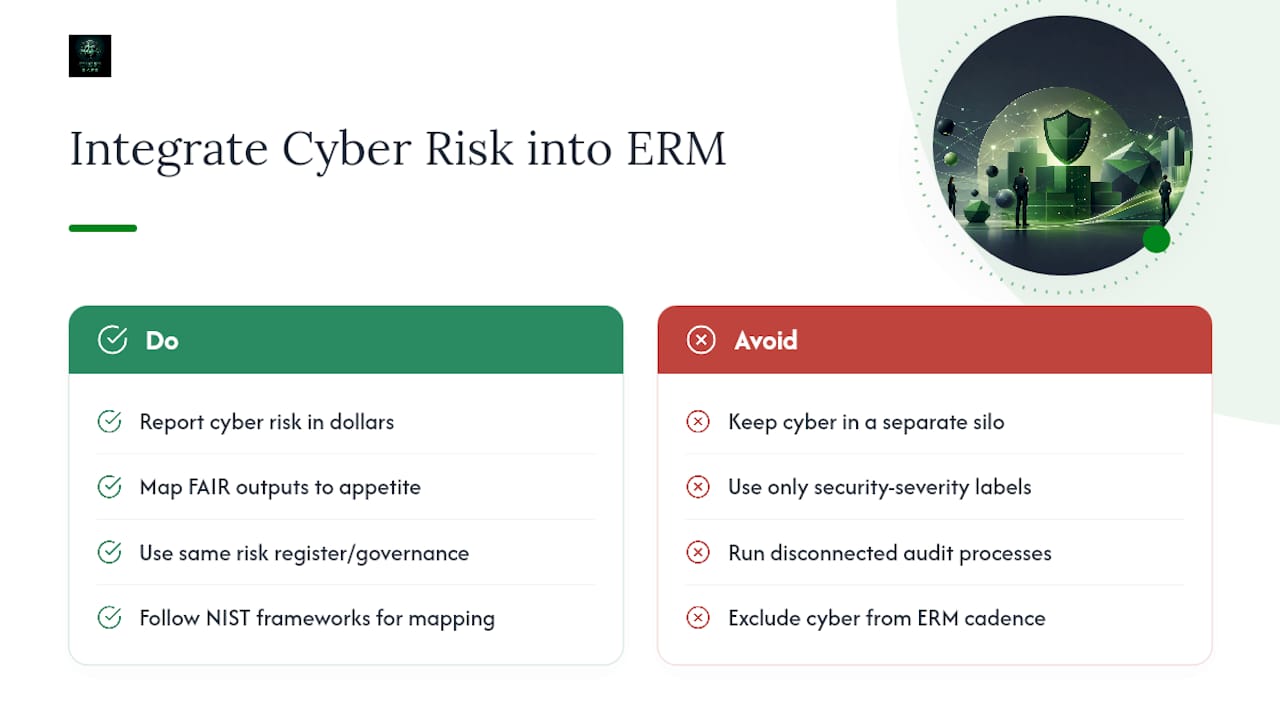
Cyber risk quantification works best when it feeds into the same risk register and governance structure the rest of the organization already uses, rather than living in a separate security silo. Most enterprise risk management (ERM) programs already rank operational, financial, and legal risks in dollar terms. Cyber risk should report in the same currency, or it never gets weighed fairly against a supply chain disruption or a litigation exposure.
Practically, that means mapping FAIR outputs directly onto your existing risk appetite statement and reporting cadence. If your ERM committee reviews top risks quarterly using expected-loss ranges, your cyber scenarios should show up on that same list, in the same format, competing for the same capital.
NIST 800-30 and the NIST Cybersecurity Framework both provide the governance scaffolding that FAIR outputs plug into cleanly. NIST CSF's "Identify" and "Govern" functions ask organizations to understand risk in the context of organizational objectives. A dollarized FAIR range gives the ERM team exactly the input that function requires, instead of a security-only severity label they have to translate themselves.
For regulated SMBs, this integration also simplifies audit conversations. When a SOC 2 or CMMC assessor asks how cyber risk gets weighed against other enterprise risks, "it feeds the same ERM register using the same dollar-based methodology" is a stronger answer than describing two disconnected processes.
Tools and Software for Running Quantitative Risk Models
Most organizations running FAIR-based quantification lean on a combination of purpose-built risk quantification platforms, statistical modeling tools, and governance, risk, and compliance (GRC) software that can ingest quantified outputs.
Dedicated FAIR-based platforms handle the modeling itself: defining LEF and LM distributions, running Monte Carlo simulations across thousands of iterations, and generating the probability curves that get presented to a board. Statistical tools like R or Python libraries built for Monte Carlo work serve the same function for teams building custom models rather than using a packaged platform.
On the governance side, GRC platforms track controls, evidence, and audit trails, but most were not built to run probabilistic loss modeling natively. That gap is exactly where a combined vCISO and SaaS approach, like the workflow CisoSafe runs, adds value: the platform automates data intake and Monte Carlo modeling, while the vCISO handles the SME elicitation and board translation that off-the-shelf GRC software cannot do on its own.
Whatever combination you choose, the tool matters less than the discipline behind it: documented assumptions, transparent data sources, and output formats your finance and compliance teams can actually use in a filing or an audit.
Validating a Quantitative Risk Model Before You Trust It
A FAIR model is only as good as the assumptions feeding it, which means validation is not optional. Before presenting any dollarized figure to a board or auditor, run a sensitivity analysis to see which inputs move the output most.
Cross-check your ranges against external benchmarks wherever possible. If your model estimates a ransomware event at $50,000 in likely loss magnitude while industry benchmark data for similarly sized firms clusters closer to $500,000, something in your scoping or loss categories is probably missing a category, likely secondary costs like regulatory fines or client attrition.
Back-testing against real incidents, yours or industry-wide, is the strongest verification available. If your model would have predicted a plausible range for a past breach at a comparable organization, that is meaningful evidence the model's structure holds up. Structured expert elicitation combined with conservative priors is the standard fallback when internal incident history is too thin to validate against directly, provided you document the priors and rerun the sensitivity analysis periodically as new data arrives.
Treat every model as a living document. Revisit assumptions annually, after any major incident, and whenever a new control changes the risk factors FAIR-CAM tracks.
Methodologies Beyond FAIR Worth Knowing
FAIR is the dominant standard, but it is not the only quantitative technique regulated organizations use, and understanding the alternatives helps you know when to reach for something else.
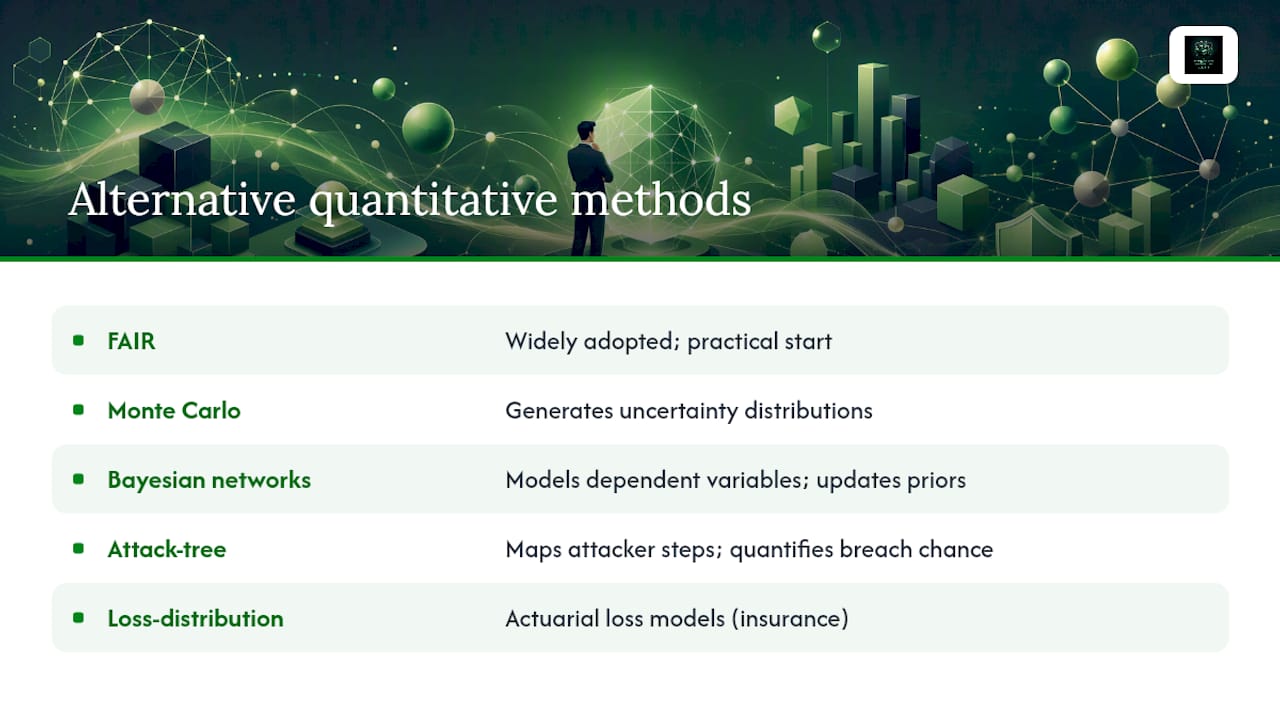
Monte Carlo simulation itself is a technique, not a framework, and it shows up inside FAIR and outside it. Any model that needs to express uncertainty as a range rather than a point estimate can use Monte Carlo to generate that distribution, which is why it pairs so naturally with FAIR's LEF and LM inputs.
Bayesian networks offer an alternative structure for organizations that need to model complex, interdependent risk factors, where one variable's probability depends heavily on another. They shine when internal data is sparse, since Bayesian methods let you start with a conservative prior belief and update it as real evidence arrives, which academic reviews of qualitative and quantitative cyber risk methods point to as a practical fallback for exactly that scenario.
Other approaches include attack-tree modeling, which quantifies the probability of a successful breach by mapping out each step an attacker would need to take, and loss-distribution approaches borrowed from actuarial science, common in cyber insurance underwriting. For most regulated SMBs, though, FAIR remains the most practical starting point: it has the clearest documentation, the widest adoption, and extensions like FAIR-CAM and FAIR-MAM that map cleanly onto compliance and disclosure needs.
Why Vendors Like CisoSafe Accelerate CRQ Adoption
The bottleneck in most quantitative risk programs isn't the math, it's getting SMEs in a room, documenting their assumptions honestly, and translating the output into something a board will act on. A vCISO handles that friction directly. Pairing that with automated modeling, the approach CisoSafe uses, cuts the time from "we should quantify this" to a board-ready report from months to weeks.
— vCISO
Pilot a FAIR-Based Assessment Built for Regulated SMBs
CisoSafe gives regulated SMBs a way to run real FAIR-based quantification without hiring a full-time analyst or paying enterprise consultancy rates. A scoped pilot, typically one or two high-impact scenarios, combines vCISO-led SME elicitation with CisoSafe's SaaS platform to produce a dollarized exposure range and a board-ready report in weeks rather than months.
That combination matters because most regulated SMBs can't justify a full-time quantitative risk hire, and generic consultancies price full FAIR engagements out of reach. CisoSafe's vCISO plus automated modeling workflow closes that gap: the platform handles data intake and Monte Carlo simulation, while the vCISO handles scoping, SME calibration, and translating output into language your auditors and board already expect for SOC 2, HIPAA, PCI DSS, or CMMC reporting.
If you're evaluating whether your organization is ready to quantify cyber risk instead of scoring it, start a pilot assessment with CisoSafe and get a scoped, dollarized report on your highest-impact scenario before your next audit cycle or board meeting.
Sources
- The FAIR Model: Factor Analysis of Information Risk (FAIR) Standard
- Cyber threat: origins and the use of qualitative and quantitative methods in cyber risk assessment (2022)
- Qualitative vs. Quantitative risk assessment (ISACA)