

AI penetration testing means AI-powered automated testing of your applications, APIs, networks, and cloud environments, using autonomous agents that discover, exploit, and validate vulnerabilities rather than just flagging them. The recommended move for regulated organizations is not to bolt this on unsupervised. Pilot it under vCISO governance, with OWASP APTS-aligned guardrails and direct control mapping, so every finding doubles as audit evidence.
TL;DR:
- AI penetration testing provides continuous, exploit-validated findings mapped directly to compliance controls, reducing audit preparation time for regulated organizations.
- Guardrails such as scope allowlists, rate limiting, human-in-the-loop review, and data governance are essential to prevent noise or disruption during automated scans.
- Verification methods involving detailed, documented processes are crucial, as enterprise-grade tools offer stronger verification, compliance mapping, and integration with existing security systems.
- Moving from single-agent scans toward coordinated multi-agent operations will improve accuracy, reduce false positives, and shorten evidence collection times.
- Successful implementation requires pairing automation with a governance layer, including pre-scan planning and post-test validation, to ensure audit-ready, actionable results.
Table of Contents
- What Does AI Penetration Testing Actually Do?
- Benefits and Limitations for Regulated SMBs and Mid-Market Organizations
- Safety, Guardrails, and the OWASP Autonomous Penetration Testing Standard
- How to Evaluate, Pilot, and Operationalize AI Penetration Testing
- Integrating AI Pentesting Into a vCISO Program
- How AI Pentesting Differs From Legacy Scanners and Human Red Teams
- What AI Techniques Power Modern Penetration Testing
- Where AI Penetration Testing Has Proven Effective
- Comparing AI Penetration Testing Tools on the Market
- Where AI Penetration Testing Technology Is Headed
- An Editorial Take: Govern the Capability, Don't Fear It
- Get Compliance-Ready AI Penetration Testing With vCISO Oversight
- Sources
What Does AI Penetration Testing Actually Do?
An AI pentesting engagement typically covers four asset classes: web applications, APIs, network infrastructure, and cloud environments. Inside those boundaries, autonomous agents run through a repeatable sequence rather than a single scan pass. That sequence is what separates this from a vulnerability scanner spitting out a list of maybes.
The agent workflow generally moves through four phases:
- Discovery: mapping attack surface, endpoints, cloud assets, and misconfigurations across the defined scope.
- Exploit: attempting to chain weaknesses into an actual working exploit, not just flagging a version number as outdated.
- Validation: confirming the exploit executes against the live target and capturing evidence, so the finding is not theoretical.
- Retest: rerunning the exploit after remediation to confirm the fix closed the gap.
Autonomous agents can chain vulnerabilities across code, APIs, infrastructure, and cloud surfaces and hand back exploitation-validated findings instead of raw scanner noise. A finished report from a mature platform includes a proof-of-concept walkthrough, supporting evidence (screenshots, request/response logs, or payloads), a remediation suggestion specific to the flaw, and a retest status once your team pushes a fix. That last piece is the one legacy tools rarely deliver, and it is the piece your auditors care about most.
Benefits and Limitations for Regulated SMBs and Mid-Market Organizations
The case for AI pentesting in a compliance-driven environment comes down to speed and proof. The tradeoffs come down to judgment calls a model still cannot fully replace.
Where it delivers real value:
- Continuous coverage instead of a single annual snapshot, so new code and configuration drift get tested between audit cycles.
- Validated exploits with reproducible evidence, which reduces the time your team spends triaging false positives.
- Faster time-to-evidence because findings arrive already mapped to remediation steps.
- Risk prioritization tied to business impact, not just CVSS scores that ignore what an asset actually does for your organization.
Where it still needs a human backstop:
- Complex business-logic flaws, like a workflow that lets a user bypass an approval step through legitimate-looking actions, often require a tester who understands your specific process.
- Guardrails have to be configured correctly up front, or an autonomous agent can generate noise (or worse, disruption) at machine speed.
- Edge cases in regulatory interpretation, such as whether a finding constitutes a reportable incident, still need a compliance professional's judgment.
Mapping findings to controls is where this earns its keep for audit prep. A validated finding tied to PCI DSS penetration test requirements or a SOC 2 control like CC6.2 gives your auditor a direct line from evidence to control, with no interpretation gap.
Pro Tip: Ask any vendor to show you one full sample report before you sign anything. If the remediation guidance is generic boilerplate rather than specific to your stack, the "AI" is doing less work than the sales deck implies.
Safety, Guardrails, and the OWASP Autonomous Penetration Testing Standard
Running exploitation attempts against production systems is not something to hand off without rules. This is exactly why the OWASP Autonomous Penetration Testing Standard exists: it gives security leaders a shared, checkable baseline instead of trusting a vendor's marketing claims.
APTS defines 173 tier-required requirements spread across eight domains, including cloud governance, API testing governance, SLA and failover expectations, and AI model provenance, plus a set of advisory practices on top. Crucially, it publishes a machine-readable JSON export and schema, so a vendor's conformance can be checked programmatically instead of taken on faith.
For your own operational guardrails, require these five things in any AI pentesting engagement:
- Scope allowlists that explicitly exclude internal or private IP ranges and enforce HTTPS-only targets.
- Rate limiting on all testing traffic to prevent accidental denial-of-service against production systems.
- Human-in-the-loop review that pauses high-risk or destructive actions before execution, a pattern most mature platforms already build in.
- SLA and availability commitments covering what happens if a test impacts uptime.
- Model provenance and data governance documentation showing what model runs the agent and how your data is handled, an area where practices like AI data governance frameworks are becoming a standard vendor ask.
When you evaluate a vendor, ask for their APTS domain mapping directly, a sample of their machine-readable evidence export, and a written escalation policy for when an agent hits something ambiguous. If they cannot produce any of the three, treat that as a red flag, not a footnote.
How to Evaluate, Pilot, and Operationalize AI Penetration Testing
A safe rollout starts before the first scan ever runs. Get the paperwork and boundaries locked down first, then let the technical evaluation follow.
Pre-pilot checklist:
- Finalize scope and a current asset inventory, so nothing gets tested (or missed) by accident.
- Build the allowlist of approved targets and exclude anything out of bounds, including private IP ranges.
- Set defined test windows that align with change control and low-traffic periods.
- Get legal and executive sign-off on the engagement terms before any exploit attempt runs.
- Confirm your incident response team knows a test is happening, so a validated exploit does not trigger a false alarm internally.
Once the pilot is scoped, the vendor conversation should follow a scorecard, not a gut feeling:
- How does the platform verify a finding before it reaches the report, and what does the verification pipeline actually look like step by step?
- What is the documented false-positive rate, and how is it measured?
- Does the report format map findings directly to compliance controls, or will your team have to do that translation manually?
- What are the SLA terms for critical findings and platform uptime?
- Is the deployment single-tenant, customer-hosted, or multi-tenant, and does it support bring-your-own-model or key options for organizations that need data to stay inside their own boundary?
- Does it integrate with your existing SIEM or ticketing system, or does someone have to copy-paste findings into Jira by hand?
For pilot success criteria, track the verified exploit rate, false-positive rate, mean time to evidence, and remediation retest time. Those four numbers tell you, in about 60 days, whether a platform is ready for your compliance calendar or still needs supervision. Organizations building out a broader mid-market security assessment program should treat this pilot as one input into that larger roadmap, not a standalone purchase decision.
Integrating AI Pentesting Into a vCISO Program
CisoSafe pairs vCISO advisory with an AI-powered SaaS platform that runs automated penetration testing and compliance intake for regulated SMBs and mid-market organizations. The point is not to hand an autonomous agent the keys and walk away. It is to put a governance layer around the technology so results actually count toward SOC 2, HIPAA, PCI DSS, or CMMC evidence.
A typical CisoSafe engagement runs like this:
- Assessment: a vCISO advisor scopes the environment, sets objectives, and confirms compliance framework targets.
- AI pentest run: the platform executes discovery, exploitation, and validation within the agreed scope and guardrails.
- Control-mapped report: validated findings arrive tied to the specific control they satisfy, not a generic severity score.
- Prioritized remediation plan: the vCISO advisor ranks fixes by business impact, not just technical severity.
- Retest: the platform reruns validated exploits post-fix to confirm closure before the audit window arrives.
For organizations in sectors like legal, energy, and healthcare, that human layer matters as much as the automation. A vendor cybersecurity assessment or an industrial cybersecurity assessment has different evidence expectations depending on your regulator, and a vCISO who already speaks that regulator's language closes the gap an autonomous agent alone cannot.
How AI Pentesting Differs From Legacy Scanners and Human Red Teams
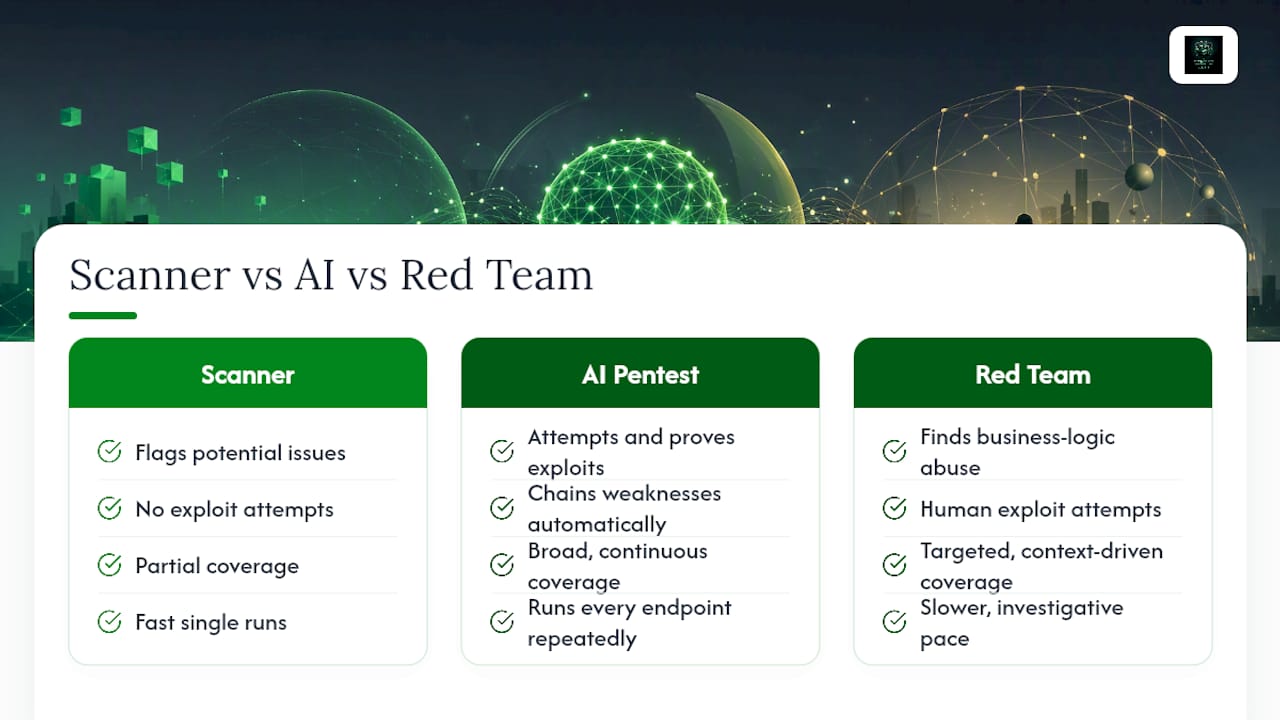
A vulnerability scanner tells you a port is open or a library version is outdated. It does not tell you whether that weakness is actually exploitable in your environment, which is the question your auditor and your attacker both care about. That gap is why scanner output alone rarely satisfies penetration test requirements under frameworks like PCI DSS.
AI pentesting closes that gap by attempting the exploit, not just flagging the possibility. It chains weaknesses the way an attacker would, across OWASP Top 10 categories, API schemas, and cloud misconfigurations, and only reports what it can prove. That is a meaningfully different deliverable than a scan report with a hundred "potential" issues and no way to tell which three actually matter.
Human red teams still hold an edge in a specific area: business-logic abuse that requires understanding how your organization actually operates, not just how your code is written. A red teamer who spends a day understanding your claims-approval workflow might find a bypass no agent would think to try, because it requires domain context rather than pattern matching. What AI pentesting delivers instead is coverage and speed. It runs continuously, tests every API endpoint the same way every time, and does not get tired on the fortieth authentication check of the day. The practical answer for most regulated organizations is not choosing one over the other. It is using AI pentesting for breadth and continuous validation, and reserving human red team hours for the judgment-heavy scenarios that actually need them.
What AI Techniques Power Modern Penetration Testing
The "AI" in AI penetration testing usually refers to a combination of techniques working together, not one single model doing everything. Understanding the pieces helps you ask sharper vendor questions.
Large language models handle reasoning and planning: interpreting scan results, deciding what to try next, and writing remediation guidance in plain language rather than a raw log dump. Machine learning classifiers handle pattern recognition, spotting configuration patterns or code structures that resemble known vulnerability classes across thousands of prior test runs. Graph-based attack-path analysis is what lets an agent chain a low-severity misconfiguration in one system with a moderate flaw in another to produce a working exploit path, the same way a human red teamer connects dots across a network diagram.
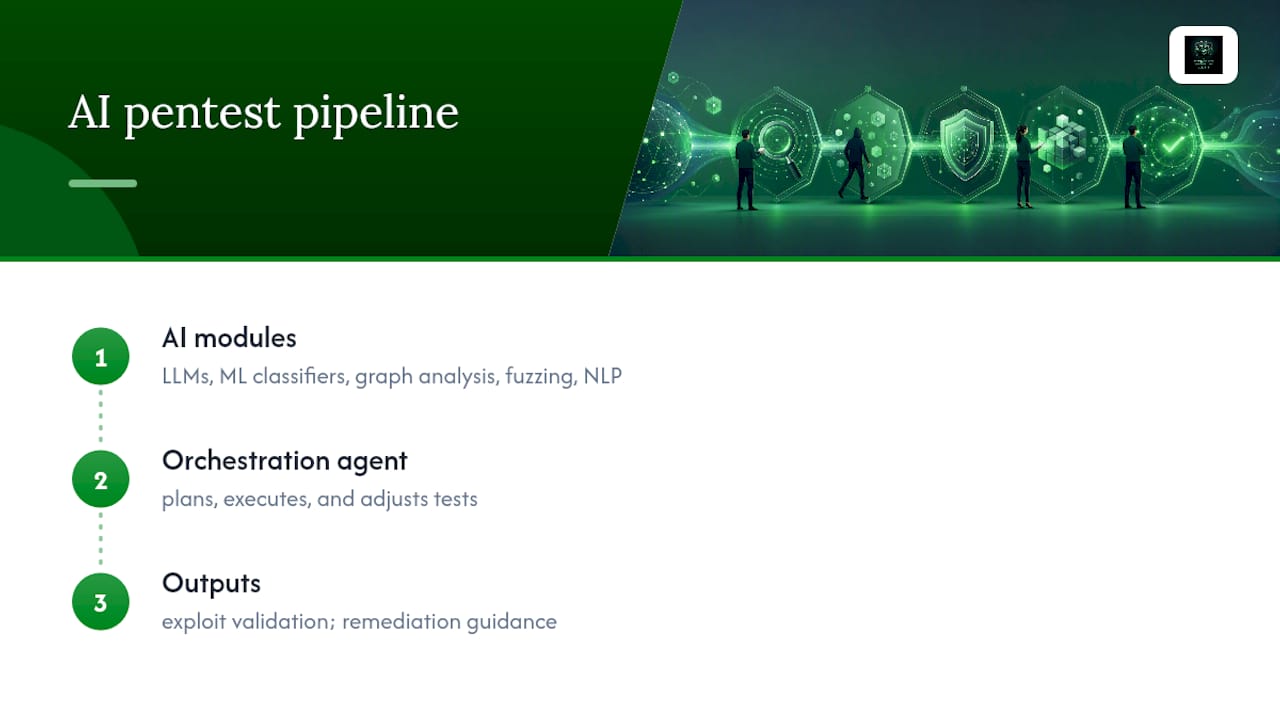
Fuzzing engines, often guided by the AI layer rather than purely random, generate malformed inputs to APIs and web forms to surface crashes or injection points faster than a manual tester could try them by hand. Natural language processing shows up in report generation, turning technical findings into control-mapped language auditors can actually use. None of these techniques is new by itself. Fuzzing and static analysis predate the current wave of AI tools by decades. What changed is the orchestration layer: an agent that can plan a multi-step attack, execute it, watch the result, and adjust its next move without a human writing each command by hand.
Where AI Penetration Testing Has Proven Effective
The clearest real-world signal for AI pentesting's effectiveness is not a single dramatic breach story. It is the shift from periodic testing to continuous validation that regulated organizations increasingly depend on for audit readiness.
Platforms built around this model report continuous testing that integrates directly into SIEM, SOAR, and ticketing workflows, which matters because a finding that never reaches a ticketing system is a finding that never gets fixed on schedule. That integration is where the practical value shows up week to week, not just at audit time.
Coverage-wise, the pattern across platform writeups is consistent: strong results on OWASP Top 10 categories, API schema-aware testing, and cloud misconfiguration checks like IAM and Kubernetes issues. These are exactly the categories that drive the highest volume of findings in a typical mid-market environment, since most breaches trace back to a misconfigured cloud role or an unauthenticated API endpoint rather than an exotic zero-day. For a regulated SMB running quarterly compliance checks, the practical win is having exploit-validated evidence sitting in a ticketing queue before an auditor ever asks for it, instead of scrambling to schedule a manual test the month before a certification renewal.
Comparing AI Penetration Testing Tools on the Market
Rather than naming names in a head-to-head chart, it is more useful for a security leader to compare tools by feature category, since that is what actually determines fit for a regulated environment.
| Evaluation category | What to look for |
|---|---|
| Verification method | A documented process (consensus checks, specialist review rules) that confirms exploitability before reporting, described in detail rather than a single line like "AI verified." |
| Deployment model | Single-tenant, customer-hosted, or multi-tenant, with bring-your-own-model or key options for organizations that cannot let scan data leave their environment. |
| Compliance mapping | Findings tied directly to named controls (SOC 2, HIPAA, PCI DSS, CMMC) rather than generic severity labels. |
| Integration depth | Native connections to SIEM, SOAR, or ticketing platforms, versus a PDF export you have to manually re-enter. |
| Guardrail maturity | Documented rate limiting, allowlists, and human-in-the-loop pauses for high-risk actions, ideally mapped to APTS domains. |
| Reporting format | Proof-of-concept, evidence, remediation guidance, and retest status included as standard, not an add-on. |
Entry-level automated tools tend to win on price and speed of setup but often skip the verification and compliance-mapping layers entirely. Enterprise-grade platforms tend to offer stronger guardrails and control mapping but come with longer onboarding and steeper pricing. For a regulated mid-market organization, the categories that matter most are verification method and compliance mapping. Speed of setup is a poor tradeoff if the report you get back cannot survive an auditor's questions.
Where AI Penetration Testing Technology Is Headed
Expect three shifts to define the next few years of this category. Standardization is the first and most consequential: as APTS matures and more vendors publish machine-readable conformance data, procurement teams will be able to compare platforms on hard requirements instead of marketing claims, the same way PCI DSS standardized card-data security expectations over the past two decades.
The second shift is deeper agent coordination. Platforms are already moving from single-agent scans toward coordinated multi-agent operations, where one agent handles discovery while another focuses on exploitation and a third validates and writes remediation guidance, a pattern that mirrors how AI agent monitoring practices are evolving across enterprise SOC operations generally. That coordination should reduce false positives further and shorten mean time to evidence, since each agent specializes rather than trying to do everything.
The third shift is tighter compliance integration. As more frameworks recognize continuous, AI-validated testing as acceptable evidence rather than requiring an annual manual test, the operational rhythm for regulated organizations will shift from a once-a-year fire drill to an always-on validation posture. That is a real change in how security budgets get planned, not just a technology upgrade. Security leaders who build governance now, rather than waiting for the standard to fully mature, will be the ones ready when auditors start asking for continuous evidence as a baseline expectation rather than a bonus.
An Editorial Take: Govern the Capability, Don't Fear It
AI penetration testing is not a replacement for the judgment your security program depends on. It is a scaling mechanism for the parts of testing that were always mechanical anyway, freeing your team and your vCISO to focus on the business-logic edge cases and regulatory interpretation that actually require a human. The conventional worry, that autonomous agents are too risky for regulated environments, gets the risk backwards. The real risk is adopting AI pentesting without guardrails, metrics, or a governance owner accountable for the pilot. Run it with defined success criteria, APTS-aligned controls, and a hybrid model where humans review escalations, and the technology becomes an asset instead of a liability.
— vCISO
Get Compliance-Ready AI Penetration Testing With vCISO Oversight
CisoSafe is the option built specifically for regulated teams that need audit-ready findings, not just a scan report someone has to translate for an auditor. Every engagement pairs the AI-powered pentesting platform with a vCISO advisor who scopes the run, sets the guardrails, and maps each validated finding directly to the SOC 2, HIPAA, PCI DSS, or CMMC control it satisfies.
That combination matters most at renewal time, when your team needs evidence ready before the auditor asks for it, not a scramble to schedule a manual test. If your last penetration test came back as a stack of unverified findings with no path to remediation, that is a sign the tooling and the governance were never connected in the first place. Visit CisoSafe to request a pilot and see how a vCISO-managed AI pentest run turns into control-mapped evidence your compliance team can actually use.
Sources
Start with the OWASP Autonomous Penetration Testing Standard and its implementation notes for the authoritative baseline on guardrails and validated-finding reporting.
- OWASP Autonomous Penetration Testing Standard (APTS)
- OWASP Nest: Autonomous Penetration Testing Standard (implementation notes)