

Continuous penetration testing is ongoing, exploit-verified adversarial testing that runs on code or environment change instead of a calendar date. It closes the window of exploitability that opens between quarterly or annual assessments, when new code ships unchecked for weeks. The right first move is a pilot on one critical application, with a strict requirement that every finding comes with a replayable, proof-backed exploit before it reaches a developer's queue.
TL;DR:
- Continuous penetration testing is triggered by code or environment changes, providing real-time validation especially for organizations with frequent deployments.
- It combines discovery, exploitation, verification, and regression to continuously map, attack, confirm, and re-test vulnerabilities in live environments.
- Implementing it as a pilot on one application with strict proof-backed exploits can build trust and control scope before expanding across larger systems.
- Automated exploits must pass verification gates and use scoped credentials to prevent false positives, operational risks, and alert fatigue.
- A managed SaaS platform paired with a vCISO offers a practical, scalable way for regulated mid-market firms to adopt continuous testing without building an in-house offensive security team.
Table of Contents
- What Is Continuous Penetration Testing, Really?
- Why Does Point-in-Time Testing Leave You Exposed?
- How Does the Continuous Testing Loop Actually Work?
- How Do You Roll Out Continuous Penetration Testing?
- What Keeps Continuous Testing Safe and Actionable?
- Does Continuous Testing Satisfy Auditors?
- Who Needs to Be Involved to Make This Work?
- What Actually Goes Wrong When Teams Deploy This?
- What Does a Successful Rollout Look Like in Practice?
- Is a Managed Approach Better Than Building In-House?
- Get Continuous Testing Running Without Building a Team From Scratch
- Standards and Advisories Worth Bookmarking
- Sources
- FAQ
What Is Continuous Penetration Testing, Really?
Vulnerability scanners flag patterns. Continuous penetration testing exploits them. That distinction separates a tool that says "this endpoint might be vulnerable to SQL injection" from one that actually injects the payload, extracts data, and hands your team a replayable exploit chain as evidence.
Scheduled PTaaS platforms improved on the old annual report by adding a portal and faster turnaround, but most still run on a fixed cadence, monthly or quarterly, rather than reacting to actual change. Continuous penetration testing triggers on deployments, new endpoints, and infrastructure changes.
The approach fits organizations that ship code weekly or faster, carry regulatory testing obligations tied to change (PCI DSS, SOC 2), or manage attack surfaces that grow faster than annual testing cycles can track. It fits less well with static, low-change environments where an annual deep assessment already covers the risk.
- Vulnerability scanning: automated, pattern-based, no exploitation, high false-positive rate
- Scheduled PTaaS: human-led, periodic, thorough but time-boxed
- Continuous penetration testing: exploit-verified, change-triggered, ongoing
Why Does Point-in-Time Testing Leave You Exposed?
A single annual pentest gives you a security snapshot on one day out of 365. Every deployment after that date runs on unverified assumptions, and most organizations deploy code far more often than they test it.
Picture a typical coverage curve: a company tests in January, finds and fixes 40 vulnerabilities, and looks clean on paper. By March, three new features and a dozen dependency updates have shipped. None of that new surface has been touched by an adversarial test. By December, the "current" security posture is really an eleven-month-old guess.
CISA's advisories consistently point to delayed detection and validation as a driver of successful breaches, not the absence of any testing at all. Continuous testing shortens that detection-to-remediation cycle by validating new attack surface close to when it appears.
Pro Tip: If your last pentest report is more than 90 days old and you've shipped major features since, treat your current risk picture as stale, not current.
Point-in-time testing still earns its place for stable, low-change systems, and for the deep, creative human-led engagements that continuous automation is not built to replace.
How Does the Continuous Testing Loop Actually Work?
A working continuous penetration testing program runs on a repeatable loop, not a single scan job. Each cycle has four movements: discovery, exploitation, verification, and regression.
Discovery maps the live attack surface: exposed subdomains, APIs, and JavaScript bundles that reveal hidden endpoints developers forgot existed. This step alone catches shadow IT and forgotten staging environments that annual assessments often miss because they scope only what's documented.
Exploitation is where AI-assisted planning and specialized exploit agents attempt real attack chains against discovered targets, backed by a deterministic exploit engine that reproduces the same result every time rather than a probabilistic guess.
Verification runs through an independent accuracy gate before anything reaches a developer. This second, separate check replays the exploit to confirm it's real, filtering out the noise that makes teams stop trusting scanner output. SANS frames this kind of operationalized offensive capability as a foundation for what it calls an Offensive SOC.
Regression converts every verified exploit into an automated test that reruns on future deployments, so a fixed vulnerability that resurfaces gets caught immediately instead of six months later.
- Discovery: attack surface and API/JS mapping
- Exploitation: AI planning plus deterministic exploit engine
- Verification: independent accuracy gate
- Regression: automated retest wired into CI/CD
Pro Tip: Ask any vendor whether their "continuous" testing runs in your staging environment, a gated production copy, or live production. The answer determines how aggressive their payloads can safely be.
How Do You Roll Out Continuous Penetration Testing?
Rolling out continuous penetration testing works best as a narrow pilot that expands, not a big-bang deployment across every application at once.
- Pick one pilot target. Choose a critical, internet-facing application, provide scoped test credentials, and write down exactly what's in and out of scope before testing starts.
- Run a baseline cycle. Let the first full loop run to completion, then triage the resulting backlog by exploitability and business impact rather than raw severity score.
- Set a blocking policy for verified criticals. Any finding that passes the accuracy gate and shows exploit proof should block release until fixed, not sit in a backlog.
- Wire retest into CI/CD. Trigger a scoped retest on every deploy, and convert each verified exploit into a permanent regression check.
- Scale scope gradually. Add applications and network segments in stages, and formalize governance rules for scope changes, credential rotation, and incident escalation before you expand further.
Pro Tip: Resist the urge to onboard every application in month one. A tight pilot with clean triage data builds internal trust in the findings faster than broad, noisy coverage does.
Teams managing exposed infrastructure, like upstream oil and gas assets, often find the pilot phase most valuable for surfacing forgotten legacy systems that never made it into the original asset inventory.
What Keeps Continuous Testing Safe and Actionable?
Running exploit attempts continuously against production-adjacent systems demands guardrails that a once-a-year pentest never had to worry about at this frequency.
- Accuracy gates first. Every finding passes through independent verification before it reaches a developer's ticket queue, cutting the false-positive volume that erodes trust in automated output.
- Non-destructive payloads only. Exploit attempts should prove impact (data access, privilege escalation) without deleting, corrupting, or exfiltrating real production data.
- Scoped, rotating credentials. Test accounts carry only the access needed for the current scope, never standing admin rights.
- Automatic retest on fix. Once a developer closes a ticket, the same exploit chain reruns automatically to confirm the fix holds, closing the loop without manual re-verification. Guardrails like these matter even more when AI models drive the exploit planning.
Does Continuous Testing Satisfy Auditors?
Auditors want evidence, not assurances, and continuous testing produces a paper trail that a single annual report can't match. Every verified exploit generates a timestamped log, a verification record from the accuracy gate, and an exportable executive summary auditors can attach directly to a compliance file.
That evidence maps cleanly onto existing frameworks. PCI DSS requires retesting after significant changes, and dated, exploit-proof evidence satisfies that requirement far more directly than a stale annual PDF. SOC 2 auditors similarly expect proof that security controls operate continuously, not just on the day of the audit. NIST's Cybersecurity Framework offers control objectives that map well onto this kind of continuous validation evidence.
- Timestamped exploit logs tied to specific commits or deployments
- Verification records from the accuracy gate
- Exportable executive summaries for auditors and leadership
Annual formal assessments still belong in the program. Most frameworks expect at least one comprehensive, human-led engagement per year, and continuous testing works as the evidence layer between those checkpoints, not a full replacement for them, as outlined in this audit-ready compliance guide.
Who Needs to Be Involved to Make This Work?
Continuous penetration testing fails as a purely technical rollout. It needs defined ownership across security, engineering, and leadership, or the findings pile up unread.
Security engineering owns the program itself: scoping, credential management, and reviewing verified findings before they route to development teams. This role decides what counts as blocking versus deferred, based on exploitability and business impact, not just a CVSS score.
Application developers need a clear, fast path to see findings tied to their actual code, not a generic PDF report. The best implementations route verified exploits directly into the same ticketing system developers already use, with reproduction steps attached so nobody has to reverse-engineer the vulnerability from scratch.
DevOps or platform engineering owns the CI/CD integration points: where the retest triggers fire, which environments get tested, and how credentials rotate without breaking pipelines. Without their buy-in early, continuous testing either gets bypassed or becomes a deployment bottleneck.
Compliance and GRC teams need visibility into the evidence output, not the raw technical findings. They care about dated logs, verification records, and whether the cadence satisfies specific framework language, which means someone needs to translate technical output into audit language regularly, not just once a year before a review.
Leadership needs a summary view: coverage trends, mean time to remediation, and open critical findings. A program with no executive-facing reporting layer tends to lose funding the moment budgets tighten, regardless of how well it performs technically.
What Actually Goes Wrong When Teams Deploy This?
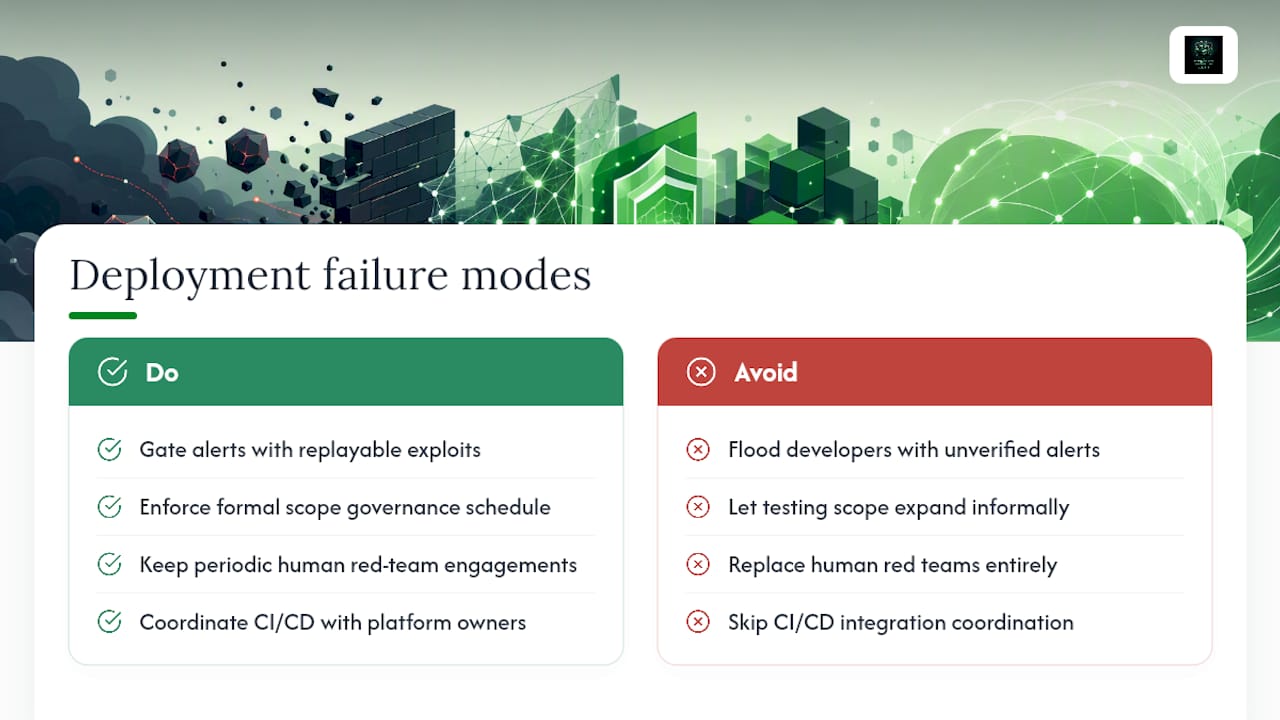
The most common failure mode is alert fatigue disguised as thoroughness. A program that surfaces hundreds of unverified findings a week trains developers to ignore the queue entirely, which defeats the purpose of testing more often in the first place. The fix is strict accuracy gating: nothing reaches a developer without a replayable exploit attached.
Scope creep is the second major pitfall. Teams often start a pilot on one application, then let scope expand informally as testing produces interesting results elsewhere. Unmanaged scope changes risk testing systems nobody approved, which can trigger real operational incidents if payloads hit a fragile legacy system. Formal scope governance, reviewed on a set schedule, keeps this from happening quietly.
A third pitfall is treating continuous testing as a full substitute for human-led red team work. Automation excels at breadth and repetition, catching the same class of injection flaw across a hundred endpoints in a night. It's weaker at the creative, multi-step attack chains a skilled human tester builds by understanding business logic specific to your application. Programs that drop human engagements entirely tend to develop blind spots in exactly the areas automated tools handle worst.
Finally, teams underestimate the CI/CD integration work. Wiring retest triggers into a deployment pipeline touches infrastructure that platform engineering owns, and skipping that coordination produces a testing program that runs on paper but never actually fires against real deployments.
What Does a Successful Rollout Look Like in Practice?
A regulated services company running weekly deployments illustrates the pattern well. Before adopting continuous testing, its security team relied on an annual third-party assessment that consistently found the same class of authentication bypass issues, because new features shipped faster than the annual cycle could catch them.
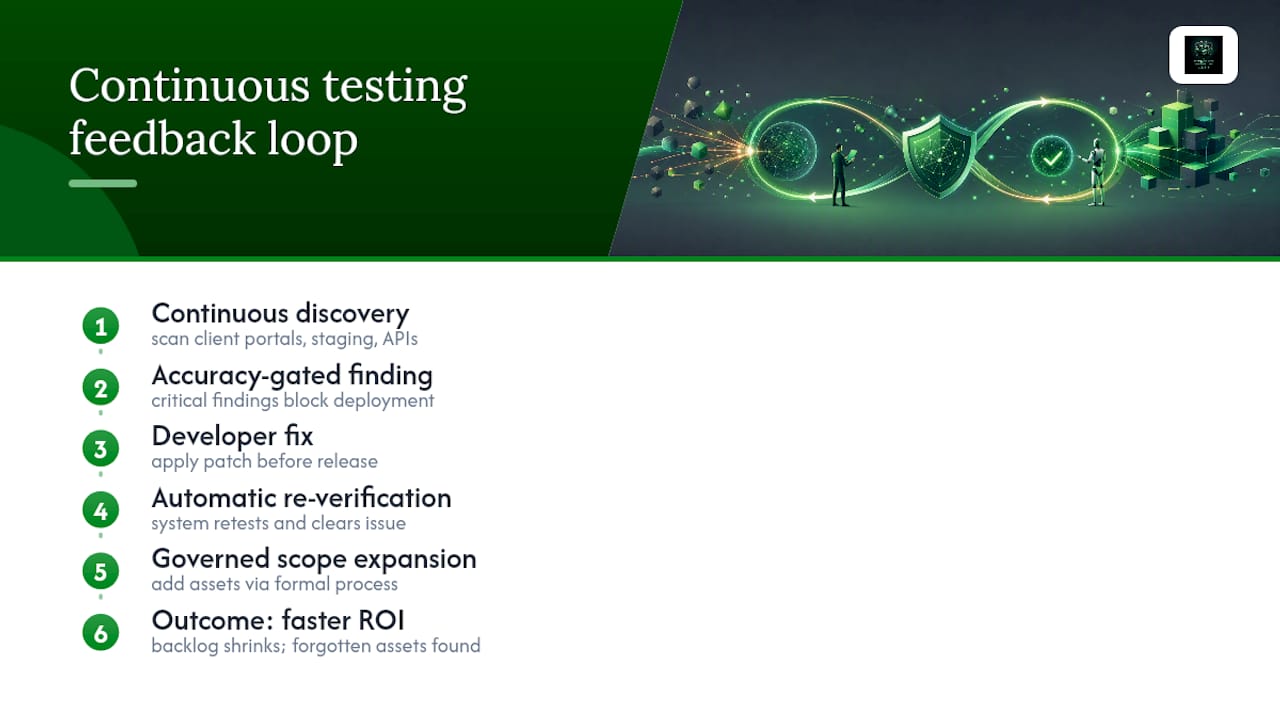
After piloting continuous testing on its client-facing portal, the team set a hard rule: any accuracy-gated critical finding blocked deployment until a developer applied a fix and the system re-verified it automatically. Within the first quarter, the backlog of unverified, scanner-flagged issues shrank because developers finally trusted that flagged items were real exploits, not noise.
A second pattern shows up often in high-change environments like energy operators managing SCADA-adjacent IT systems. Continuous discovery routinely surfaces forgotten staging servers and orphaned API endpoints that predate the current security team, assets that an annual pentest scoped to "production" would never touch. Finding these early, before an adversary does, tends to be where continuous testing earns its budget fastest.
What both patterns share is discipline around the loop itself: no finding without proof, no fix accepted without automatic retest, and scope expansion that follows a deliberate governance process rather than ad hoc requests from whichever team asks loudest.
Is a Managed Approach Better Than Building In-House?
Building continuous testing in-house demands a team that can run exploit tooling, tune accuracy gates, and maintain CI/CD integrations without breaking release pipelines. Most regulated SMBs don't have that bench strength sitting idle. A managed vCISO-plus-SaaS approach trades a chunk of that operational burden for a retainer relationship, with an actual security professional accountable for the program instead of a tool nobody has time to babysit.
The tradeoffs are straightforward: in-house gives full control but demands specialized staff; managed gives faster time to value and defined retest service levels but requires trusting an outside evidence custodian. Whichever path you choose, insist on written retest SLAs, clear evidence retention terms, and a documented incident escalation path before signing anything.
— vCISO
Get Continuous Testing Running Without Building a Team From Scratch
A managed vCISO service can be paired with an AI-enabled SaaS platform to run continuous penetration testing without requiring your team to build and staff an offensive security function from the ground up.
That combination matters because most regulated SMBs can't justify a full-time security engineering hire just to run exploit tooling and tune accuracy gates. Such platforms handle the discovery, exploitation, and verification loop, while a vCISO reviews findings, sets governance policy, and keeps evidence organized for audits like SOC 2, HIPAA, PCI DSS, and CMMC. This approach suits law firms, oil and gas operators, and other compliance-sensitive mid-market companies that need real exploit-verified evidence, not just a scanner report, without hiring a full security team. If your current testing runs once a year and your deployments run every week, talk to CisoSafe about scoping a pilot on one critical application.
Standards and Advisories Worth Bookmarking
- NIST Cybersecurity Framework
- CISA Cybersecurity Advisories
- OWASP Web Security Testing Guide
- Network Penetration Testing for IT Managers
Sources
- Continuous Penetration Testing and the Rise of the Offensive SOC — SANS
- CISA cybersecurity advisories
- NIST Cybersecurity Framework
- OWASP Web Security Testing Guide
FAQ
What Are the Three Main Types of Penetration Testing?
The three main types are black box (no internal knowledge of the system), white box (full access to source code and architecture), and gray box (partial knowledge, simulating an insider or partially informed attacker).
Is Penetration Testing Illegal?
Penetration testing is legal when performed with explicit written authorization from the system owner defining scope, timing, and methods; testing without that authorization can violate computer fraud laws regardless of intent.
What Are the Best Tools for Continuous Penetration Testing?
Effective continuous penetration testing depends less on any single tool and more on a program combining automated discovery, an exploit engine capable of deterministic proof, and an independent verification layer, which is the architecture platforms like CisoSafe are built around.
What Are the 7 Phases of PTES?
The Penetration Testing Execution Standard defines seven phases: pre-engagement interactions, intelligence gathering, threat modeling, vulnerability analysis, exploitation, post-exploitation, and reporting.
How Often Should Continuous Penetration Testing Run?
Continuous testing runs on a trigger, not a fixed interval, firing whenever code deploys or the attack surface changes, rather than on a monthly or quarterly schedule like traditional PTaaS.