

A professional penetration testing report needs six core components: an executive summary, a scope and methodology section, detailed findings with reproducible evidence, risk ratings tied to CVSS, a remediation and retest plan, and supporting appendices. Reports typically split into two layers, an executive narrative for leadership and a technical narrative for engineers, and both should trace back to recognized standards like PTES, NIST SP 800-115, and OWASP. The sections below break down how to build each part and what auditors and security teams actually expect to see.
TL;DR:
- Detailed findings must include reproducible proof-of-concept evidence, clear affected assets, and a business impact statement to ensure actionable insights.
- Scope and methodology should specify tested assets, exclusions, testing windows, prohibited techniques, and references to recognized standards like NIST SP 800-115.
- The report format should be tailored to the audience, with shorter executive briefs for leadership and in-depth technical or compliance reports for engineers and auditors.
- Vulnerability prioritization relies on CVSS scores plus contextual factors such as exposure, blast radius, and asset sensitivity to determine fixing order.
- Sensitive reports require encryption, strict access control, and careful redaction of unrelated or internal details to prevent risks from data exposure.
Table of Contents
- Why Pentest Report Contents Determine Whether a Test Pays Off
- How Do You Write an Executive Summary That Leadership Actually Reads?
- What Scope and Methodology Details Make a Report Defensible?
- Which Report Format Fits Your Audience?
- What Should Each Finding Include for Engineers to Reproduce It?
- How Should You Rate and Prioritize Vulnerabilities?
- How Do You Turn Findings Into Fixed Vulnerabilities?
- What Belongs in the Appendices?
- How a vCISO Turns a Report Into Compliance Progress
- Who Reads a Pentest Report, and How Should It Adapt?
- What Legal and Compliance Factors Affect Report Content?
- How Should Sensitive Findings Be Protected After Delivery?
- What Should You Demand From Every Vendor Report?
- Get Audit-Ready Reports Without Building a Security Team From Scratch
- Where to Verify Methodology and Scoring Standards
- Sources
Why Pentest Report Contents Determine Whether a Test Pays Off
A penetration test is only as valuable as the document it produces. Security teams routinely pay tens of thousands of dollars for an engagement, then receive a report that reads like raw scanner output with a logo pasted on top. That's not a penetration testing report. It's a liability, because auditors will ask questions the document can't answer.
Industry standards like PTES and NIST both frame the deliverable around the same skeleton: an executive summary, scope and methodology, detailed findings with evidence, risk ratings, and remediation recommendations. Every well-built pentest report template follows this structure, whether the target is a law firm's client portal or an oil and gas operator's industrial control network. The details inside each section, not the section names themselves, separate a report that drives action from one that sits in a shared drive untouched until the next audit cycle.
The rest of this guide walks through each section in the order a reader would encounter it, from the summary a managing partner skims in five minutes to the appendix a forensic engineer might reference six months later during a retest.
How Do You Write an Executive Summary That Leadership Actually Reads?
The executive summary is the only part of the report most decision-makers will read in full, so it has to work in one to two pages without a single technical acronym that requires a follow-up call. Write it for a managing partner, a CFO, or a board member who needs to understand risk exposure and next steps in five minutes.
A strong executive summary states the overall security posture in plain language, lists the top three to five findings by business impact rather than technical severity, and confirms whether testers actually compromised critical systems or sensitive data. It should also state the testing window and scope boundaries so the reader understands exactly what was and wasn't evaluated.
Essential fields to include:
- A one-paragraph posture statement (e.g., "The environment showed moderate risk exposure, driven primarily by outdated authentication controls.")
- Finding counts broken down by severity (critical, high, medium, low)
- A clear yes/no on whether testers achieved access to critical assets or exfiltrated sample data
- Recommended immediate actions, limited to the two or three items that matter most
- Testing dates, target environment, and a one-line scope summary
Leave out IP addresses, exploit code, and step-by-step reproduction steps. Those belong in the technical section. A useful phrasing pattern for business impact reads something like: "An attacker with no prior access could have viewed client billing records within four hours of starting the test." That sentence tells a nontechnical reader exactly what was at stake without requiring them to understand the underlying vulnerability class.
Pro Tip: Draft the executive summary last, even though it appears first. Writing it after the findings are finalized keeps the severity counts and top risks accurate instead of guessed.
What Scope and Methodology Details Make a Report Defensible?
Scope and methodology are what make a report defensible months later when an auditor or a skeptical board member asks, "How thorough was this, really?" Vague scope language is one of the fastest ways to lose credibility on an otherwise solid engagement.
The scope section should name exact assets tested: specific domains, IP ranges, application environments, user account types, and cloud tenants. Just as important is naming what was explicitly excluded, whether that's a legacy system frozen from testing or a third-party integration outside the client's control. Ambiguity here creates disputes later.
Rules of engagement round out the section:
- Testing time windows and blackout periods
- Techniques permitted and prohibited (social engineering, physical access, denial-of-service simulation)
- Escalation contacts and the process for pausing testing if something breaks
- Data handling rules agreed on before testing began
Methodology references give the engagement credibility; early-stage companies especially benefit from understanding the role of penetration testing in startups when defining scope and methods. NIST SP 800-115 provides detailed guidance for planning and documenting technical security tests in a repeatable way, and citing it (along with PTES, the OWASP Web Security Testing Guide, and MITRE ATT&CK where adversary emulation applies) shows the tester followed a recognized process rather than improvising. State the balance between manual testing and automated scanning explicitly. A report built entirely on automated output is a different deliverable than one backed by hands-on exploitation.
Which Report Format Fits Your Audience?
Not every engagement needs the same deliverable. Matching format to audience keeps the report usable instead of ignored.
- Executive brief. A short document, often under five pages, for engagements where leadership needs a risk snapshot without the full technical record. Common for recurring internal assessments.
- Full technical report. The standard deliverable for compliance-driven testing. Expect 20 to 60+ pages depending on finding count, with a cover page, version history, table of contents, and appendices handled as separate secured attachments.
- Red-team narrative. Written as a chronological attack story rather than a findings table, showing how an adversary moved from initial access to objective. Useful for engagements testing detection and response, not just vulnerability presence.
Long technical reports need real navigation: a table of contents, consistent finding IDs, and appendix cross-references so an engineer can jump straight to the evidence for a specific issue without scanning fifty pages.
What Should Each Finding Include for Engineers to Reproduce It?
This is where most reports either earn their price tag or fail entirely. A finding without reproducible evidence is an opinion, not a security assessment, and SANS guidance is direct on this point: proof-of-concept evidence and business-impact framing are what separate an actionable report from a scanner dump.
Every finding needs these fields, at minimum:
- A unique finding ID for tracking and cross-referencing across sections
- Title and severity rating (critical, high, medium, low, informational)
- CVSS score with the full vector string, not just the numeric score
- CWE and, where applicable, OWASP category mapping
- Affected assets, listed specifically (hostnames, endpoints, account roles)
- Plain-language description of the vulnerability
- Business impact statement, written the way it would appear in the executive summary but with more technical grounding
- Technical analysis explaining the root cause
- Step-by-step reproduction instructions or a runnable proof-of-concept
- Screenshots, request/response pairs, or log excerpts as evidence
- Remediation recommendation, fix priority, and estimated effort
Real-world sample reports typically organize this into a findings summary table (ID, title, severity, CVSS) followed by a full write-up per finding, and that two-layer format holds up well across industries.
Documenting what didn't work matters almost as much as what did. Recording failed exploitation attempts and the constraints under which testing occurred proves the engagement was thorough rather than lucky. NIST and PTES both treat this as part of a defensible methodology, since a report showing only successes can look cherry-picked, while one showing attempted attacks that failed demonstrates the environment's actual resilience in specific areas.
Sanitize evidence before it leaves your hands. Redact customer PII from screenshots, replace live credentials in PoC code with placeholders, and strip internal IP ranges from anything shared outside a secured channel. A reproducible PoC structure generally includes the exact request sent, the response received, the tool or script used, and the expected versus actual outcome. Evidence quality built this way is what lets an internal engineering team fix an issue without scheduling a call to ask what the tester meant.
How Should You Rate and Prioritize Vulnerabilities?
CVSS gives every finding a common language, but the base score alone tells you almost nothing about what to fix first. CVSS, maintained by FIRST, is the industry baseline, and a report should always document the full vector string used, not just the resulting number, so anyone reviewing the score later can see exactly which factors drove it.
The real prioritization work happens in the contextual layer on top of that baseline score. A critical CVSS score on an isolated test server means something very different from a medium score on a system holding regulated client data. CVSS base scores are a useful starting point, but they need contextualizing with exposure, privilege level, and blast radius to become actionable guidance rather than a static number.
Contextual modifiers worth documenting for each finding:
- Internet exposure versus internal-only access
- Blast radius: how many systems or accounts a successful exploit would touch
- Privilege level required to exploit versus privilege level gained
- Exploit maturity: is there public exploit code, or does it require custom development
- Whether the affected asset touches regulated data (PHI, cardholder data, client trust funds)
How Do You Turn Findings Into Fixed Vulnerabilities?
A finding sitting in a PDF changes nothing. It becomes a security improvement only when someone owns it, fixes it, and someone independent confirms the fix actually worked.
- Assign ownership immediately. Every finding needs a named owner, not a team name. "Infrastructure team" gets ignored; "Maria Chen, Network Engineering" gets a ticket assigned.
- Offer remediation options where they exist. A single finding might have four paths: a vendor patch, a configuration change, a compensating control (like a WAF rule) as a stopgap, or a longer architectural fix. List the trade-offs so the owner can choose based on their change-window constraints.
- Estimate effort honestly. "Low," "medium," and "high" effort labels, paired with a rough time estimate, help teams sequence work realistically instead of tackling findings in severity order regardless of actual complexity.
- Retest independently. The person verifying a fix should not be the person who wrote the original finding description, when staffing allows it. Independent verification catches partial fixes that the original engineer might rubber-stamp.
- Collect retest evidence. A screenshot or log confirming the exploit path no longer works, dated and tied to the original finding ID, gives auditors something concrete instead of a checkbox.
- Label status precisely. Use consistent terms: verified-fixed, risk-accepted (with sign-off from a named executive), partially remediated, or not remediated. Vague labels like "resolved" invite disputes at audit time.
Ticket templates that mirror the finding fields (ID, severity, affected asset, remediation steps) cut translation errors between the report and whatever system engineering uses to track work. A security risk roadmap built from prioritized findings gives leadership a single view of what's fixed, what's in progress, and what's been formally risk-accepted.
Pro Tip: Never let "risk-accepted" become a silent default. Require a named executive signature and a review date, or low-priority findings quietly become permanent gaps that resurface in the next audit.
What Belongs in the Appendices?
Appendices carry the raw material that supports every claim in the body without cluttering the findings themselves. Keep them referenced, not buried.
Typical appendix contents include raw tool output, network diagrams showing tested segments, full request and response logs, any custom scripts used during testing, host and port inventories, a list of CVEs referenced, and command history for reproducibility.
- Reference appendix items by ID directly from each finding (e.g., "See Appendix C, Log 4")
- Note where data was redacted or sanitized and why
- Deliver highly sensitive artifacts, like working exploit code, through a secured channel separate from the main PDF
- Give auditors a quick-reference checklist mapping each finding ID to its supporting evidence location
This structure, paired with security templates built for audit use, keeps a 60-page technical report navigable instead of overwhelming.
How a vCISO Turns a Report Into Compliance Progress
A penetration test report sitting unread in an inbox does not satisfy an auditor, and it does not reduce risk. A vCISO's job is translating that document into board-level language and a tracked remediation plan tied to the frameworks that actually matter—for example, SOC 2, HIPAA, or PCI DSS.
That starts with framing the executive summary around obligations the board already cares about: "This finding creates a gap against SOC 2 CC6.1" lands differently than a bare severity label. Remediation governance follows the same logic: assign an owner, set a retest cadence, and keep a dated audit trail showing when each finding moved from open to verified-fixed.
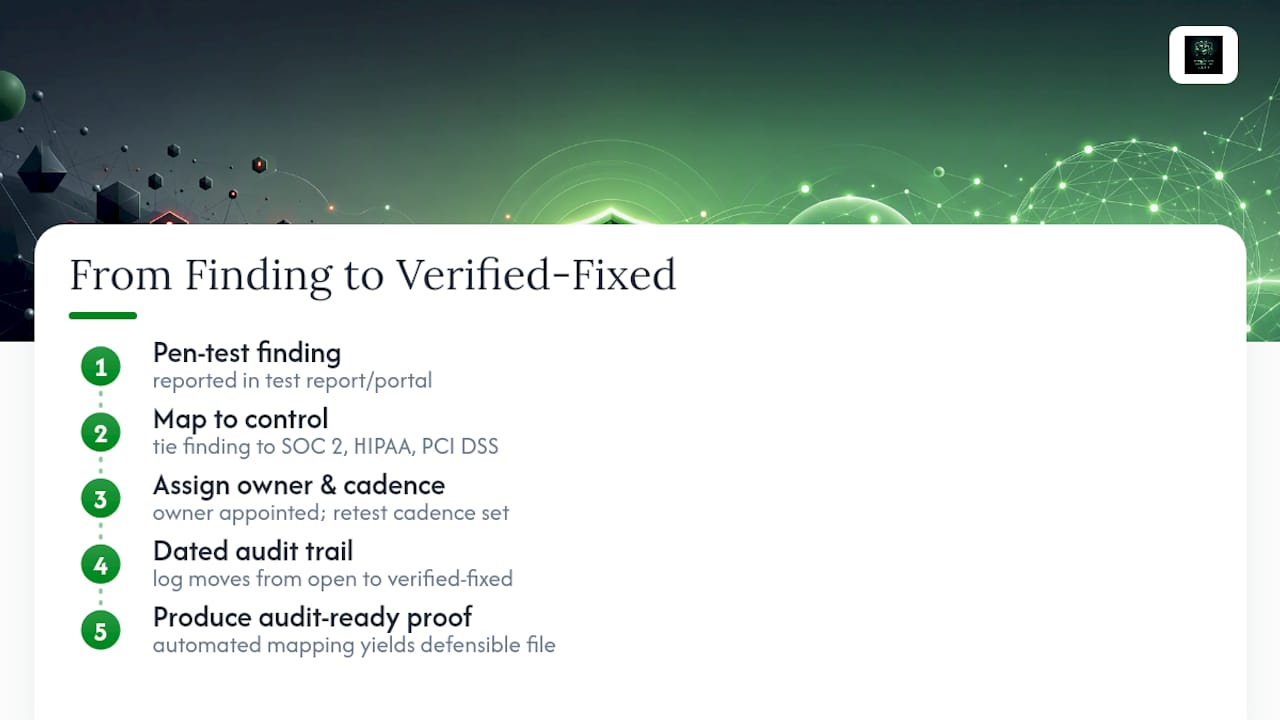
Pairing that advisory work with an automated reporting portal that maps findings directly to compliance controls cuts the manual translation work that normally eats weeks between a test and an audit-ready file. The result organizations see most often is a shorter time-to-remediate and a clean, defensible trail when a regulator or a client's security questionnaire asks for proof.
Who Reads a Pentest Report, and How Should It Adapt?
A single report rarely serves every reader the same way, which is why customization matters more than most teams assume. A managing partner at a law firm needs risk exposure and business impact. A network engineer needs exact reproduction steps and affected hostnames. An auditor needs mapped compliance controls and dated evidence trails.
Rather than writing three separate documents, the strongest approach layers one report so each audience finds what they need without wading through irrelevant detail. The executive summary sits up front for leadership. The findings and technical analysis sit in the body for engineers. Compliance mappings, whether to PCI DSS requirements or SOC 2 trust criteria, sit either inline with each finding or in a dedicated cross-reference table so auditors can locate what they need fast.
Customization also means adjusting depth based on the organization's maturity. A company running its first penetration test needs more explanatory context around terms like CVSS and CWE. A mature security team that's been through a dozen assessments needs the report to move fast, skip the definitions, and get straight to what changed since the last test. Ask the client which stakeholders will actually read the document before drafting begins, since that answer shapes how much translation work the report needs to do on its own.
What Legal and Compliance Factors Affect Report Content?
Penetration test reports carry legal weight that extends well beyond the security team. Written authorization to test, sometimes called a "get out of jail free" letter, needs to exist before testing starts, and its terms should be reflected in the scope section so there's no ambiguity about what was authorized.
Compliance frameworks often dictate report content directly. PCI DSS requires evidence that testing covered the cardholder data environment and that findings were remediated before the next assessment cycle. HIPAA-covered entities need documentation showing testing addressed systems touching protected health information. Reports built without these mappings in mind often require a costly rewrite when audit season arrives.
Data handling during the engagement itself carries legal exposure too. If testers accessed real customer records during exploitation, the report and its appendices need clear documentation of what was accessed, how it was handled, and how it was purged after the engagement closed. This protects the testing firm and the client if a regulator ever asks what happened to sensitive data during the assessment.
Contract language matters as much as report content. Nondisclosure terms, data retention limits for the report itself, and liability language should be settled before the engagement starts, not negotiated after a critical finding surfaces. A report that ignores this groundwork can become a liability instead of an asset the moment a regulator or client's legal team requests it.
How Should Sensitive Findings Be Protected After Delivery?
A penetration test report is one of the most sensitive documents an organization holds. It's a literal map of where the organization is weakest, and it needs handling that matches that risk.
Encrypt the report at rest and in transit, and limit distribution to a named list rather than a shared drive open to the broader company. Many firms deliver the main narrative as a password-protected PDF and route highly sensitive artifacts, like working exploit code or credential dumps captured during testing, through a separate secured channel entirely.
Retention policy deserves explicit attention. Decide upfront how long the report and its supporting logs stay accessible, and to whom, since a report from three testing cycles ago sitting in an unmonitored archive is itself a risk if it details unpatched issues. Some organizations set automatic expiration or require re-authorization to access reports older than a defined window.
Internally, treat the report the way you'd treat legal privilege material: need-to-know access, logged views where possible, and a clear policy on whether contractors or third-party auditors get full access or a redacted version. If the report will be shared with a client, insurer, or auditor outside the organization, redact anything that isn't relevant to their specific need, such as unrelated internal findings or details about other business units. The goal is giving each recipient exactly what they need to act, and nothing that expands the blast radius if their copy is ever compromised.
What Should You Demand From Every Vendor Report?
After reviewing enough reports, patterns emerge fast. The good ones share a checklist: reproducible proof-of-concept for every finding, a business impact statement in plain language, a named remediation owner, retest evidence with dates, and appendices sanitized before delivery.
The anti-patterns are just as consistent. Watch for raw scanner dumps presented as findings, severity ratings with no CVSS vector or justification behind them, and remediation sections that say "patch the vulnerability" without naming who's responsible or by when. A report missing any of these is a report that will generate follow-up meetings instead of fixed issues.
One line to demand from every vendor, for every finding: "Show me the exact steps to reproduce this, who owns fixing it, and how we'll verify it's actually gone." If a report can't answer that for a single finding, it's not a security assessment. It's a summary of a scan.
— vCISO
Get Audit-Ready Reports Without Building a Security Team From Scratch
Most organizations don't have a full-time CISO to translate technical findings into board language, chase remediation owners, or map results against SOC 2 and HIPAA controls between testing cycles. That gap is exactly where CisoSafe fits: a vCISO team paired with an AI-enabled reporting portal that produces the executive summary, findings detail, and compliance mapping in one workflow, instead of leaving your team to reverse-engineer a vendor's PDF into something an auditor accepts.
CisoSafe's platform generates prioritized remediation roadmaps directly from findings, tracks retest verification with dated evidence, and keeps an audit trail ready for SOC 2, PCI DSS, or HIPAA reviews without your internal team building that structure by hand. Templates and reporting formats are built around the same standards covered here, PTES, NIST, and CVSS, so what you receive is already structured for compliance use rather than requiring a rewrite before audit season. If your last pentest report left your team with more questions than answers, visit the CisoSafe vCISO and compliance platform to see how a managed reporting engagement compares to what you're working with now.
Where to Verify Methodology and Scoring Standards
The standards referenced throughout this guide are publicly available and worth bookmarking directly. The Penetration Testing Execution Standard lays out the full engagement lifecycle auditors expect to see reflected in scope and methodology sections. NIST SP 800-115 remains the go-to reference for planning defensible, repeatable technical tests.
For scoring, FIRST's CVSS documentation explains exactly how vector strings are built, which matters when a report cites a score without showing its work. OWASP provides the classification system most web-application findings map to, and SANS whitepapers on report writing remain a solid check against scanner-dump reports masquerading as real assessments. Auditors across most compliance frameworks recognize all five as credible references.
Sources
- Penetration Testing Execution Standard
- NIST Special Publication 800-115
- FIRST — CVSS
- OWASP
- Writing a Penetration Testing Report (SANS)