

AI compliance automation uses machine learning models to continuously scan regulatory sources, extract specific obligations, map them to existing controls, and collect audit-ready evidence without manual tracking. The core benefit is scale and speed: work that once took a compliance team weeks now runs continuously in the background. It only works, however, when human experts review the automation's output and can trace every decision back to its source regulation.
TL;DR:
- Human oversight remains crucial, as automation outputs must be reviewed and traced back to specific regulatory sources to ensure compliance validity.
- Automation significantly reduces audit preparation time by continuously collecting and tracking evidence, especially in frameworks like SOC 2, HIPAA, and PCI DSS.
- Cross-framework mapping minimizes redundant control testing by identifying overlapping obligations across standards such as SOC 2, HIPAA, PCI DSS, and the EU AI Act.
- Effective implementation demands thorough system inventories, defined scope, integration planning, and established human approval gates before scaling automation efforts.
- Compliance platforms must provide clear explanation of flagged issues, support standard export formats, and enable role-based access to ensure operational security and audit readiness.
Table of Contents
- What AI Compliance Automation Actually Does
- Where AI Compliance Automation Pays Off Fastest
- How to Roll Out AI Compliance Automation Without Losing Control
- What to Look for When Evaluating a Compliance Automation Platform
- How a vCISO and AI Portal Turn This Roadmap Into Practice
- The Regulatory Signals Compliance Leaders Should Watch
- Get a Practical Path to Continuous Compliance
- Sources
What AI Compliance Automation Actually Does
Most compliance teams still confuse "automation" with a smarter spreadsheet. Real AI compliance automation is a different animal. It performs six distinct jobs, and understanding each one helps you separate genuine capability from marketing language.
Horizon scanning and continuous ingestion. AI models monitor regulatory bodies, agency bulletins, and standards updates around the clock, flagging changes relevant to your industry the day they publish rather than the quarter you happen to review them. For a law firm or an energy operator juggling multiple state and federal regimes, this closes a gap that used to depend on someone remembering to check a website.
Obligation extraction. This is where generative AI in compliance earns its keep. Instead of a 40-page rule sitting in a PDF, natural language processing pulls out discrete, assignable obligations, tags them by owner, and routes them into a tracking workflow. Naaia's compliance engine demonstrates this pattern well: regulatory text becomes an executable action item rather than a document someone has to reread every audit cycle.

Cross-framework mapping. A single control, like multifactor authentication, often satisfies requirements across SOC 2, HIPAA, and PCI DSS simultaneously. AI models trained on control taxonomies identify that overlap automatically, so a team stops re-proving the same control five different ways for five different auditors. NIST's Cybersecurity Framework profiles exist precisely to support this kind of alignment, giving organizations a standard reference point for mapping controls across frameworks including the emerging EU AI Act.
Continuous monitoring and evidence collection. Rather than a point-in-time audit snapshot, automated systems pull logs, configuration states, and access records on a rolling basis, then package them with a clear lineage back to the source control. That lineage matters more than people realize: an auditor doesn't just want to know a control exists, they want to trace exactly when it was tested and what evidence proves it held.
Integrations and APIs. Compliance automation tools only add value when they connect to where the work actually happens: ticketing systems, HR platforms for onboarding and offboarding, procurement software for vendor intake, and observability platforms for security logs. A tool that can't pull from your existing stack just creates a second system of record nobody trusts.
Human-in-the-loop governance. Every credible platform sets confidence thresholds. High-confidence classifications move forward automatically; anything below the threshold routes to a human reviewer before it touches a control or an audit file.
- Horizon scanning flags regulatory changes as they publish, not on a quarterly review cycle
- Obligation extraction converts dense regulatory text into assignable, trackable tasks
- Cross-framework mapping reduces duplicate control testing across SOC 2, HIPAA, PCI DSS, and similar standards
- Continuous evidence collection replaces static audit snapshots with rolling, lineage-tracked records
- API integrations connect compliance data to HR, procurement, ticketing, and observability tools
- Confidence thresholds route uncertain classifications to human reviewers before action
Pro Tip: Ask any vendor to show you the exact source citation behind a generated obligation, not just the summary. If the platform can't point to the specific regulatory clause it pulled from, treat that gap as a governance risk, not a minor UX flaw.
Where AI Compliance Automation Pays Off Fastest
The return on AI for compliance shows up unevenly. Some functions see dramatic time savings; others need more caution before you lean on automated output.
- Vendor and third-party due diligence. Automated intake forms paired with AI classification can screen a new vendor against your risk criteria in hours instead of the multi-week cycle a manual questionnaire review usually takes.
- Continuous SOC 2, HIPAA, and PCI DSS evidence collection. Instead of scrambling before an annual audit, automated systems capture control evidence on a rolling basis, so the audit becomes a review of existing records rather than a fire drill.
- AI model inventory and risk classification. As organizations deploy their own machine learning tools, they now need to inventory those systems and classify them against emerging obligations like the EU AI Act's Fundamental Rights Impact Assessment requirements. Platforms like ComplyLayer show how this kind of inventory and documentation work can happen quickly rather than through a manual spreadsheet exercise.
- Automated policy acknowledgment tracking. Confirming that every employee has read and signed off on a security policy update sounds trivial until you're chasing 400 signatures manually. Automation handles the distribution, reminders, and audit trail without a compliance officer touching it.
Industry fit varies. Law firms carry heavy confidentiality and ethics obligations layered on top of standard security frameworks, which makes automated obligation tracking particularly valuable, an angle covered in more depth in guidance on cybersecurity compliance for legal teams. Energy and oil and gas operators face a patchwork of federal and state critical infrastructure rules where cross-framework mapping saves real audit hours, a dynamic explored further in energy sector compliance frameworks. Healthcare organizations benefit from continuous HIPAA evidence capture given how often protected health information touches new systems. Financial services firms gain the most from cross-mapping since they often answer to multiple overlapping regulators at once.
The realistic limits matter too. Automation only works as well as the data access you grant it, model confidence still varies by regulation complexity, and jurisdictional variance means a single automated ruleset rarely covers every state or country cleanly.
How to Roll Out AI Compliance Automation Without Losing Control
A rushed automation rollout creates more risk than it removes. Following a deliberate sequence keeps the project defensible from day one.
- Inventory your systems, data sources, and existing obligations. Before you automate anything, know what you're automating. Catalog every system that touches regulated data, every existing framework you're already tracking against, and, if relevant, every AI model already in production that needs its own governance entry.
- Define a minimal viable automation scope. Pick one framework and one function, continuous SOC 2 evidence collection is a common starting point, rather than trying to automate every framework at once. Set clear success metrics: hours saved per audit cycle, percentage of controls with automated evidence, or reduction in manual policy chase-downs.
- Map your integration and data requirements. List the logs, APIs, CMDB entries, HR feeds, and procurement systems the automation needs to reach. A pilot that can't access real data just produces a demo, not a working program.
- Design human oversight and approval gates before you design the automation itself. Decide who reviews low-confidence classifications, who signs off before evidence gets submitted to an auditor, and how every automated decision gets logged for later review.
- Validate with confidence thresholds and error handling. Run the pilot against known-good historical audit cycles first. Compare the automated output to what a human reviewer would have produced, and set a retraining or recalibration cadence rather than assuming the model stays accurate indefinitely.
- Scale with cross-framework mapping and role-based access. Once the pilot proves out, extend the mapping to additional frameworks, using a structure like NIST's Risk Management Framework as the backbone, and restrict access so only the right roles can approve or override automated findings.
Pro Tip: Build your audit trail using a structured format from the start. OSCAL, the machine-readable standard developed by NIST, lets you represent controls and assessment data in a way that survives a vendor switch, an auditor request, or a system migration without manual rebuild.
What to Look for When Evaluating a Compliance Automation Platform
Not every platform billed as AI-driven compliance automation deserves that title. Run any candidate, whether an external vendor or an internal build, through this checklist before committing budget.
- Technical fit: Does it offer real APIs, exportable evidence in a standard format, and reproducible results you can hand to an outside auditor without translation?
- Governance depth: Can it explain why it flagged a control as compliant or noncompliant, and does every automated action log to a versioned audit trail a human can review later?
- Framework coverage: Does it map cleanly across the frameworks you actually answer to, rather than covering one framework well and treating the rest as an afterthought?
- Operational fit: How long does deployment realistically take, and does the vendor provide implementation support or leave you to configure it alone?
- Security posture: What data does the platform need access to, how is it stored, and what does the vendor's own security and privacy practice look like?
- Red flags: Be wary of any platform that can't show its reasoning, that treats every classification as equally confident, or that has no clear process for a human to override an automated decision.
Automated compliance solutions research from Gartner points to a widening gap between vendors with mature evidence pipelines and those still selling dashboards without real automation underneath. A detailed comparison of alternative platforms is worth reviewing before you commit to any single vendor's roadmap.
How a vCISO and AI Portal Turn This Roadmap Into Practice
A phased rollout works better with a guide who has run it before. Automation adoption often proceeds in three stages: an initial assessment that inventories systems and existing controls, a scoped pilot targeting one framework and one high-value use case, and a scale phase that extends cross-framework mapping once the pilot proves reliable.
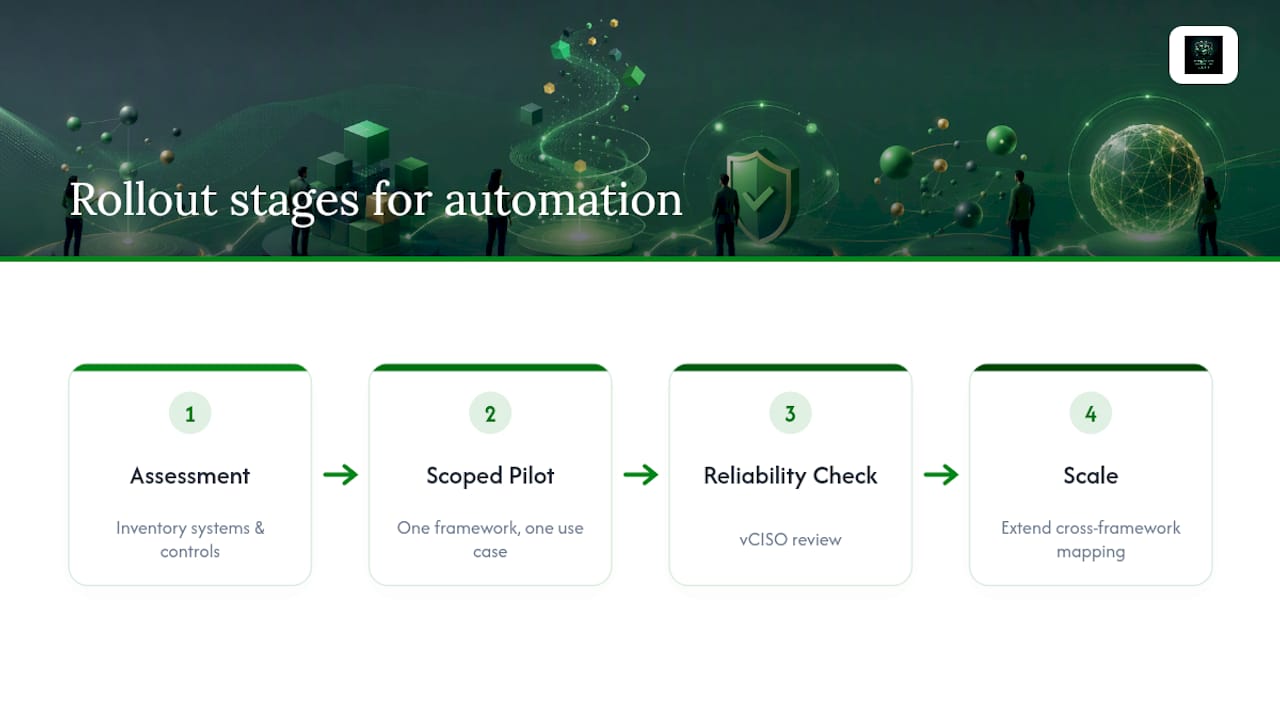
A multi-tenant SaaS portal behind that process can automate penetration testing, compliance intake, and professional reporting using AI models, while security professionals review the output before it reaches leadership or an auditor. That combination matters because a platform alone can flag a gap, but it takes a security professional to weigh what that gap actually means for your risk posture. Evidence packaging follows the same discipline covered in audit-ready information security compliance: every control ties back to a documented source, not a generic checklist item.
The build versus buy decision usually comes down to governance capacity. A team with the bandwidth to own model oversight, retraining cadence, and audit trail design internally might build. Most regulated SMBs and mid-market firms lack that bandwidth, which is exactly why pairing automation software with ongoing vCISO oversight tends to close the gap between what a platform generates and what a leadership team can actually defend to a regulator.
The Regulatory Signals Compliance Leaders Should Watch
NIST's continued expansion of its cybersecurity and AI risk frameworks is setting the baseline for what regulators and auditors will expect from AI governance going forward. Organizations that can't show a versioned, traceable evidence trail will struggle to defend their compliance posture as enforcement scrutiny grows, particularly as the EU AI Act's obligations phase in and start touching US companies with European operations or customers.
The practical takeaway is straightforward: traceable evidence and active human oversight aren't optional extras layered onto automation, they're what makes automation defensible in the first place. Thomson Reuters has noted that irresponsible AI use in compliance work can backfire, undermining the very trust automation is supposed to build. Leaders should audit their own evidence lineage now, before a regulator asks to see it.
— vCISO
Get a Practical Path to Continuous Compliance
Some service providers combine vCISO expertise with an AI-enabled SaaS portal to deliver automated penetration testing, compliance intake, and audit-ready reporting alongside security professional review before results reach leadership or auditors.
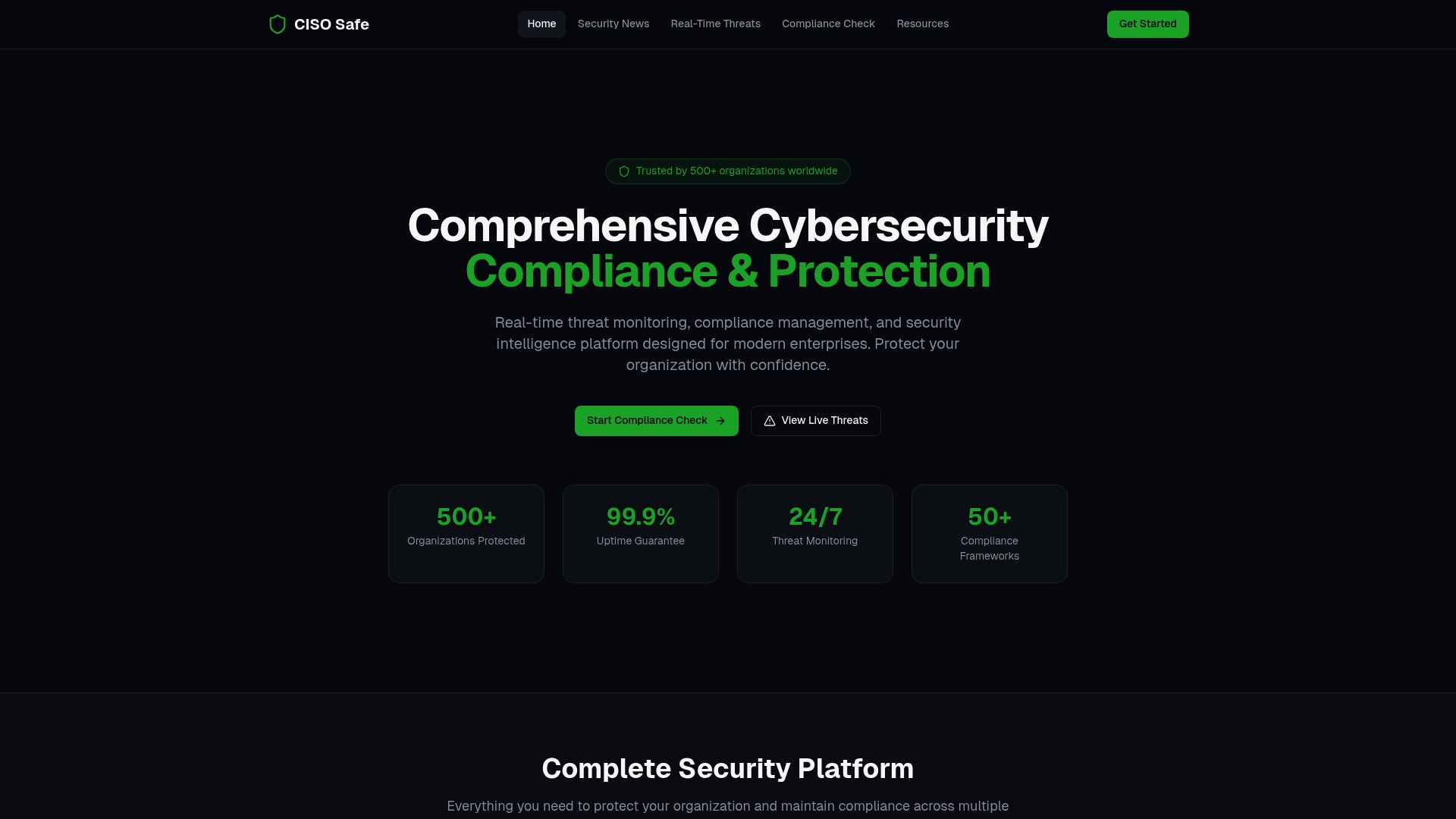
A typical engagement starts with a security assessment and risk roadmap, moves into a scoped pilot targeting a chosen priority framework such as SOC 2, HIPAA, PCI DSS, or CMMC, and scales from there once the results hold up under review. For organizations weighing internal governance builds against outside support, a 90-day playbook for AI agent governance offers a useful comparison point for how much oversight structure a serious rollout actually requires. This approach aims to give regulated firms enterprise-grade security expertise without the cost of a full-time CISO or a large consultancy. If you want to see what a scoped pilot looks like for your organization, schedule a compliance assessment and get a clear roadmap before you commit further budget.
Sources
Verify any automation claim against primary standards rather than vendor marketing. NIST's Cybersecurity Framework profiles give you the reference structure for cross-framework mapping. OSCAL defines the machine-readable format serious platforms use for evidence exchange. The Cloud Security Alliance's analysis explains the broader industry shift toward continuous, proactive compliance. For governance patterns specific to AI systems, Tekkr's guidance on AI governance strategies is worth a close read, and a practical compliance checklist for cybersecurity SaaS helps translate standards into procurement questions.
- NIST Cybersecurity Framework profiles
- OSCAL — NIST
- AI for compliance and due diligence — Thomson Reuters