

A vendor security questionnaire is a standardized set of controls questions used to evaluate a supplier's data protection posture before or during a business relationship. The recommended approach is to start from a proven framework like SIG or CAIQ, tier vendors by risk, maintain a version-controlled answer library, require documented evidence at higher tiers, and automate the repetitive steps. Done right, this produces defensible, repeatable decisions and cuts questionnaire cycle time from multiple days down to only a few hours.
TL;DR:
- Using a risk-tiered approach to questionnaires reduces response time and effort by customizing controls based on data sensitivity levels.
- Most organizations should start with established frameworks like SIG or CAIQ and adapt them, considering licensing and internal policy guidelines.
- Automating response collection and evidence verification with a central portal and AI tools can cut processing time from hours to just a few.
- Evidence requirements should scale with vendor risk tier, prioritizing artifacts like SOC 2 reports and penetration test summaries for higher tiers.
- Human review remains critical for high-risk vendors to verify answers and evidence, preventing reliance solely on automated assessments.
Table of Contents
- What Are Vendor Security Questionnaires (And When Do You Send One)?
- Which Framework Should You Use: SIG, CAIQ, or VSA?
- How Do You Design a Risk-Tiered Questionnaire?
- How Should You Manage Vendor Responses and Evidence?
- What Questions Belong in a Security Questionnaire?
- How Do You Evaluate Responses and Spot Red Flags?
- What Timelines and Costs Should You Expect?
- What Do Practitioners Get Wrong About Vendor Questionnaires?
- How CisoSafe Helps You Run a Defensible Vendor Questionnaire Program
- Where To Find the Official Templates and Question Banks
- Sources
- FAQ
What Are Vendor Security Questionnaires (And When Do You Send One)?
Vendor security questionnaires go by several names depending on who's asking and why. A due diligence questionnaire (DDQ) usually appears during procurement or M&A. A request for information (RFI) can precede a formal security review. "Security questionnaire," "compliance questionnaire," and "third-party risk assessment" all describe close variations of the same instrument: a structured document that asks a vendor to disclose controls around encryption, access management, incident response, and data handling.
You need one at several points in the vendor lifecycle, not just once at signing:
- Onboarding, before any contract or data-sharing agreement is finalized.
- Annual or biennial renewal, timed to match contract cycles.
- Material change events, such as an acquisition, a new subprocessor, or a reported breach.
- Continuous monitoring triggers, like a failed vulnerability scan or a new CVE affecting the vendor's stack.
The workflow itself is simple in outline: identify the vendor's risk tier, send the matching question set, collect responses and evidence, verify what matters, and log the decision. The complexity lives in getting each of those steps right.
Which Framework Should You Use: SIG, CAIQ, or VSA?
Most security teams don't write a questionnaire from scratch. They start from an established framework and adapt it, which saves time and gives vendors a familiar format they've likely answered before.
- Shared Assessments' SIG is the most widely licensed standardized questionnaire. SIG Lite contains a substantial number of risk-control questions suited to lower-risk vendors, while SIG Core expands into deeper control detail for higher-tier suppliers handling sensitive data.
- CSA's CAIQ (Consensus Assessments Initiative Questionnaire) targets cloud service providers specifically, mapping to the Cloud Security Alliance's Cloud Controls Matrix. The CSA's own guidance highlights categories like certifications, encryption, incident response, and vulnerability management as non-negotiable inclusions.
- Vendor Security Alliance (VSA) publishes VSA-Full and a condensed VSA-Core, and offers audited completion services that some vendors use to produce a pre-verified response set.
Licensing matters here. SIG's official workbook is a paid, licensed product, and organizations running high volumes of vendor reviews need to budget for it or build a curated internal template that borrows its structure without violating licensing terms. A compact core set, whether SIG Lite or VSA-Core, covers most procurement needs without the overhead of a full assessment.
How Do You Design a Risk-Tiered Questionnaire?
Sending the same 300-question SIG Core to every vendor, from your payroll processor to the company that refills your office coffee, wastes everyone's time. Tiering fixes that.
- Define tiers by data sensitivity and access level. A common structure: Low (no data access, no network connection), Medium (limited data, no PII), High (PII or regulated data), Critical (access to core systems or bulk sensitive data).
- Gate the question set to the tier. Low tier might need a 15-question attestation. High and Critical tiers warrant full SIG Core or CAIQ coverage plus evidence requests.
- Require the same core control domains at every tier, scaled by depth: encryption (in transit and at rest), access control and authentication, incident response planning, vulnerability management cadence, subprocessor and fourth-party management, data retention and deletion, and privacy program maturity.
- Decide evidence versus attestation per tier. Low and Medium tiers can often rely on self-attestation. High and Critical tiers should require actual artifacts: SOC 2 reports, penetration test summaries, vulnerability scan exports.
Pro Tip: Build your tiering rules into a one-page policy before you send a single questionnaire. Ad hoc tiering decisions made vendor-by-vendor create inconsistency that auditors flag immediately.
How Should You Manage Vendor Responses and Evidence?
Spreadsheets and email threads collapse under volume. Once you're running more than a handful of vendors reviews a quarter, a centralized portal that tracks status, stores documents, and timestamps every submission becomes necessary rather than optional.
An evidence-first approach means you request artifacts alongside answers, not after a follow-up email:
- SOC 2 Type II reports (not older than 12 months)
- Penetration test summaries from the last 12 months
- Vulnerability scan exports or remediation logs
- Signed policies for incident response and access control
Automation earns its place in the routine steps: auto-filling repeated answers from a version-controlled library, matching submitted evidence against required document types, and using AI-assisted tools to flag inconsistencies between a vendor's answers and their attached evidence. Setting up an answer library and automation has been reported to cut response time from roughly 16 hours per questionnaire down to 2 to 3 hours once the system is in place.
Human review still belongs at the top of the stack. Industry analysis on third-party risk management consistently recommends pairing automated prefill with manual verification for high-risk vendors rather than letting software make the final call. Escalate to a human analyst, or an outside auditor, whenever a Critical-tier vendor's evidence is ambiguous or missing.
What Questions Belong in a Security Questionnaire?
A well-built answer library covers the same 15 to 20 questions across nearly every vendor review, adapted by tier. Here's a practical starting set with model answer postures:
- Do you hold SOC 2, ISO 27001, or equivalent certification? A growth-stage vendor might answer, "SOC 2 Type I completed, Type II audit in progress with expected completion Q3." An enterprise vendor states current certifications with report dates directly.
- Is data encrypted at rest and in transit? Specify the standard (AES-256, TLS 1.2 or higher) rather than a bare "yes."
- What is your patch and vulnerability scan cadence? State the actual interval (weekly, monthly) and the tool used.
- Do you have a documented, tested incident response plan? Note the last tabletop exercise date if you have one.
- How do you vet subprocessors? Describe the contractual and technical review step, not just "we have a policy."
- What is your data retention and deletion policy? State retention periods by data type.
The honesty principle matters more than polish here. Guidance from the plainanswer answer bank is direct: if a control isn't fully implemented, say so and attach a remediation timeline rather than overclaiming. Reviewers spot inflated answers fast, and it costs more trust than an honest gap ever would. Map each model answer to its SIG or CAIQ control ID so your library stays portable across questionnaire formats.
How Do You Evaluate Responses and Spot Red Flags?
Acceptance criteria should be written down before responses arrive, not decided case by case. Evidence needs a recency window: SOC 2 reports and penetration test summaries older than 12 to 18 months should trigger a request for updated documentation, not automatic approval.
- A vendor claiming certification without providing the actual report or certificate number.
- Vague answers to specific questions (asked for encryption standard, received "we use encryption").
- No named owner for incident response or security policy.
- Evidence that contradicts the questionnaire answers, such as a scan report showing unpatched critical vulnerabilities the vendor described as "fully remediated."
Escalation should follow a small set of defined outcomes: accept as submitted, accept with a documented remediation plan and firm deadline, require a follow-up audit or updated evidence, or refuse the engagement. Writing these thresholds into policy, rather than leaving them to individual reviewer judgment, is what makes the program defensible when a regulator or SOC 2 auditor asks how a vendor decision was reached.
What Timelines and Costs Should You Expect?
Low-tier vendor reviews typically close in 1 to 3 business days when using a self-attestation form. High and Critical-tier reviews requiring evidence collection and verification commonly run 2 to 4 weeks, longer if the vendor needs time to produce a current pen test report.
- Bottlenecks usually appear at evidence collection, not at the questionnaire itself. Vendors stall when asked for artifacts they don't have ready.
- Annual reviews move faster than initial onboarding once an answer library exists on both sides of the relationship.
- The cost trade-off is straightforward: additional headcount scales linearly with vendor volume, while automation plus documented process scales far better but requires upfront investment in template design and a defined risk assessment methodology.
What Do Practitioners Get Wrong About Vendor Questionnaires?
Most security teams treat the questionnaire as the deliverable. It isn't. The real value shows up during evidence verification, when someone actually checks whether the answers match reality. Internal reviews consistently uncover undocumented accounts or configuration drift that never would have surfaced from a clean-looking questionnaire alone. If your process stops at "the vendor answered yes," you've built a paperwork exercise, not a risk control.
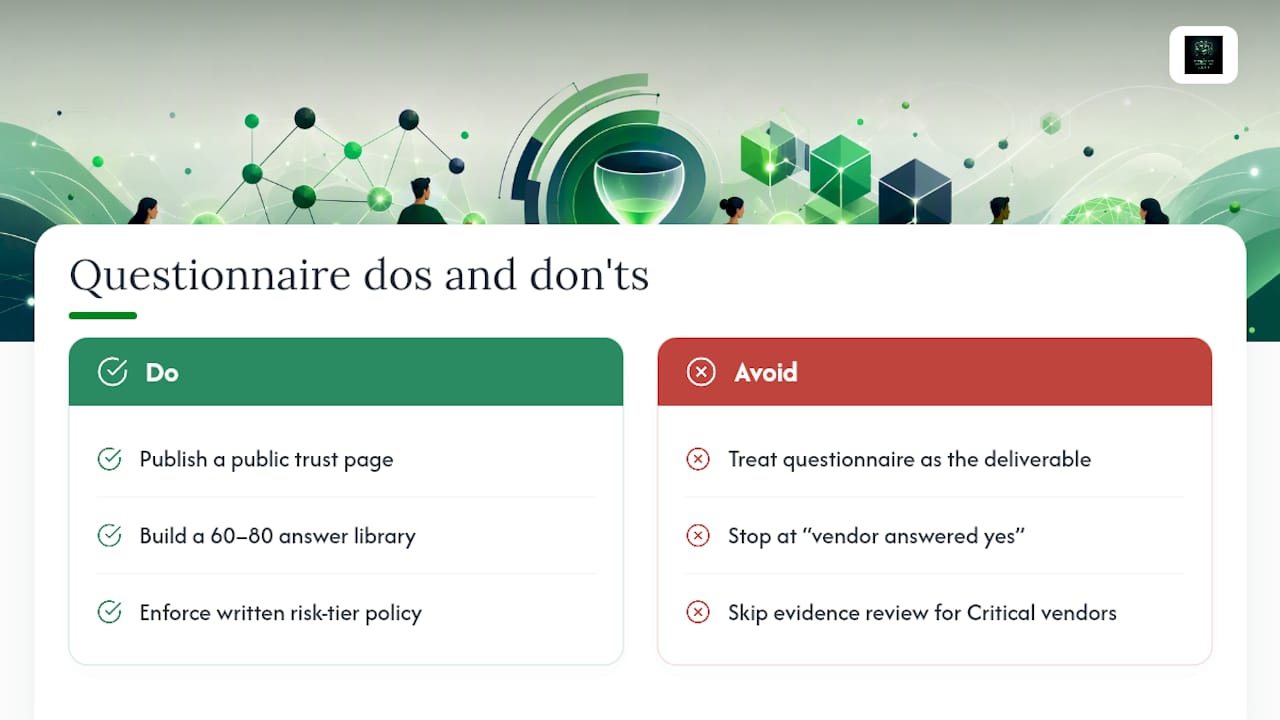
Regulated organizations, law firms and energy operators especially, can't afford that gap. A vendor risk checklist built for legal industry requirements works because it forces evidence review at the tier where it matters most.
Three quick wins raise program maturity fast: publish a public trust page summarizing your own security posture (it cuts inbound questionnaire volume from your own customers), assemble a 60 to 80 answer library covering your most common questions, and enforce a written risk-tier gating policy so nobody skips evidence review on a Critical vendor because a deadline is tight.
— vCISO
How CisoSafe Helps You Run a Defensible Vendor Questionnaire Program
Building and maintaining all of this in-house, the framework selection, the tiering policy, the answer library, the evidence verification, takes real bandwidth that most mid-market security teams don't have spare. CisoSafe is built for exactly that gap: a vCISO-led program combined with an AI-enabled platform that automates compliance intake and evidence matching so your team spends time on judgment calls, not paperwork.
If you're a law firm, energy operator, or regulated mid-market company running vendor reviews without a dedicated security leader, this is where a fractional model pays off. CisoSafe's vCISO and compliance program management services bring the same risk-tiering and evidence standards outlined above, backed by policy development and audit readiness support so your board sees clear, consistent reporting instead of an inbox full of unreviewed PDFs. Visit CisoSafe to talk through where your current vendor review process has gaps and what a scoped engagement would look like for your team.
Where To Find the Official Templates and Question Banks
Start with the primary sources rather than a third-party summary when you're building your baseline template.
- Shared Assessments' SIG page for the official licensed SIG workbook and Core/Lite comparison.
- Cloud Security Alliance for CAIQ downloads and cloud control guidance.
- Vendor Security Alliance for VSA-Full and VSA-Core questionnaires.
- The plainanswer security questionnaire answer bank for a public, community-maintained model answer repository.
Sources
- 10 Important Questions to Add to Your Security Questionnaire — Cloud Security Alliance
- plainanswer/security-questionnaire-answers — GitHub
- Free security questionnaire response template (Excel + Word) | FillBase
FAQ
What's the difference between a DDQ and a security questionnaire?
A due diligence questionnaire (DDQ) is a broader term often used in procurement or M&A, while "security questionnaire" typically refers specifically to controls-focused assessments like SIG or CAIQ. In practice, the terms overlap heavily and many organizations use them interchangeably.
Is SIG or CAIQ better for evaluating a SaaS vendor?
CAIQ is purpose-built for cloud service providers and maps directly to the Cloud Controls Matrix, making it the faster fit for SaaS vendors. SIG offers broader coverage and works better when you need a single framework across cloud and non-cloud suppliers alike.
How often should we send a vendor security questionnaire?
Send one at onboarding, then again annually or biennially at renewal, plus any time a material change occurs, such as a new subprocessor, an acquisition, or a reported breach.
Do we need to buy the official SIG workbook?
Only if you need Shared Assessments' full licensed content and support; many organizations build curated internal templates inspired by SIG's structure for lower-tier vendors and reserve the paid workbook for Critical-tier reviews.
Can CisoSafe help us build a vendor questionnaire program?
Yes. Some vCISO and compliance program management services help regulated organizations design risk-tiered questionnaires, build answer libraries, and automate evidence collection through AI-enabled platforms.