

SOC 2 Type 1 verifies that your controls are designed correctly as of a single date. SOC 2 Type 2 verifies that those same controls actually operated effectively over a period of months. Startups closing early deals often lean on Type 1 as a bridge, but enterprise and regulated buyers generally require Type 2 before they'll sign.
TL;DR:
- SOC 2 Type 1 verifies control design at a specific date, usually completed within 3 to 5 months, but does not assess operational effectiveness.
- SOC 2 Type 2 extends testing over a 3 to 12 month period, evaluating both control design and operating effectiveness with evidence like logs, tickets, and review records.
- Startups typically opt for Type 1 to quickly progress, while regulated industries and enterprise buyers prefer Type 2 to ensure controls work over time.
- Achieving a Type 2 report involves significant ongoing evidence collection and internal effort, often requiring 9 to 18 months and automated support tools.
- Ask vendors which SOC 2 report they have and for what period, since "SOC 2 certified" claims are often vague without specifying the report type and scope.
Table of Contents
- What Is a SOC 2 Type 1 Report?
- What Is a SOC 2 Type 2 Report?
- Type 1 vs Type 2: What Actually Changes for Your Business
- How Do You Decide Between Type 1 and Type 2?
- What Do Timelines and Costs Actually Look Like?
- What Will Auditors Actually Look For?
- What Should You Do Right Now to Get Audit Ready?
- How Does CisoSafe Approach the Type 1 to Type 2 Path?
- How CisoSafe Shortens Your Path to SOC 2 Type 2
- Where to Read More on SOC 2 Standards
- Sources
What Is a SOC 2 Type 1 Report?
A SOC 2 Type 1 report answers one narrow question: are your security controls designed properly, as of a specific date? The AICPA's Trust Services Criteria define what "properly designed" means across categories like security, availability, and confidentiality, and a licensed CPA firm issues the actual opinion. Nobody at the AICPA hands out a certificate. It's an attestation, backed by an auditor's professional judgment.
The report itself contains three core pieces:
- Management's written assertion about the controls in scope
- A description of the system and the controls being evaluated
- The auditor's opinion on whether those controls are suitably designed
Most organizations can move from a readiness assessment to a finished Type 1 report in a few months, often faster than Type 2. There's no observation window to sit through because Type 1 only tests design at a point in time, not behavior over time. Internal effort is still real. Someone has to document policies, map controls to the criteria, and gather evidence for a single snapshot, but the timeline compresses considerably compared to what Type 2 demands.
What Is a SOC 2 Type 2 Report?
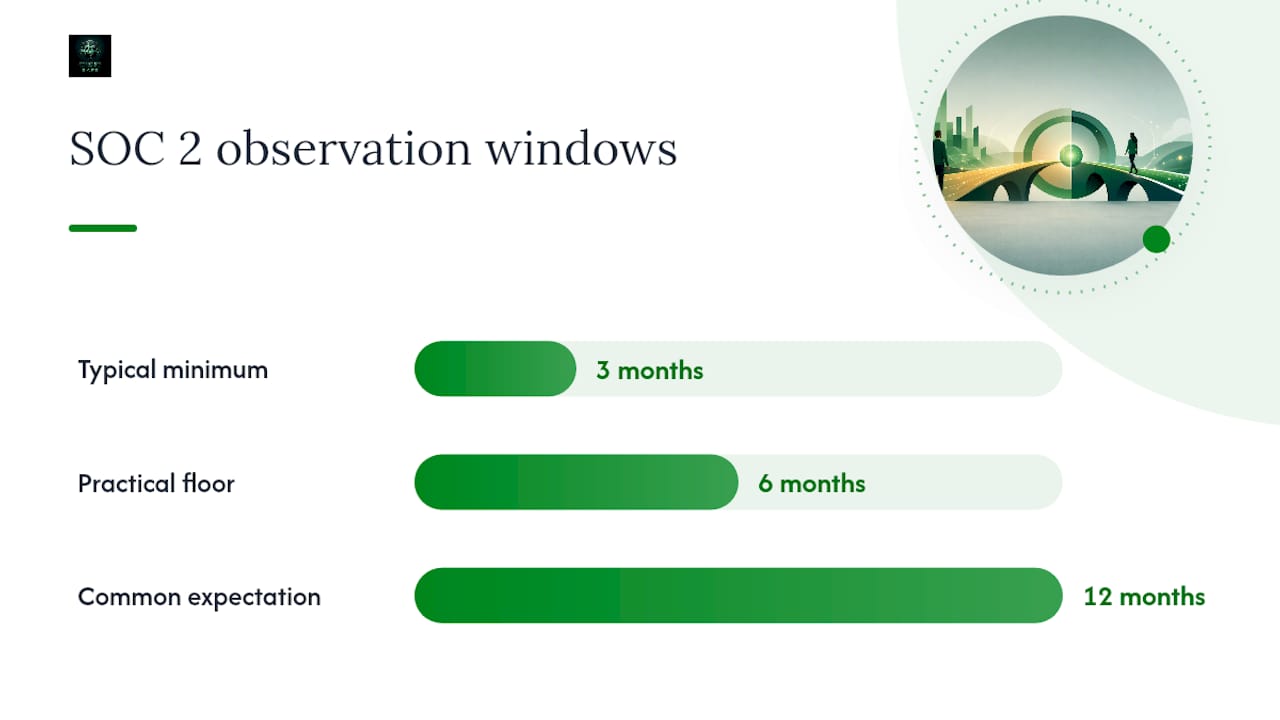
Type 2 tests the same control design as Type 1, then adds a second, harder question: did these controls actually function correctly over time? Observation windows typically run 3 to 12 months, with 6 months treated as the practical floor for a credible first report and 12 months as the common enterprise expectation.
Auditors don't take management's word for it. They pull samples and test them directly, including:
- Access logs showing who touched sensitive systems and when
- Change management tickets tied to code or infrastructure updates
- User access reviews and offboarding records
- Incident response documentation, including how issues were detected and closed
The auditor's sampling judgment matters here. A six-month window with sparse, inconsistent evidence produces a weaker opinion than a well-documented window of the same length. This is why the SOC 1 and SOC 2 distinction between report types matters just as much for financial-controls reporting as it does for security, since both frameworks share the same Type 1 versus Type 2 logic.
Type 1 vs Type 2: What Actually Changes for Your Business
The gap between the two reports isn't paperwork. It's what gets tested and how long that testing takes.
| Factor | Type 1 | Type 2 |
|---|---|---|
| What's evaluated | Control design only | Design plus operating effectiveness |
| Time to report | Roughly 3 to 5 months | Often 9 to 18 months total, including the observation window |
| Evidence burden | One point-in-time snapshot | Continuous logs, tickets, and records across months |
| Fieldwork duration | Days to a couple of weeks | Spread across the entire observation period |
| Buyer acceptance | Startups, early pilots, smaller deals | Mid-market, enterprise, regulated industries |
One myth worth killing outright: there is no such thing as a "SOC 2 certification." Both report types are CPA-issued attestations under AICPA standards, not certificates you earn once and keep forever. Every SOC 2 report has an expiration built into its scope and period.
Pro Tip: If a vendor tells you they're "SOC 2 certified," ask which type of report they have and for what period it covers. That single question filters out a lot of vague claims fast.
Procurement teams treat the two reports very differently in practice. A Type 1 often gets a deal through legal review with a signed commitment to deliver Type 2 within a set window. Enterprise security teams reviewing vendor risk, especially in regulated procurement contexts, frequently reject Type 1 outright once contract value or data sensitivity crosses a certain threshold. There's no universal dollar figure that triggers this, but the pattern shows up consistently in fintech, healthcare, and government-adjacent deals.
How Do You Decide Between Type 1 and Type 2?
The right call depends on five factors: your buyers' risk tolerance, the contract value on the table, whether you're in a regulated industry, how mature your controls already are, and how much time pressure you're under to close deals.
- Early-stage companies with smaller deals usually start with Type 1. It proves controls exist and are designed correctly, which satisfies startup buyers and gets contracts moving.
- Growth-stage companies with a healthy sales pipeline should treat Type 1 as a bridge, not a destination. Start the Type 2 observation window immediately after the Type 1 opinion lands, so you're not caught flat-footed when a bigger prospect asks for it.
- Mid-market companies selling into regulated customers should skip straight to Type 2 planning. Healthcare, fintech, and government-adjacent buyers often require Type 2 evidence contractually, and a Type 1 alone won't clear procurement.
- Enterprise-focused organizations need a 12-month Type 2 window as the default expectation, not the exception. Anything shorter invites follow-up questions from buyer security teams.
Timeline pressure changes this math. If you have a large deal closing in 60 days and no SOC 2 history, Type 1 is the only realistic option, paired with a public commitment to start the Type 2 clock right after.
What Do Timelines and Costs Actually Look Like?
Budget planning for SOC 2 comes down to two separate cost centers: getting to Type 1, then sustaining the evidence discipline needed for Type 2.
- Type 1 timeline: roughly 3 to 5 months from the start of readiness work to the final report, assuming controls aren't starting from zero.
- Type 2 timeline: often 9 to 18 months total, once you factor in the readiness phase, the observation window itself, and reporting.
- Major cost drivers: auditor fees scale with scope and company size, remediation work fixes gaps found during readiness, and evidence tooling either automates collection or forces someone to do it manually every week for months.
The internal hours add up fastest during the observation window, when someone has to keep pulling access logs, change records, and incident documentation on a recurring basis. This is exactly where automation and outside advisory support change the math, since manual evidence collection is the single biggest hidden cost in a Type 2 engagement.
What Will Auditors Actually Look For?
Auditors follow a fairly predictable sequence, and knowing it in advance saves weeks of back-and-forth during fieldwork.
- Scoping. You and the auditor agree on which Trust Services Criteria apply and which systems fall inside the boundary.
- Evidence collection. For Type 1, this means a single snapshot. For Type 2, it means continuous documentation across the whole observation period.
- Sampling and testing. The auditor pulls a sample of access logs, patch records, and change tickets, then checks whether reality matches the documented control.
- Findings and remediation. Gaps get flagged, and you fix what you can before the report locks.
- Opinion issuance. The auditor writes the final opinion based on what the evidence actually showed.
The specific evidence auditors ask for rarely changes: access logs showing least-privilege enforcement, patch management records proving timely updates, change management tickets tied to every production change, and incident response records showing detection-to-resolution timelines. Auditors sample rather than review everything, so gaps in a few weeks of records can undermine an otherwise strong window. Give auditors context alongside raw evidence. A log entry means little without a note explaining why an exception happened.
What Should You Do Right Now to Get Audit Ready?
Readiness work done before the clock starts saves months later, especially once you're locked into a Type 2 observation window you can't restart.
- Map every system and control in scope to the specific Trust Services Criteria you're pursuing, and assign a named owner to each one.
- Stabilize your automated evidence sources (access management, logging, ticketing) before you start any Type 2 window, not during it.
- Schedule a formal readiness assessment now, and build remediation sprints into your calendar before fieldwork begins.
- Document exceptions as they happen instead of reconstructing explanations months later for an auditor's sample.
Pro Tip: Treat your Type 1 report as a dry run for Type 2 evidence collection. Whatever process breaks during the Type 1 snapshot will break worse across a six-month window, so fix it now while the stakes are lower.
How Does CisoSafe Approach the Type 1 to Type 2 Path?
CisoSafe generally recommends Type 1 only when a deal timeline genuinely demands it, since a staged path from readiness to Type 1 to Type 2 works best when the Type 2 clock starts immediately after. Pairing vCISO advisory with automated evidence collection cuts the manual burden that usually stalls observation windows, and timing the audit calendar around actual contract negotiations avoids paying for a report before a buyer asks for it.
— vCISO
How CisoSafe Shortens Your Path to SOC 2 Type 2
Getting from "we should probably do SOC 2" to a clean Type 2 report usually stalls on the same thing: nobody has the hours to chase logs and tickets for six straight months while also doing their actual job. Organizations close that gap with a dedicated vCISO plus a platform built to automate the evidence grind.
CisoSafe's engagements start with a readiness assessment that maps your existing controls to the Trust Services Criteria and flags gaps before an auditor ever sees them. From there, the SaaS portal automates evidence collection across access logs, change records, and incident documentation, so the observation window doesn't turn into a part-time job for your IT director. Combined with hands-on vCISO support for policy development and remediation planning, regulated SMBs and mid-market firms across law, energy, and oil and gas typically move through Type 1 and into a well-documented Type 2 window with far fewer internal hours burned. If a contract deadline or a procurement requirement is driving your timeline, book a readiness assessment with CisoSafe and get a clear picture of what your Type 1 or Type 2 path actually looks like.
Where to Read More on SOC 2 Standards
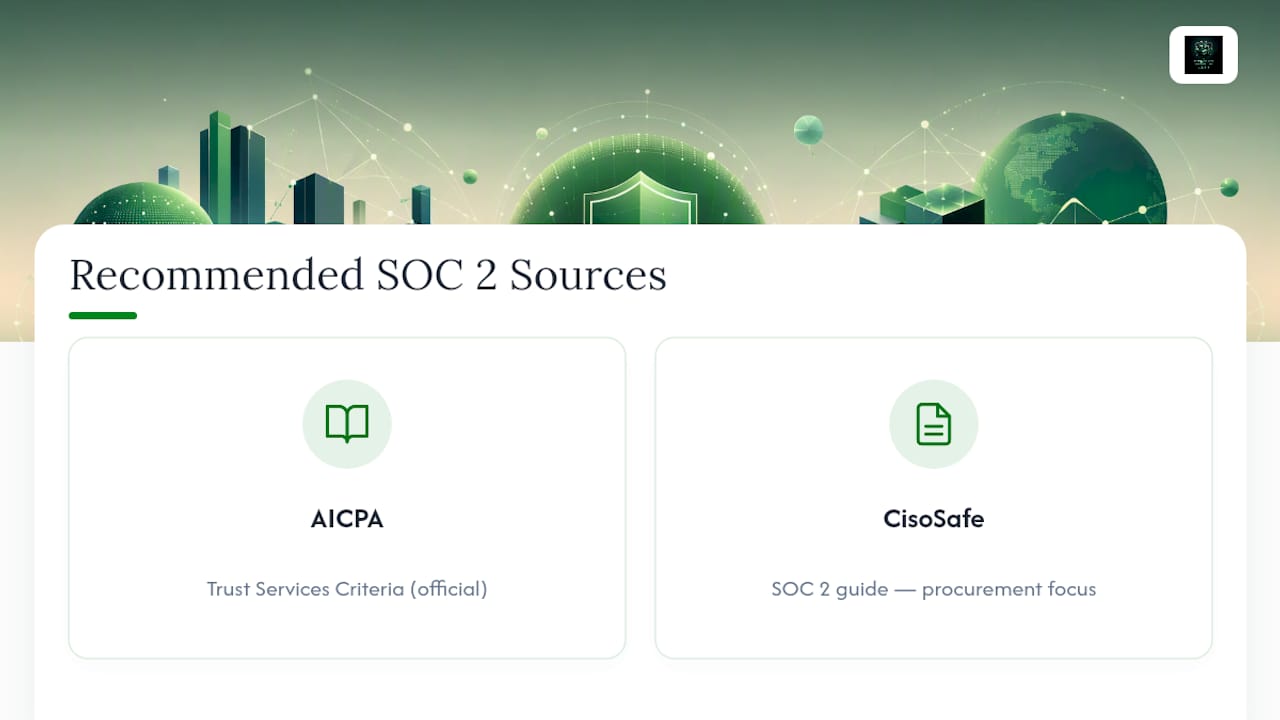
Start with the AICPA's SOC framework for the official Trust Services Criteria, and review CisoSafe's SOC 2 guide for business leaders for procurement context.
Sources
- AICPA — System and Organization Controls (SOC)
- SOC 2 Compliance Guide: 2026 Requirements & AI Controls — SureCloud
- SOC 2 Type 1 vs Type 2: What the Difference Actually Means for Your Audit — Security Compliance Guide
- SOC 2 Compliance Explained: A Complete 2026 Guide — GovernanceDocs