

PCI DSS readiness means proving you have a correctly scoped cardholder data environment and the controls and evidence an assessor will actually test, not just a policy binder. The single highest-value move is confirming and documenting your scope under Requirement 12.5.2 before anything else. Whether you self-attest with a SAQ or need a QSA-led ROC depends on criteria set by payment brands, merchant level, and service-provider status, but both paths start with scope.
TL;DR:
- Confirming and documenting scope under Requirement 12.5.2 is the most valuable step upfront to avoid costly remediations later.
- Readiness assessments must include updates for mandatory controls that became effective after March 31, 2025, such as anti-skimming measures and expanded multi-factor authentication.
- Scope must be mapped accurately by tracing all cardholder data flows, including overlooked systems like remote access tools and backup environments, and documented with diagrams and statements.
- Evidence for each PCI DSS requirement should be organized, retained for at least a year, and easily accessible to prevent delays during audits.
- External vulnerability scans and penetration tests are mandatory, with findings requiring remediation before re-testing, and the choice between SAQ or ROC depends on merchant level and service provider status.
Table of Contents
- What Does PCI DSS Readiness Actually Mean?
- How Do You Map Cardholder Data Flows and Reduce Scope?
- What Evidence Do Auditors Expect for Each Requirement?
- When Do You Need ASV Scans, Pen Tests, or a QSA?
- How Do You Manage Third-Party and Service-Provider Risk?
- What Does a 30, 60, and 90 Day Remediation Plan Look Like?
- The Readiness Failures That Actually Sink Audits
- Get PCI DSS Readiness Support From CisoSafe
- Where to Verify PCI DSS Requirements Directly
- Sources
- FAQ
What Does PCI DSS Readiness Actually Mean?
A readiness assessment, sometimes called a gap analysis, is a dry run against the 12 principal PCI DSS requirements before you face formal validation through a Self-Assessment Questionnaire (SAQ) or a Report on Compliance (ROC). It is not the audit itself. It is the work that keeps the audit from turning into a scramble.
Organizations that skip this step tend to discover their gaps in front of a QSA, which is the most expensive place to find them. Readiness work catches missing evidence, undocumented scope, and stale segmentation before an assessor's clock starts running.
PCI DSS v4.0.1 raised the stakes here. Several controls that were optional recommendations became mandatory after March 31, 2025, including anti-skimming measures and expanded multi-factor authentication. Readiness assessments conducted today have to treat those as in-force requirements, not future considerations. That shift matters because it reorders priorities:
- Anti-skimming controls for payment terminals now need active monitoring, not just physical inspection logs.
- MFA now extends to all access into the cardholder data environment, not just remote administrative access.
- Risk assessments supporting a customized approach need documentation that didn't exist under earlier versions.
A readiness assessment that ignores these updates will pass a checklist and fail the actual audit.
How Do You Map Cardholder Data Flows and Reduce Scope?
Requirement 12.5.2 obligates every entity to confirm and document scope annually, listing every location where account data lives and every system connected to it. Assessors validate this documentation directly, and Middlebury's summary of PCI-DSS v4.0.1 confirms this is the entity's responsibility, not something the assessor builds for you.
Getting scope wrong is the single costliest mistake in the entire process. Underscoping multiplies remediation later; overscoping multiplies your audit cost and ongoing maintenance burden for systems that never needed to be in play.
- Trace every data flow end to end. Follow account data from point-of-sale terminals and e-commerce checkout pages through payment processors, into backups, and across any failover or disaster-recovery site.
- Check the systems people forget. Remote administrative access tools, log aggregation servers, and backup environments frequently touch cardholder data without anyone flagging them as in-scope.
- Apply segmentation deliberately. Firewalled network segments, tokenization, and hosted or redirect payment pages can pull entire systems out of scope, cutting assessment effort dramatically.
- Document what you find. Keep network diagrams, data flow diagrams, and a written scope statement dated and version-controlled, since assessors will ask to see the trail, not just the conclusion.
What Evidence Do Auditors Expect for Each Requirement?
The 12 PCI DSS requirements sort cleanly into practical control buckets, and each bucket has a specific evidence expectation attached to it:
- Perimeter and hardening: firewall and router configuration standards, hardened build baselines, and change records showing when configurations were last reviewed.
- Data protection: encryption implementation details and key management procedures, including where keys are stored and who can access them.
- Access control: role-based access documentation, multi-factor authentication proof for all CDE access, and periodic access review records.
- Monitoring and logging: centralized log collection with retention periods, alerting configuration, and evidence that logs are actually reviewed, not just generated.
- Secure development: code review records and vulnerability management tied to any application handling payment data.
- Policy and governance: written information security policies, incident response plans, and signed acknowledgments from staff.
Pro Tip: Assessors move faster when evidence is organized by requirement number in a shared repository, not scattered across email threads and personal drives. A messy evidence trail slows the audit down even when your actual controls are solid.
Most organizations underestimate document retention. PCI DSS expects supporting evidence, ASV reports, configuration baselines, and log samples, retained and readily producible, often going back a full year of quarterly cycles. Assessors will ask for that history, not just a snapshot from last week.
When Do You Need ASV Scans, Pen Tests, or a QSA?
Testing cadence is not negotiable, and it is where readiness assessments most often reveal gaps that have been quietly accumulating.
- External vulnerability scans through an Approved Scanning Vendor (ASV) run quarterly, and findings need remediation or documented compensating controls before the next scan cycle.
- Annual penetration testing covers both external and internal environments, and any high-severity finding typically requires a re-test to confirm the fix actually worked.
- Segmentation testing validates that your network isolation actually holds, which matters enormously if you're relying on segmentation to reduce scope.
Whether you land on a SAQ or a full ROC depends on your merchant level and whether you're a service provider. SAQ D applies to merchants and service providers eligible for self-assessment, while many Level 1 merchants and larger service providers require a QSA-led ROC regardless of preference. If you're unsure which applies, that uncertainty itself is a signal to bring in a QSA early rather than guess. CisoSafe's guide to PCI penetration test requirements walks through how to present pen-test evidence in a way assessors accept the first time.
How Do You Manage Third-Party and Service-Provider Risk?
Outsourcing payment processing doesn't outsource your responsibility. Guidance on connected-to service providers makes clear that customers must exercise due diligence and confirm exactly which PCI requirements a provider covers, in writing.
- Request the provider's current Attestation of Compliance, and if applicable, their ROC or SAQ evidence, and read the scope statement closely, not just the cover page.
- Map any nested providers, since your primary vendor may rely on subcontractors whose compliance status you also need visibility into.
- Confirm contractually which controls the provider owns versus which remain yours, then verify minimum operational controls like MFA on remote access and centralized logging are actually in place.
Refresh this evidence quarterly. A provider's AOC from eighteen months ago tells you nothing about their posture today. CisoSafe's vendor cybersecurity assessment guide breaks down the specific questions to ask before signing.
What Does a 30, 60, and 90 Day Remediation Plan Look Like?
Once a readiness assessment surfaces findings, triage them by severity and assign realistic deadlines. A workable model looks like this:
- Days 1 to 30 (Critical, 7-day SLA): Fix scope errors first, close any exposed cardholder data paths, and patch critical vulnerabilities flagged in ASV scans.
- Days 31 to 60 (High, 30-day SLA): Expand MFA coverage across remaining CDE access points and remediate high-severity penetration test findings, then schedule re-tests.
- Days 61 to 90 (Medium and ongoing): Finalize evidence collection, complete anti-skimming control documentation, and run a full internal dry run of the evidence package.
Practitioner checklists that sort environments into "will pass," "at risk," and "will not pass" bands make this prioritization faster, since they target scope reduction, MFA gaps, and ASV remediation in that order.
Pro Tip: Bring in a QSA or vCISO the moment a finding touches scope determination or segmentation validity. Those two areas carry the highest risk of a failed assessment, and outside judgment early costs far less than a rejected ROC later.
The Readiness Failures That Actually Sink Audits
Most PCI DSS audit delays trace back to three repeat offenders: incomplete scoping documentation, segmentation that looked solid on a diagram but was never tested, and missing evidence for quarterly scans or annual penetration tests that technically happened but were never filed anywhere retrievable.
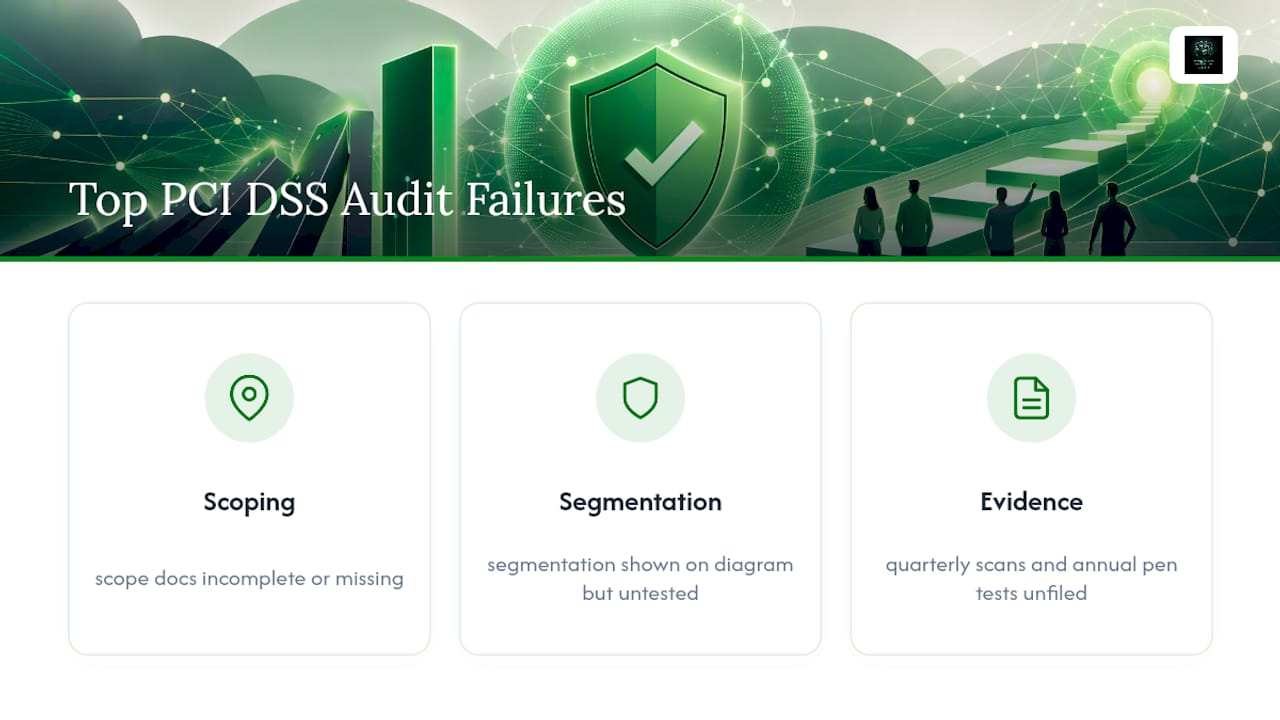
None of these are exotic problems. They're organizational ones. The fix isn't more security tooling, it's discipline: a centralized evidence repository, documented change control so configuration drift doesn't quietly expand scope, and active tracking of every vendor's Attestation of Compliance instead of a folder of PDFs nobody revisits until audit week arrives.
Ongoing vCISO involvement changes the math here because someone is watching evidence freshness between audits, not just during them. That's the difference between a readiness assessment that takes weeks of frantic backfilling and one that's mostly confirming what's already documented. Energy operators face this acutely given how often POS and field systems sit outside typical IT oversight, a pattern CisoSafe has detailed in its PCI DSS compliance guide for energy retail operations.
— vCISO
Get PCI DSS Readiness Support From CisoSafe
Some firms address the gap between "we think we're compliant" and "we can prove it to a QSA." Regulated organizations often lack the internal bandwidth to run scope mapping, evidence collection, and remediation tracking simultaneously while also managing their core responsibilities.
An engagement model follows the readiness assessment sequence: identifying gaps, prioritizing them by severity, managing remediation on a defensible timeline, and supporting the audit process with a QSA relationship when applicable. The Audit & Certification Readiness service pairs a hands-on vCISO with the platform's automated penetration testing and compliance intake tools, so evidence stays organized instead of scattered across spreadsheets nobody updates.
If your last readiness check happened more than a year ago, or never happened at all, visit CisoSafe to schedule a scope and gap review before your next assessment window opens.
Where to Verify PCI DSS Requirements Directly
For exact requirement language and testing procedures, consult the PCI SSC Document Library and the official SAQ D for merchants. Ciphrix's overview of the PCI DSS audit process offers a useful walkthrough of what assessors look for step by step.
Sources
- Payment Card Industry Data Security Standard (PCI DSS)
- PCI-DSS v4.0.1 — Payment Card Industry Data Security Standard (summary)
- Connected-to Service Providers guidance
- PCI-DSS v4.0.1 Readiness Checklist 2026: Free Audit Prep
FAQ
What Are the 12 Requirements for PCI DSS Compliance?
The 12 requirements cover firewall configuration, secure system defaults, cardholder data protection, encrypted transmission, malware defense, secure development, access restriction, unique user IDs, physical access control, logging and monitoring, regular testing, and a written security policy. Assessors use documented testing procedures tied to each one.
Can I Do PCI Compliance Myself?
Many organizations can self-attest using an SAQ if they meet the eligibility criteria for their merchant level, and SAQ D applies to merchants and service providers who qualify for self-assessment. Larger processors and many service providers need a formal ROC completed by a QSA instead.
What Are the 6 PCI DSS Requirement Goals?
The 12 requirements group into six broader goals: building a secure network, protecting cardholder data, maintaining a vulnerability management program, implementing strong access control, monitoring and testing networks regularly, and maintaining an information security policy. Each goal maps to two or more of the individual numbered requirements.
What Should a PCI DSS Compliance Checklist Include?
A working checklist starts with documented scope confirmation under Requirement 12.5.2, then covers quarterly ASV scans, annual penetration tests, MFA coverage across the cardholder data environment, encryption and key management records, and current Attestations of Compliance for every service provider. CisoSafe's readiness assessment builds this checklist against your actual environment rather than a generic template.
How Long Does PCI DSS Readiness Take?
Timelines vary by how clean your scope already is, but a realistic remediation arc runs 30 to 90 days for organizations with moderate gaps, covering critical fixes first, then MFA expansion and penetration test remediation, then final evidence collection. Organizations with significant segmentation or scope problems often need longer.