

Industrial IoT security is the risk-managed practice of protecting the sensors, controllers, and networks that run physical operations from cyber threats that could cause safety incidents or downtime. The single top priority for defenders is continuous asset visibility paired with zones-and-conduits segmentation, both grounded in the ISA/IEC 62443 framework. Everything else in a mature program, from device hardening to incident response, builds on that foundation.
TL;DR:
- Asset visibility is essential, as most industrial networks contain more shadow devices than owners realize, affecting segmentation and patching efforts.
- Prioritizing safety-critical assets for segmentation and protection offers the highest risk reduction per dollar and prevents resource waste on lower-impact assets.
- Firmware tampering poses a stealthy but severe threat because compromised devices can pass security checks while allowing attackers persistent control.
- Industry standards like ISA/IEC 62443, IISF, and NIST SP 800-82 provide a comprehensive framework for designing, implementing, and monitoring IIoT security programs.
- A phased approach that starts with asset inventory and segmentation delivers better security outcomes than trying to implement multiple controls simultaneously.
Table of Contents
- What Makes IIoT Security Different From IT Security?
- What Are the Biggest IIoT Security Risks?
- Which Standards Should Guide Your IIoT Security Program?
- How Do You Architect an IIoT Security Program?
- Where Do AI, Edge Computing, and Digital Twins Fit In?
- How Do You Assess and Respond to IIoT Incidents?
- How Does a vCISO Turn Standards Into an IIoT Security Program?
- What Should Leaders Prioritize First?
- How CisoSafe Helps You Operationalize IIoT Security
- Sources
- FAQ
What Makes IIoT Security Different From IT Security?
Industrial IoT covers the sensors, actuators, programmable logic controllers, SCADA systems, and edge gateways that monitor and control physical processes, often bridging into cloud platforms for analytics. That mix separates IIoT from enterprise IT and consumer IoT in ways that change every security decision you make.
In an office network, confidentiality usually comes first. In a plant, safety and availability come first. A ransomware attack that locks a laptop is an inconvenience; one that stops a compressor or a chemical dosing pump can injure someone or shut down a facility for days. That priority shift, sometimes called reconciling IT and OT risk models, means convergence risks need their own playbook rather than a copy of the corporate security policy.
Several structural realities compound the problem:
- Many field devices run on constrained processors that cannot support modern encryption or endpoint agents.
- Legacy protocols like Modbus and DNP3 were built for reliability on closed networks, not for authentication against an intruder.
- Equipment lifecycles run 15 to 25 years, far outlasting the vendor support windows common in IT hardware.
- Patching often requires a planned outage, so vulnerabilities can sit unaddressed for a full production cycle.
These constraints are exactly why a generic IT security checklist falls short, and why standards purpose built for industrial control systems, like IEC 62443, matter more here than almost anywhere else in cybersecurity.
What Are the Biggest IIoT Security Risks?
IIoT threats break down into four categories, and mapping a specific asset to the right one is the fastest way to know what to fix first.
- Device and firmware risks. Insecure boot processes, hardcoded credentials, and unpatched firmware let attackers gain persistent, hard-to-detect control of a device. Firmware compromise is particularly dangerous because it can survive reboots and evade endpoint tools designed for IT systems.
- Network risks. Insecure legacy protocols, man-in-the-middle interception, lateral movement across flat networks, and denial-of-service attacks against control traffic all fall here. A flat OT network turns one compromised sensor into a path toward the whole production line.
- Application and cloud risks. Misconfigured APIs connecting field devices to cloud dashboards, weak TLS implementations, and poor tenant segregation in multi-site deployments expose data and control channels that were never meant to be internet-facing.
- Supply chain risks. Third-party firmware, embedded components, and integrator software introduce vulnerabilities before a device ever reaches your network, and they're often invisible until an incident forces a teardown.
Industry data point: Survey research on IIoT attack patterns identifies denial-of-service, man-in-the-middle interception, and firmware tampering as the highest-risk vectors across device, network, and application layers, with consequences ranging from data theft to physical equipment damage and full production outages.
Firmware compromise deserves particular attention because it's the quietest of the four categories. A device running tampered firmware can pass every network security check while an attacker maintains standing access, which is one reason firmware hardening reviews treat secure boot and controlled update mechanisms as non-negotiable baseline controls, not advanced hardening.
Which Standards Should Guide Your IIoT Security Program?
You don't need to invent a security framework for industrial environments. Three references cover nearly everything a program needs, and each plays a distinct role.
- ISA/IEC 62443 is the globally recognized standard for industrial automation and control system security. It provides a risk-based, defense in depth structure with parts covering program requirements, system design through zones and conduits, and secure product development for the devices themselves.
- The Industry IoT Consortium's IISF operates one level up, at the architecture layer. It calls for security to be designed in from the start rather than bolted on later, and its current version adds specific guidance on endpoint protection, certificate management, and secure boot.
- NIST SP 800-82 and the NIST Cybersecurity Framework give practical, control-level guidance for ICS and OT environments, particularly around vulnerability management and continuous monitoring.
The practical move is mapping each asset's criticality to a target security level under 62443, then using IISF architecture guidance to design the network around that rating and NIST controls to operationalize monitoring. A pump controlling non-hazardous cooling water doesn't need the same target security level as a valve on a pressurized line, and treating them identically wastes budget on the low-risk asset while under-protecting the high-risk one.
How Do You Architect an IIoT Security Program?
Every control in this section builds on the one before it. Skipping the first step, asset visibility, undermines everything that follows.
- Build an authoritative asset inventory first. You cannot segment, patch, or monitor a device you don't know exists, and most industrial networks have more shadow devices than their owners expect.
- Design zones and conduits. Group assets by function and risk level, then control every path between zones, using one-way data flow (a data diode, for instance) where a zone should never accept inbound commands from a less trusted one. CisoSafe's zones-and-conduits blueprint walks through this design pattern in detail.
- Harden the device lifecycle. Require secure boot, assign every device a unique cryptographic identity, disable unused services and ports, and retire default credentials before a device ever touches the production network.
- Manage authentication and keys properly. Use hardware-backed identity (TPM-based where available) and certificate-based authentication instead of shared administrator passwords that get copied into a dozen maintenance runbooks.
- Plan patching around constrained and legacy assets. Stage every update in a test environment first, and where a device genuinely cannot be patched, apply compensating controls like tighter network isolation or added monitoring around it.
- Deploy OT-aware monitoring. Generic IDS tools don't understand Modbus or DNP3 traffic. Detection tuned for industrial protocols, backed by edge-based anomaly models, catches the deviations that matter.
Pro Tip: Don't try to segment your way to security level 4 on every asset. Rank devices by safety and business impact first, then spend your segmentation budget on the top tier. A blanket approach spreads resources thin exactly where a targeted one would protect what matters most.
Vulnerability management for constrained industrial assets, particularly in sectors running decades-old equipment, is its own discipline. CisoSafe's guide on vulnerability management for upstream oil and gas assets covers staged patching approaches that apply well beyond that one sector.
Where Do AI, Edge Computing, and Digital Twins Fit In?
Newer technologies extend the standards-based foundation above rather than replace it, and each solves a specific gap that older tools leave open.
- AI and machine learning improve anomaly detection by learning normal operational baselines, but the models are only as good as the telemetry feeding them, and poor data quality produces false positives that erode trust in the system fast.
- Edge and fog computing cut detection latency by processing data close to the device and reducing what leaves the plant floor, though edge nodes introduce their own attack surface that needs the same hardening as any other endpoint.
- Digital twins let teams test detection models and incident scenarios against a virtual replica instead of risking a live production system, which is increasingly how practitioners train models without exposing raw industrial data externally.
- Firmware provenance tracking helps validate that a component hasn't been tampered with across the supply chain, though it works best as one layer in a broader verification process, not a standalone fix.
How Do You Assess and Respond to IIoT Incidents?
A risk assessment for a plant floor has to weigh safety consequences the way a typical IT assessment weighs data sensitivity, and the process that follows an incident has to respect that same priority.
- Run a risk-based assessment first. Map every system, note which failures carry safety implications, and assign target security levels accordingly, following the same safety-aware methodology that underlies the 62443 series. CisoSafe's industrial cybersecurity assessment guide breaks down which assessment type fits which environment.
- Use noninvasive discovery and staged testing. Active scanning that's routine on an IT network can crash a fragile PLC, so OT-appropriate testing methods matter as much as the findings themselves.
- Build incident response playbooks that prioritize containment without shutting down safety systems. The instinct to isolate everything during an incident can itself create a hazard if it disables a safety interlock.
- Plan for manual fallback and test failover regularly. If the network goes dark, operators need a documented manual process to keep critical functions running, and that process is only as good as the last time someone actually rehearsed it.
How Does a vCISO Turn Standards Into an IIoT Security Program?
A virtual CISO's role in an IIoT program is governance: translating 62443 and IISF requirements into a prioritized roadmap, overseeing vendors touching OT systems, and reporting risk to leadership in terms that connect to business continuity, not just technical findings.
The deliverables a vCISO engagement typically produces include:
- A validated asset inventory covering both IT and OT devices
- Zone-and-conduit segmentation diagrams tied to target security levels
- A phased remediation roadmap sequenced by risk and safety impact
- Executive-level risk reporting that ties technical gaps to business exposure
Automated compliance and testing tools accelerate this work considerably. Instead of a manual audit cycle stretching over months, an AI-assisted platform can run assessments and generate reporting in a fraction of the time, giving leadership faster visibility into where remediation dollars belong.
What Should Leaders Prioritize First?
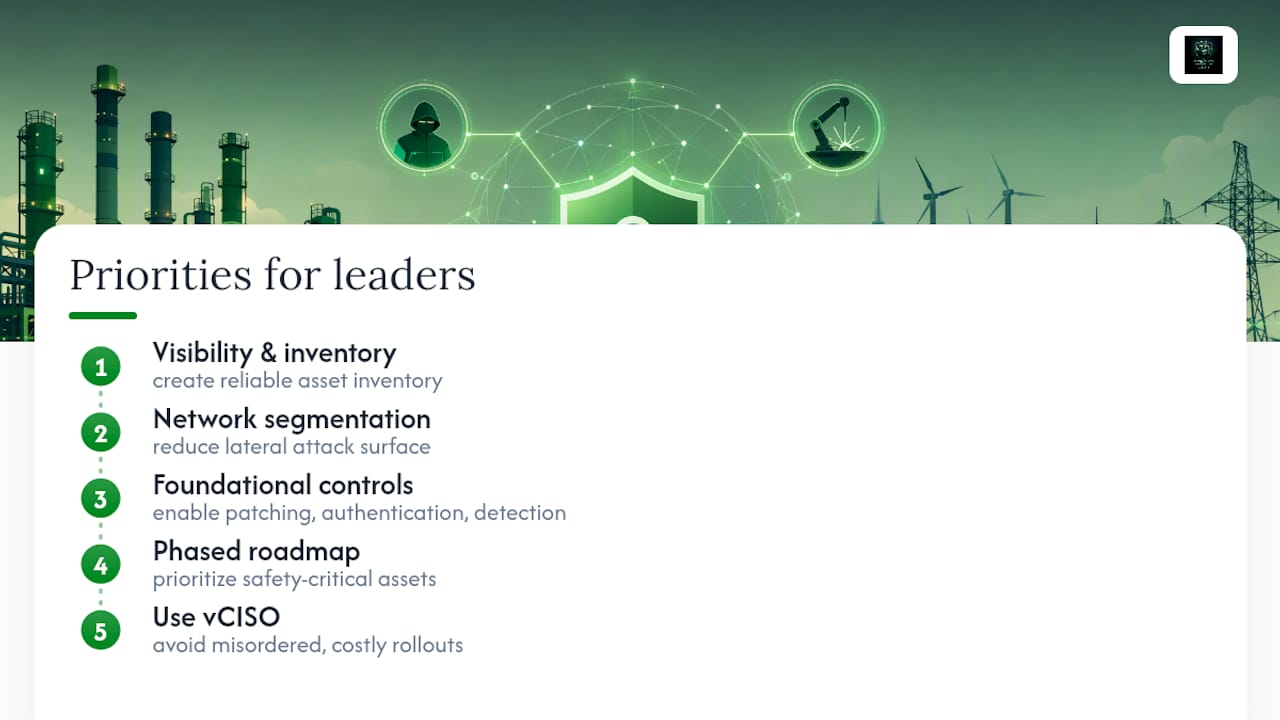
Most IIoT security programs try to do too much at once, chasing device hardening and monitoring before anyone has a reliable asset inventory. That's backwards. Visibility and segmentation deliver the largest risk reduction per dollar spent, and everything else, patching, authentication, detection, works better once those two are in place.
A phased roadmap tied to safety-critical assets beats a flat, one-size-fits-all rollout every time. Smaller organizations without a dedicated security team often underestimate how quickly a misordered rollout becomes an expensive redo, which is exactly the kind of misstep a vCISO engagement is built to prevent.
— vCISO
How CisoSafe Helps You Operationalize IIoT Security
The combination of hands-on vCISO advisory with an AI-powered compliance platform helps ensure that roadmaps do not remain unexecuted. The services include running risk assessments, building segmentation and remediation plans, and providing ongoing governance, while the platform automates penetration testing and compliance reporting across frameworks like SOC 2, HIPAA, and CMMC.
That combination solves a specific problem for regulated operators: proving OT continuity and audit readiness to a board or a regulator without hiring a full-time CISO or paying enterprise consultancy rates. If your organization needs a clear-eyed view of where your industrial systems stand today, CisoSafe can walk you through a consultation and show you exactly where your program's biggest gaps are.
Sources
Start with the ISA/IEC 62443 guidance for IIoT projects if you're building a program from scratch. It sequences well with the IISF Version 2 framework for architecture-level decisions and NIST SP 800-82 for ICS-specific controls.
On the technical research side, the survey on AI-based IIoT security solutions covers edge computing tradeoffs in depth, and the broader technology commentary at POW IT UP offers useful context on how IoT infrastructure trends are evolving across industries.
- A survey on industrial IoT security: requirements, attacks, AI-based solutions, and edge computing opportunities — PMC
- IIoT security threats classification (conference proceedings)
- Industry IoT Consortium (IISF) Version 2 — IIoT Security Framework
- NIST SP 800-82 Revision 3: Guide to Industrial Control Systems (ICS) Security
FAQ
What does industrial IoT mean?
Industrial IoT refers to the network of sensors, actuators, controllers, and edge devices that monitor and control physical industrial processes, often connected to cloud analytics platforms for data collection and remote management.
What is IoT security?
IoT security is the set of practices and controls that protect connected devices, their data, and the networks they run on from unauthorized access, tampering, and disruption; in industrial settings, it extends to protecting physical safety and operational uptime.
What are the top vulnerabilities in IoT devices?
The most common categories include insecure firmware and hardcoded credentials, unpatched software, weak or absent authentication, insecure network protocols, misconfigured cloud APIs, and unvetted third-party components introduced through the supply chain.
What are the "5 C's" of IoT?
Definitions of this framework vary across sources, so treat any specific list with some caution; the concept is generally used to describe core design pillars like connectivity, control, and computation rather than a single standardized model.
Does CisoSafe help with IIoT security compliance?
Yes. CisoSafe's vCISO services and compliance platform support risk assessments, segmentation planning, and audit readiness across frameworks including SOC 2, HIPAA, and CMMC for organizations running industrial or operational technology environments.