

A CMMC self-assessment is the contractor's official annual verification that in-scope systems meet required safeguarding practices. Contractors scope the assessment, run interviews, examine, and test procedures against each control, collect defensible evidence, submit results to SPRS, and complete the senior official affirmation. Retain every artifact for six years, and treat the whole exercise as a legal certification, not paperwork.
TL;DR:
- Proper scoping requires a complete inventory of assets handling FCI or CUI, along with detailed network and process maps, to avoid invalidating the assessment.
- Evidence must be finalized policies, configurations, logs, or screenshots, with inherited controls documented and stored in a dedicated, retrievable repository.
- Each assessed objective must be scored accurately, as a single unmet objective results in failure of the entire requirement, with results submitted through SPRS.
- Most assessment errors stem from using draft evidence, applying partial scores broadly, or failing to document inherited controls, risking legal exposure under false claims statutes.
- A finalized System Security Plan before assessment, thorough internal checks, and support from a virtual CISO can significantly improve assessment defensibility.
Table of Contents
- What Does a CMMC Self-Assessment Cover at Level 1 vs. Level 2?
- How Do You Scope a CMMC Self-Assessment?
- What Evidence Counts in a CMMC Self-Audit?
- How Do You Submit CMMC Results to SPRS?
- What Are the Most Common CMMC Self-Assessment Mistakes?
- What Is the Step-by-Step CMMC Self-Assessment Process?
- A vCISO's Take: What Actually Makes an Assessment Defensible
- How CisoSafe Supports Your CMMC Self-Assessment
- Where to Verify These Requirements Directly
- Sources
What Does a CMMC Self-Assessment Cover at Level 1 vs. Level 2?
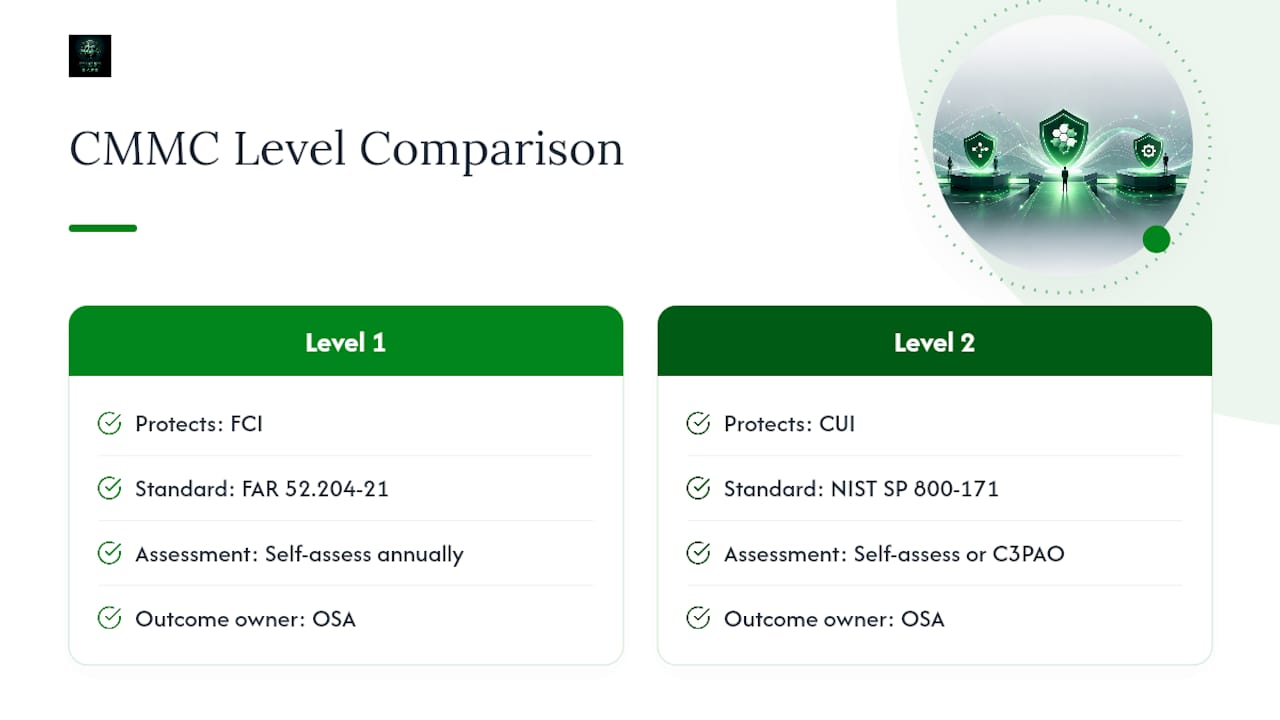
Level 1 protects Federal Contract Information (FCI) and maps to the 15 basic safeguarding practices in FAR 52.204-21. Any contractor handling FCI, meaning nonpublic information provided by or generated for the government under contract, falls under this tier and can self-assess annually.
Level 2 covers Controlled Unclassified Information (CUI) and requires meeting the practices in NIST SP 800-171. Some Level 2 contracts allow self-assessment; others require third-party certification through a C3PAO, depending on the sensitivity the contracting officer assigns. Either way, contractual obligations under DFARS 252.204-7012 still apply. The Organization Seeking Assessment (OSA) owns the outcome, but subcontractors handling FCI or CUI carry the same safeguarding duty, and primes increasingly flow down CMMC requirements as a condition of subcontract award.
How Do You Scope a CMMC Self-Assessment?
Scoping determines what actually gets tested, and getting it wrong invalidates the entire exercise. The CMMC Scoping Guide directs OSAs to include every asset that processes, stores, or transmits FCI or CUI, then separately document specialized assets that may sit outside the assessment boundary with a stated justification.
Build your scoping package around these deliverables:
- A complete asset inventory tagging each device by data sensitivity and function
- A network diagram showing data flow paths and any CUI/FCI enclaves
- A people and process map identifying who touches in-scope systems and how
- Documented exclusions for IoT, OT, government-furnished equipment, and test equipment, with the reasoning for each exclusion recorded
Skipping the exclusion documentation is a common shortcut. An assessor or prime auditing your work later has no way to confirm a device was legitimately out of scope if you never wrote down why.
What Evidence Counts in a CMMC Self-Audit?
NIST SP 800-171A defines three assessment methods: interview, examine, and test. You don't need all three for every objective. Interviews confirm that staff understand and follow a policy. Examine means reviewing a document, configuration, or log. Test means actively verifying a control works, like attempting an unauthorized login to confirm lockout settings function.
A practical sequence looks like this:
- Pull the relevant policy or configuration and confirm it's the final, approved version.
- Interview the control owner to verify the practice is actually followed day to day.
- Test the control directly where feasible, especially for access control and system monitoring practices.
- Record the finding against the specific assessment objective, not just the broader practice.
Acceptable artifacts include finalized policies, current system configurations, log exports, screenshots with timestamps, and recorded control demonstrations. Draft policies, meeting notes, and email threads don't hold up as final evidence. If a control is inherited from an External Service Provider (ESP), such as a managed IT provider or cloud host, document the shared responsibility split and request the ESP's own compliance documentation to show the control is actually in place.
Pro Tip: Store evidence in a single, dated repository tied to each assessment objective as you collect it. Reconstructing evidence six months after the fact, when a prime contractor requests proof, costs far more time than capturing it during the original self-assessment.
How Do You Submit CMMC Results to SPRS?
Scoring runs at the individual assessment objective level. One NOT MET objective fails the entire security requirement, even if every other objective under that practice checks out. That single rule surprises a lot of first-time assessors who assume partial compliance earns partial credit across the board.
SPRS entries require your score, assessment scope, assessment date, and CAGE code, submitted through the SPRS/PIEE system. Level 1 requires annual self-assessment plus a senior official affirmation confirming accuracy. Level 2 self-assessments follow a similar affirmation cadence where applicable.
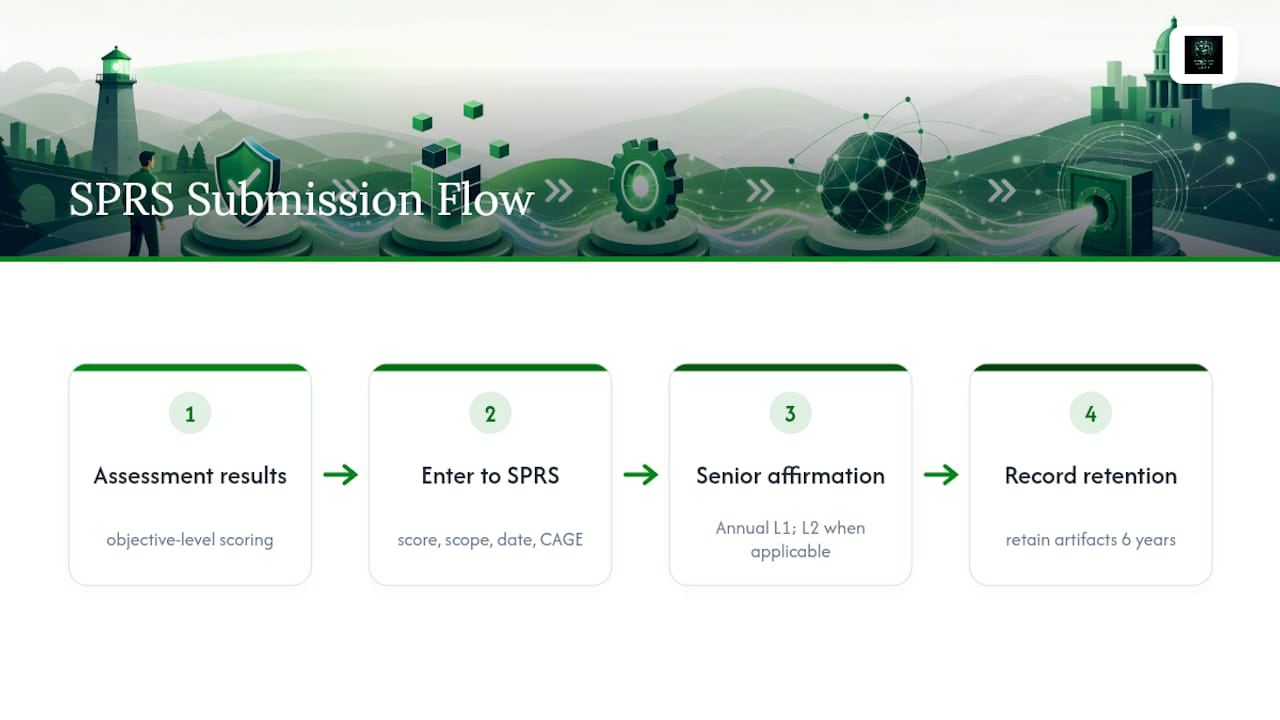
Partial credit exists for some Level 2 controls, including specific MFA and FIPS-validated encryption practices, but is limited in application. Use the official SPRS scoring methodology rather than estimating, because an inflated score entered into a federal system carries False Claims Act exposure. Retain every artifact supporting your submission for six years.
What Are the Most Common CMMC Self-Assessment Mistakes?
Most invalid self-assessments trace back to a handful of repeat errors, and nearly all of them are avoidable with basic discipline.
- Using draft policies or unofficial working notes as evidence instead of finalized artifacts
- Applying partial credit broadly instead of restricting it to the specific controls that allow it
- Failing to document how a control inherited from an ESP actually gets fulfilled
- Losing or never generating retrievable evidence, leaving nothing to produce six years later when a prime or auditor asks
One overlooked risk deserves its own callout: under 32 CFR § 170.15, a mis-scored or inflated SPRS entry isn't just a compliance gap. It's a false statement to the federal government, and the same statute that requires annual affirmation is the one that creates the legal exposure when that affirmation doesn't match reality.
Mitigate with a formal System Security Plan, a POA&M with real milestones for anything NOT MET, and periodic internal spot checks between annual cycles.
What Is the Step-by-Step CMMC Self-Assessment Process?
A compliant self-assessment moves through five distinct phases, and skipping ahead is where most contractors run into trouble.
- Prepare. Finalize your scope, build the asset inventory, draft or update your SSP, and identify every ESP touching in-scope systems.
- Assess. Run interview, examine, and test procedures against each practice, recording findings at the objective level as you go.
- Document. Produce the self-assessment report and a POA&M listing remediation milestones for every NOT MET item.
- Submit. Enter your score, scope, and CAGE code into SPRS, then complete the senior official affirmation.
- Maintain. Archive every artifact for six years and trigger a new assessment whenever scope changes materially, such as a network expansion or acquisition. Routine operational changes inside an unchanged scope can typically be handled through your existing POA&M and affirmation cycle instead of a full reassessment.
A vCISO's Take: What Actually Makes an Assessment Defensible
The single biggest predictor of a defensible self-assessment isn't the score. It's whether a finalized SSP exists before the assessment starts. Contractors who write the SSP as an afterthought spend weeks reconstructing what they already knew. A vCISO earns its cost fastest on organizations juggling multiple frameworks at once, where internal staff can run daily operations but lack bandwidth for the evidence discipline auditors expect. Automation handles the repetitive capture work; judgment still decides what counts as proof.
— vCISO
How CisoSafe Supports Your CMMC Self-Assessment
Running a defensible self-assessment while managing daily security operations stretches most internal teams thin, and that gap is exactly where a compliance mistake gets expensive. A virtual CISO advisory service can be paired with an automated compliance portal built to carry a contractor through scoping, SSP development, evidence capture, and POA&M tracking without adding headcount.
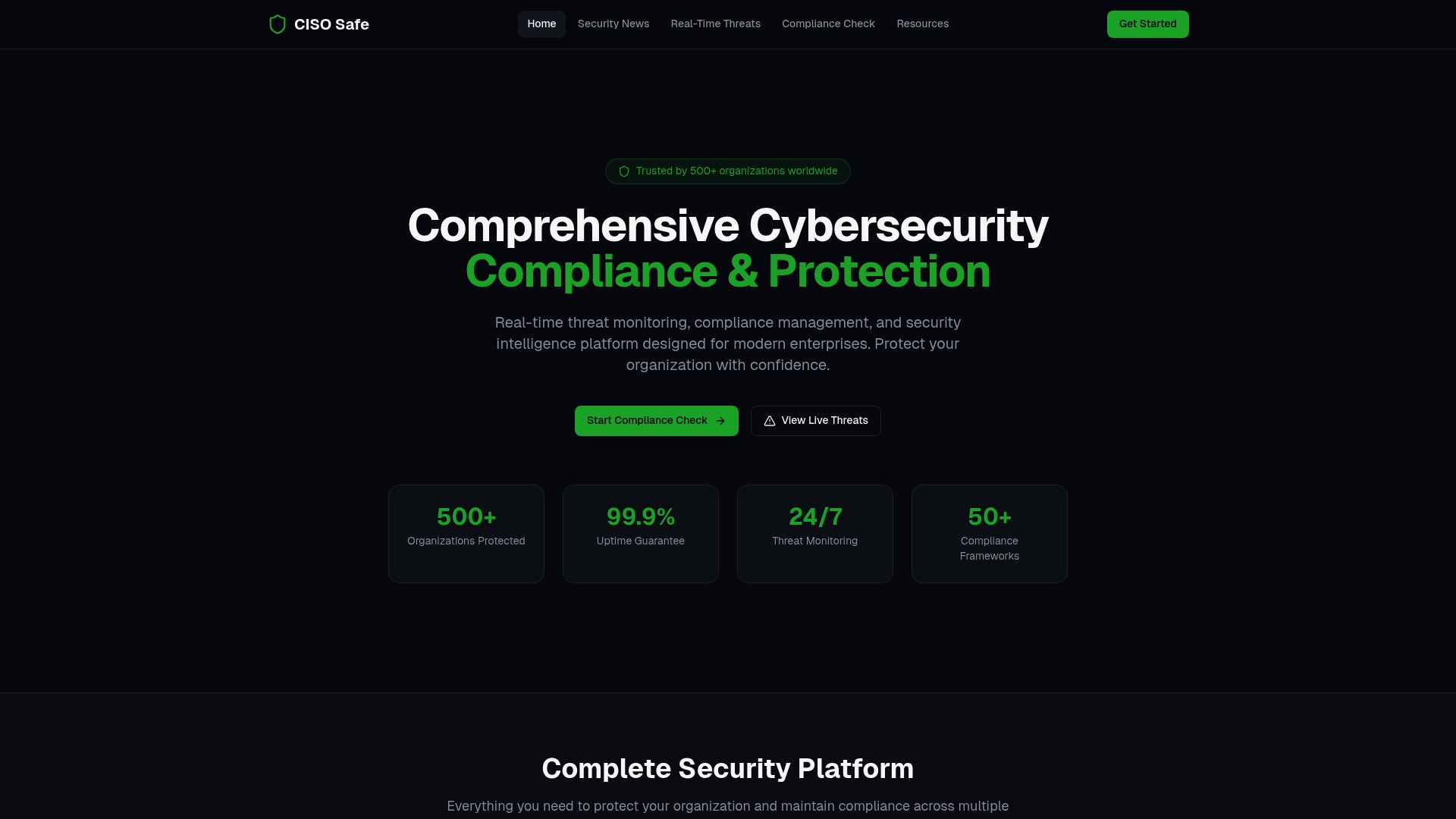
Such platforms typically help define your assessment boundary, keep your SSP current, timestamp and organize evidence by assessment objective, and produce SPRS-ready reporting your senior official can affirm with confidence. For contractors also managing SOC 2 or overlapping frameworks, CisoSafe's vCISO team handles the control mapping so evidence gets reused instead of recreated. If your team is heading into an assessment cycle without a finalized SSP or a clear evidence trail, book a diagnostics call with CisoSafe to see where your current documentation stands before you submit anything to SPRS.
Where to Verify These Requirements Directly
Go to the source documents before you finalize anything. The CMMC Assessment Guide – Level 1 and its companion Scoping Guide define practice requirements and boundaries. 32 CFR § 170.15 sets the legal affirmation and six-year retention rules. NIST SP 800-171A governs assessment methods, and SPRS is where you submit and affirm results.
Sources
- CMMC Assessment Guide – Level 1 (DoD CIO)
- 32 CFR § 170.15 — CMMC Level 1 self-assessment and affirmation requirements
- NIST SP 800-171A — Assessment procedures
- SPRS — CMMC