

Cloud pentesting is authorized attack simulation aimed at cloud identities, permissions, workloads, and the APIs that expose your control plane, not just servers and open ports. The goal is validated evidence of real attack paths and the business impact they create, so remediation gets prioritized correctly. Every engagement runs under explicit authorization and provider-appropriate rules of engagement, testing only resources you own or have permission to touch.
TL;DR:
- Cloud pentesting emphasizes identity misconfigurations, privilege escalation, and trust relationship breaches over traditional host vulnerabilities.
- Testing scope must strictly follow cloud provider rules, covering only authorized resources and techniques, with clear engagement and abort criteria.
- Automation is shifting from periodic scans to continuous, on-demand validation integrated into DevOps pipelines to catch drift early.
- Findings should be linked into attack chains, quantified by blast radius, and presented in structured reports with actionable remediation, not just vulnerability lists.
- Regular retesting after infrastructure changes is essential, as overbroad scopes and lack of remediation ownership often leave critical attack paths unaddressed.
Table of Contents
- What Cloud Penetration Testing Is (and How It Differs From Traditional Pentesting)
- Why Cloud Pentesting Matters for Risk and Compliance
- A Practical Cloud Pentest Lifecycle
- Cloud Provider Rules of Engagement You Need Before You Start
- Tools, Automation, and the Shift Toward Continuous Testing
- Provider-Specific Notes: AWS, Azure, and GCP
- Scoping the Engagement: What Belongs in Your Authorization
- What Makes a Cloud Pentest Report Actually Useful
- Where to Learn Cloud Pentesting
- Legal and Compliance Considerations Beyond Provider Rules
- A vCISO's View on Where Cloud Pentests Go Wrong
- How CisoSafe Turns Cloud Pentesting Into Audit-Ready Evidence
- Primary Sources Worth Bookmarking
- Sources
- FAQ
What Cloud Penetration Testing Is (and How It Differs From Traditional Pentesting)
Traditional network pentesting hunts for open ports, unpatched services, and weak credentials on hosts you control end to end. Cloud pentesting starts somewhere else entirely: identity. In a cloud environment, the front door isn't a firewall rule, it's an IAM role, a service principal, or a workload identity that was scoped too loosely six months ago and never revisited.
That shift matters because cloud attacks rarely look like traditional exploitation. An attacker doesn't need a zero-day when a misconfigured trust policy lets them assume a role three privilege levels above where they started. Cloud penetration testing focuses on exactly these paths: IAM misconfigurations, storage permissions, workload identities, and federation trust, rather than purely host-based vulnerabilities.
The shared responsibility model draws a hard line testers have to respect. Cloud providers secure the physical infrastructure, hypervisors, and the underlying control plane. You, and by extension your pentester, are responsible for how you configure identity, storage, networking, and the workloads running on top of that infrastructure. That boundary defines the entire scope of a legal cloud pentest.
Common cloud-specific findings look nothing like a classic vulnerability scan output:
- Role chaining, where a low-privilege identity assumes a series of roles to reach administrative access.
- OIDC federation trust misconfigurations that let an external identity provider authenticate as an internal service.
- Publicly exposed storage buckets with overly permissive access policies.
- Exposed Kubernetes API servers or container orchestration control planes reachable from the internet.
- Over-permissioned workload identities tied to serverless functions or CI/CD pipelines.
Two frameworks give this work a shared vocabulary. The MITRE ATT&CK Cloud matrix maps adversary tactics specific to cloud platforms, from initial access through privilege escalation and impact. The Cloud Security Alliance's top-threats research catalogs the recurring failure patterns, like misconfiguration and inadequate identity management, that show up across nearly every cloud breach post-mortem. Testers who anchor their methodology to both frameworks produce findings that map cleanly to how real adversaries actually operate.
Why Cloud Pentesting Matters for Risk and Compliance
Identity chains are where cloud breaches actually happen. A developer's over-permissioned service account gets compromised through a leaked credential, and within a few hops that identity can assume a role with administrative rights over your data stores. That's not a hypothetical. It's the standard shape of cloud incident response reports across every major provider.
Compliance reviews check whether the right controls exist on paper. A pentest proves whether those controls actually stop an attacker. Organizations often mistake compliance reviews for penetration testing: compliance verifies that a policy is in place, while a pentest actively attempts to exploit gaps to demonstrate real impact. Those are two different questions, and only one of them tells you whether you're actually exposed.
Pro Tip: A pentest that only confirms what your compliance checklist already claims is a wasted engagement. Push your testing team to chain findings together into a full attack path, not a list of isolated misconfigurations.
Frameworks like SOC 2, PCI DSS, and CMMC increasingly expect evidence of tested security controls rather than documented ones. For regulated organizations in law, energy, and healthcare, a cloud pentest report doubles as audit evidence and as a genuine measure of exploitable risk. The two purposes reinforce each other, but they aren't the same thing, and treating a compliance scan as a substitute for adversarial testing leaves real attack paths undiscovered.
A Practical Cloud Pentest Lifecycle
Cloud penetration testing typically follows a standardized lifecycle: pre-engagement and scoping, reconnaissance, enumeration, exploitation, and reporting. Cadence should be recurring and tied to the software development lifecycle, especially around major feature launches or infrastructure changes.
- Pre-engagement. Define exact scope: accounts, regions, resource groups, allowed techniques, and test windows. This is also where rules of engagement get signed off in writing.
- Reconnaissance. Discover exposed control planes, leaked API keys or access tokens, public-facing endpoints, and subdomain sprawl tied to cloud infrastructure.
- Enumeration. Map service principals, IAM roles, trust relationships, and workload identities. Cloud providers rarely offer a clean API that lists a principal's full effective permissions, so testers often have to attempt low-risk actions just to infer what a role can actually do.
- Exploitation and validation. Safely chain privileges to prove an attack path is real, then measure the blast radius, meaning what an attacker could reach once inside.
- Post-exploitation and reporting. Document business impact, rank remediation by severity and exploitability, and schedule a retest once fixes land.
The NIST SP 800-115 technical guide formalizes much of this structure, covering reconnaissance, documentation review, and target vulnerability validation techniques as part of a repeatable assessment methodology. The Penetration Testing Execution Standard, or PTES, offers similar stage guidance, though it needs cloud-native adaptation since its original framing predates identity-centric, API-driven attack surfaces.
On cadence: a one-time annual pentest misses the drift that happens every time a developer spins up a new IAM role or a DevOps engineer adjusts a trust policy under deadline pressure. Testing after major releases, new integrations, or significant architecture changes catches the misconfigurations that annual-only testing schedules miss entirely.
Pro Tip: Build a lightweight retest clause into every statement of work. A finding that gets "fixed" but never retested is a finding you're assuming is closed, not one you know is closed.
Cloud Provider Rules of Engagement You Need Before You Start
Before anyone runs a single command, check your provider's rules. Testing the underlying control plane, the hypervisor layer, or another tenant's infrastructure is off-limits everywhere, full stop, because that infrastructure belongs to the provider, not to you.
Each major provider documents this boundary differently:
- Microsoft no longer requires pre-approval to test customer-owned Azure resources, but testers must follow the documented Cloud Unified Penetration Testing Rules of Engagement, which explicitly bans denial-of-service testing and testing resources you don't own.
- AWS publishes a permitted-services list defining which resource types customers may test without prior notification, alongside a prohibited-activities list.
- Google Cloud Platform provides similar customer-testing guidance scoped to resources under your own project ownership.
Across every provider, a short list of prohibitions repeats: no denial-of-service or availability-impacting testing without explicit written approval, no testing of tenants or accounts you don't own or control, and no exfiltrating secrets, credentials, or data belonging to other customers even if you happen to stumble across them mid-test.
A compact ROE authorization artifact should spell out, at minimum:
- The exact accounts, subscriptions, or projects in scope, with owner sign-off.
- Techniques explicitly permitted and explicitly forbidden.
- The test window, including start and end timestamps and time zone.
- An emergency contact reachable during the entire window.
- Abort criteria, meaning the conditions under which testing stops immediately.
The NIST glossary entry on rules of engagement frames this document as the single biggest differentiator between an engagement that runs cleanly and one that causes an outage or a legal dispute. Treat it that way. It's the artifact that protects both sides.
Tools, Automation, and the Shift Toward Continuous Testing
Cloud pentesting tooling breaks into a handful of categories, and most mature programs run tools from each one rather than betting everything on a single platform.
- Reconnaissance and asset discovery tools map exposed cloud assets, subdomains, and storage buckets across an organization's footprint.
- IAM and permission-graph tools trace role assumptions, trust policies, and effective permissions to surface privilege-escalation paths.
- Kubernetes and container security tools check cluster configurations, exposed API servers, and workload-identity bindings for over-permissioned service accounts.
- API fuzzing and testing tools probe cloud-hosted APIs for injection flaws, broken authorization, and improper input validation.
The bigger shift in the field right now is automation moving from periodic scanning toward continuous, on-demand validation. AWS Security Agent exemplifies this trend: it runs autonomous, on-demand penetration tests across AWS, Azure, and GCP, and validates vulnerabilities by actually attempting exploitation rather than flagging theoretical risk. That model scales testing across many applications at once in a way a quarterly manual engagement structurally can't match.
Automation like this doesn't replace human testers. Autonomous agents validate exploitation chains faster than traditional scanning, but they still need careful configuration, architectural context, and human triage to avoid false positives and to catch chained impacts that span multiple systems. CisoSafe's own guardrails for AI-managed penetration testing cover exactly this tension: where automation earns its keep, and where a human analyst still has to sign off.

Integration into CI/CD pipelines is where continuous testing pays off fastest. Running automated checks on every deployment catches drift before it reaches production, though noisy false positives can quickly erode developer trust in the tooling if they aren't tuned. Certificate-related failures are a classic example of a noisy signal; monitoring SSL certificates directly in the pipeline prevents expired-certificate alerts from drowning out genuine security findings. The market's broader shift toward continuous testing reflects a simple reality: annual pentests can't keep pace with weekly deploys, but automation without human review misses the complex, multistep attack chains that actually cause breaches.
Provider-Specific Notes: AWS, Azure, and GCP
Each major cloud platform has its own quirks that change how a pentest gets scoped and executed.
AWS. Testers spend a lot of time on AWS Security Token Service (STS) and how temporary credentials get assumed across roles, since that's the most common privilege-escalation vector. OIDC federation between external identity providers and AWS accounts is a recurring source of misconfiguration, often letting an unintended identity assume a trusted role. S3 bucket permissions remain a perennial finding category, and AWS's own permitted-services list defines exactly which resource types you can test without prior notification.
Azure. Microsoft Entra ID (formerly Azure AD) sits at the center of most Azure attack paths, particularly around managed identities and application service principals that accumulate excess permissions over time. A compromised managed identity attached to a virtual machine or function app can often pivot straight into resources that identity was never meant to touch. Azure's ROE explicitly permits testing customer-owned resources without pre-notification, provided testers stay within the documented rules.
GCP. Service account bindings and IAM policy inheritance across projects and folders create some of the most confusing privilege chains in cloud security, largely because GCP's resource hierarchy inherits permissions in ways that aren't always obvious from a single project view. Workload Identity Federation, which lets external workloads assume GCP service accounts without long-lived keys, is increasingly common and worth testing directly since a misconfigured binding here grants broad access with no credential to rotate.
Testers moving between providers need to relearn these patterns each time. A finding pattern that's routine on AWS, like role chaining through STS, has a structurally different analog on GCP through service account impersonation, and the tooling for finding each one isn't interchangeable.

Scoping the Engagement: What Belongs in Your Authorization
A tight scoping document is the difference between a productive pentest and one that either misses real risk or triggers an outage. At minimum, your scoping checklist should nail down:
- Accounts and resource lists. Every account, subscription, or project in scope, named explicitly rather than described generally.
- Allowed techniques. What testers may attempt, including whether social engineering or physical testing are in or out of scope.
- Test windows. Exact start and end times, plus time zone, with any blackout periods around business-critical events.
- Contacts and escalation path. Named individuals reachable throughout the window who can authorize a pause if something unexpected happens.
- Abort criteria. The specific conditions, like service degradation or unexpected data exposure, that trigger an immediate stop.
Testers should also request supporting artifacts that make the engagement more efficient and less risky: architecture diagrams, relevant infrastructure-as-code snippets, CI/CD pipeline documentation, dedicated test accounts rather than production credentials, and access to logging endpoints so findings can be correlated with actual system behavior during the test window.
Instrumenting detection before testing begins serves two purposes. It lets your security team verify their monitoring actually catches the simulated attack, and it preserves availability by giving someone visibility to intervene if a test starts affecting production systems unexpectedly.
What Makes a Cloud Pentest Report Actually Useful
A report stuffed with a raw vulnerability list rarely drives remediation. Structure matters as much as findings. An effective report opens with an executive summary that translates technical risk into business terms, follows with attack-chain evidence showing exactly how findings connect, quantifies blast radius for each validated path, and closes with remediation steps specific enough that an engineer can act on them without a follow-up call.
Machine-readable exports, whether structured JSON or an OPTRS-style format, let findings flow directly into ticketing systems and vulnerability management platforms instead of sitting in a PDF nobody revisits. CisoSafe's own guidance on audit-ready pentest report contents walks through this structure in more depth. Every finding needs an assigned remediation owner and a priority tied to actual exploitability, not just severity score, so fixes get scheduled into change control instead of drifting on a backlog indefinitely.
Where to Learn Cloud Pentesting
Hands-on lab time beats theory here. SEC588: Cloud Penetration Testing, offered through SANS, is the most widely referenced course for practitioners who want structured, lab-based training on identity and workload-focused cloud attacks. It pairs naturally with the GIAC Cloud Penetration Tester certification for practitioners who want a credential attached to the skill set.
Beyond formal courses, each major cloud provider runs sandbox environments and free-tier accounts suited for safe practice. Capture-the-flag competitions focused specifically on cloud misconfigurations, along with curated vulnerable-by-design cloud lab projects, give newer practitioners a legal, contained space to build the enumeration and privilege-escalation instincts that formal coursework only partially covers.
Legal and Compliance Considerations Beyond Provider Rules
Provider ROE covers what you're allowed to touch technically. It doesn't cover what happens to the data you touch along the way, and that gap creates real legal exposure if it's ignored.
Cloud environments routinely span regions, and data residency requirements under regulations like the EU's GDPR restrict where certain data can be processed or stored, even temporarily during a security test. A pentest that pulls customer records into a test environment hosted in the wrong region can create a compliance violation independent of any security finding. Healthcare organizations bound by HIPAA face similar constraints on how protected health information gets handled during testing, including who can access it and how it must be logged and destroyed afterward.
Contractual obligations matter just as much as statutory ones. Many enterprise contracts and cloud service agreements include clauses restricting third-party security testing against shared infrastructure, particularly in multi-tenant SaaS environments where your pentest could inadvertently touch another customer's data or workload. Before scoping a test against any third-party-managed service, confirm what your contract actually permits, separate from what the cloud provider permits.
For regulated organizations specifically, pentest scope and data handling procedures should get reviewed against the frameworks driving the engagement in the first place, whether that's PCI DSS, HIPAA, SOC 2, or CMMC. A finding that requires exfiltrating live customer data to prove exploitability, for instance, needs a data-handling plan agreed upon before testing starts, not worked out after the fact.
A vCISO's View on Where Cloud Pentests Go Wrong
The most common failure isn't technical. It's organizational: teams treat a passed compliance audit as proof they're secure, when a compliance review verifies documentation, not exploitability. That gap gets discovered the hard way, usually after an incident, rather than proactively through testing.
The second recurring pitfall is scope. Overbroad scopes waste engagement hours on low-value targets while under-scoped ones miss the exact identity chains that matter most. And too many organizations skip assigning remediation ownership entirely, so findings sit in a report with nobody accountable for closing them.
My recommendation for regulated organizations: pair human-led pentesting for complex, multi-step attack chains with continuous automated validation for baseline coverage between engagements. Neither approach alone catches everything. A managed vCISO model that owns both the strategic pentest cadence and the remediation tracking closes the gap that causes most audit findings to reopen year after year.
— vCISO
How CisoSafe Turns Cloud Pentesting Into Audit-Ready Evidence
Most regulated SMBs face a real choice: hire a full-time CISO they can't afford, bring in a traditional consultancy for a one-off engagement that goes stale within months, or find a way to get continuous validation without either price tag. A solution combines hands-on vCISO strategic leadership with an AI-enabled SaaS platform that automates pentest orchestration and produces audit-ready reporting, giving regulated organizations enterprise-grade security oversight without the overhead of a full-time hire or a large consultancy retainer.
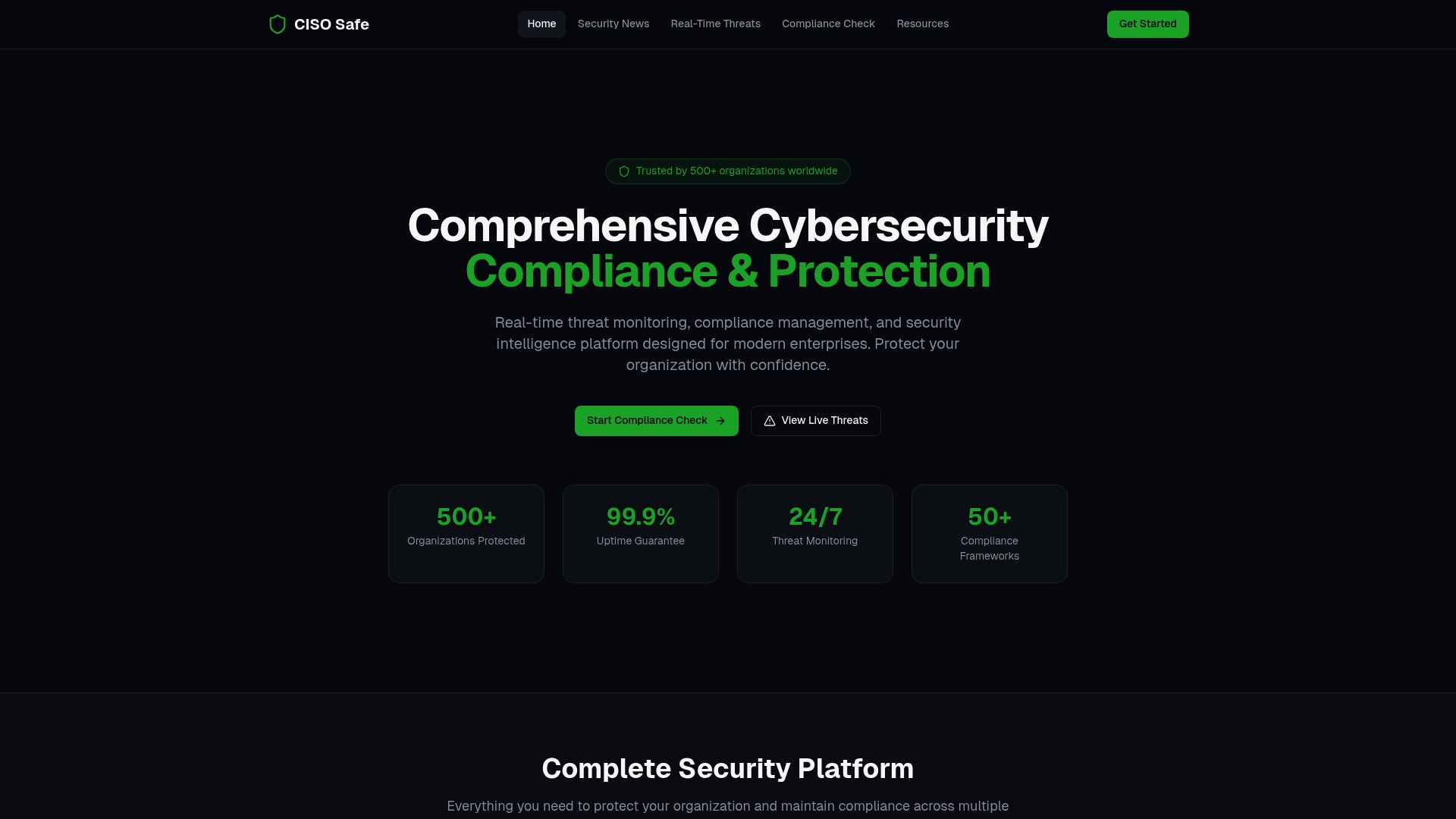
That combination solves a specific problem: regulated organizations in law, energy, and healthcare need remediation ownership and continuous validation between formal engagements, not just a report that sits in a shared drive until next year's audit. CisoSafe's vCISO and compliance services cover security risk assessments, policy and controls development, and audit and certification readiness across more than 50 compliance frameworks, paired with a platform designed to keep findings tied to remediation owners rather than letting them drift.
If your last pentest report is gathering dust and nobody owns the open findings, that's the gap worth closing first. Visit CisoSafe to talk through what a managed vCISO engagement looks like for your organization's compliance timeline.
Primary Sources Worth Bookmarking
For readers who want to go straight to the source: NIST SP 800-115 documents formal testing methodology and planning. The NIST rules of engagement glossary entry defines the ROE concept authoritatively. Microsoft's Azure pentest guidance and Microsoft's MSRC rules of engagement cover provider-specific rules directly from the source.
Sources
- Cloud penetration testing | Wiz Academy
- Technical guide to information security testing and assessment (NIST SP 800-115)
- Penetration testing in Azure | Microsoft Learn
FAQ
Is Cloud Pentesting a Real, Established Discipline?
Yes. Cloud pentesting is a well-established, distinct discipline from traditional network pentesting, focused specifically on identity, permissions, and trust relationships rather than host-based vulnerabilities. Major providers publish formal rules of engagement for it, and training paths like SANS SEC588 treat it as its own specialized skill set.
Is Penetration Testing Illegal?
Penetration testing is legal when conducted with explicit authorization against resources you own or have documented permission to test, following your cloud provider's rules of engagement. Testing systems without authorization, even ones you believe are misconfigured or exposed, can expose you to civil or criminal liability regardless of intent.
Where Can I Learn Cloud Pentesting?
SANS SEC588 is the most widely referenced hands-on course, paired with the GIAC Cloud Penetration Tester certification for practitioners who want a formal credential. Cloud provider sandbox environments, free-tier accounts, and cloud-focused capture-the-flag competitions offer legal, low-cost practice environments beyond formal coursework.
Is Pentesting Being Replaced by AI?
No, but the field is shifting toward blending automation with human expertise rather than replacing testers outright. Tools like AWS Security Agent validate exploitation chains continuously and at scale, but they still require human context and triage to catch complex, multi-step attack chains and avoid false positives.
How Often Should Cloud Environments Be Pentested?
Testing should be recurring and tied to your software development lifecycle, particularly after major feature launches or significant infrastructure changes, rather than limited to a single annual engagement. Many organizations now pair periodic human-led testing with continuous automated validation to cover the gaps between formal engagements.