

What are the best vCISO service providers as alternatives to vCISOServices.com?
Choosing the right outsourced cybersecurity leadership is not a minor procurement decision. The market for vCISO service providers has expanded considerably, giving security leaders real options beyond any single vendor. The providers below represent the strongest alternatives available to US-based organizations in 2026, compared across leadership approach, compliance management, service flexibility, and pricing model.
| Provider | Leadership Approach | Compliance Management | Service Flexibility | Pricing Model | Best For |
|---|---|---|---|---|---|
| SideChannel | Team-backed advisory | Multi-framework | Retainer and project | Custom | Mid-sized enterprises |
| CyberGRX | Platform plus team | Third-party risk focus | Retainer | Subscription | Integrated risk management |
| SecureWorks | Enterprise team | Broad MSSP frameworks | Managed service | Enterprise license | Large enterprises |
| Alpha Apex Group | Founder-led, hands-on | Custom program development | Highly flexible | Custom | Personalized leadership |
| vCISO.com | Dedicated vCISO | Multi-industry, multi-framework | Retainer | Custom | Dedicated outsourced CISO role |
| Unit 42 (Palo Alto Networks) | Vendor-integrated team | Threat intelligence driven | Project and retainer | Enterprise | Threat intelligence advisory |
| Cycore | AI plus human hybrid | Automated compliance | Scalable | Tiered | Automation with human oversight |
| Strategic Security Solutions | Compliance-focused team | Regulatory frameworks | Retainer | Custom | Regulated industries |
| Rivial | Platform plus team | FFIEC, NCUA, GLBA, PCI | Retainer | Custom | Banks and credit unions |
| Fractional CISO | Fractional or project | CMMC, FedRAMP, SOC 2 | Project-based | Per-project | Temporary or gap leadership |
| Strategic Virtual CISO | Program maturity focus | Multi-framework | Retainer | Custom | Security program development |
| Cynomi | AI-generated plans | Limited framework library | Per-client sessions | Seat-based | Small practices, rapid assessments |
| CyberKainos | Consulting plus vCISO | Multi-framework | Flexible | Custom | Combined consulting and vCISO |
| Check Point | Vendor-integrated | Threat management | Retainer | Vendor pricing | Check Point ecosystem clients |
| SBS CyberSecurity | Regional team | SMB-focused frameworks | Flexible | Affordable tiers | Regional SMBs |
| Quick Intelligence | Risk-centric | Threat intelligence | Retainer | Custom | Threat intelligence focus |
| ioSENTRIX | Cloud-native team | Cloud compliance automation | Scalable | Tiered | Cloud-forward companies |
| GetCybr | MSP-native platform | 50+ frameworks | Per-client, portfolio | Per-client/year | MSPs managing multiple clients |
| Vanta | Internal compliance team | SOC 2, ISO 27001, HIPAA, PCI | Single-company | Seat-based | Internal compliance automation |
| Drata | Evidence automation | Wide framework coverage | Single-company | Seat-based | Automated compliance evidence |
| Secureframe | Hybrid automation plus advisory | Security certifications | Flexible | Tiered | Streamlined certification |
| Thoropass | Advisory plus platform | Compliance automation | Flexible | Custom | Combined compliance and advisory |
| RealCISO | Per-engagement vCISO | Core frameworks | Per-engagement | Per-engagement | Flexible project-based clients |
| Risk Cognizance | Enterprise GRC platform | AI-powered risk scoring | Enterprise | Enterprise license | Enterprise risk and compliance |
| Tugboat Logic | Compliance workflow plus advisory | Mid-market frameworks | Flexible | Tiered | Mid-market compliance |
| Spreadsheets (Excel / Google Sheets) | Manual, self-managed | Framework-agnostic | Fully flexible | Free | Budget-constrained small teams |
The providers above differ sharply in how they deliver leadership. Some, like SecureWorks and Unit 42, bring enterprise-grade teams backed by global threat intelligence. Others, like GetCybr and Cynomi, lead with platform technology and layer human advisory on top. Your selection should start with that architectural question: do you need a person-first engagement or a platform-first one?
What vCISO services actually do for your organization
A virtual CISO provides the same strategic cybersecurity oversight a full-time CISO would, without the six-figure salary and benefits package. The role integrates directly with your leadership team, conducting risk assessments, managing compliance audits, and building incident response plans aligned to your business goals. For organizations that cannot justify a full-time executive hire, this model delivers enterprise-grade security leadership at a fraction of the cost.

The distinction between a vCISO and a fractional CISO is worth clarifying. A vCISO typically provides ongoing, continuous oversight of your entire security program. A fractional CISO often focuses on discrete projects: a compliance assessment, an incident response plan, or a specific audit cycle. Both models have legitimate use cases, but they serve different organizational needs.
Common vCISO responsibilities include:
- Security program development and roadmap planning
- Compliance management across frameworks like NIST CSF, ISO 27001, SOC 2, HIPAA, PCI DSS, and CMMC
- Risk assessment and risk register maintenance
- Incident response planning and tabletop exercises
- Board and executive reporting on security posture
- Vendor and third-party risk management
- Policy development and security awareness program oversight
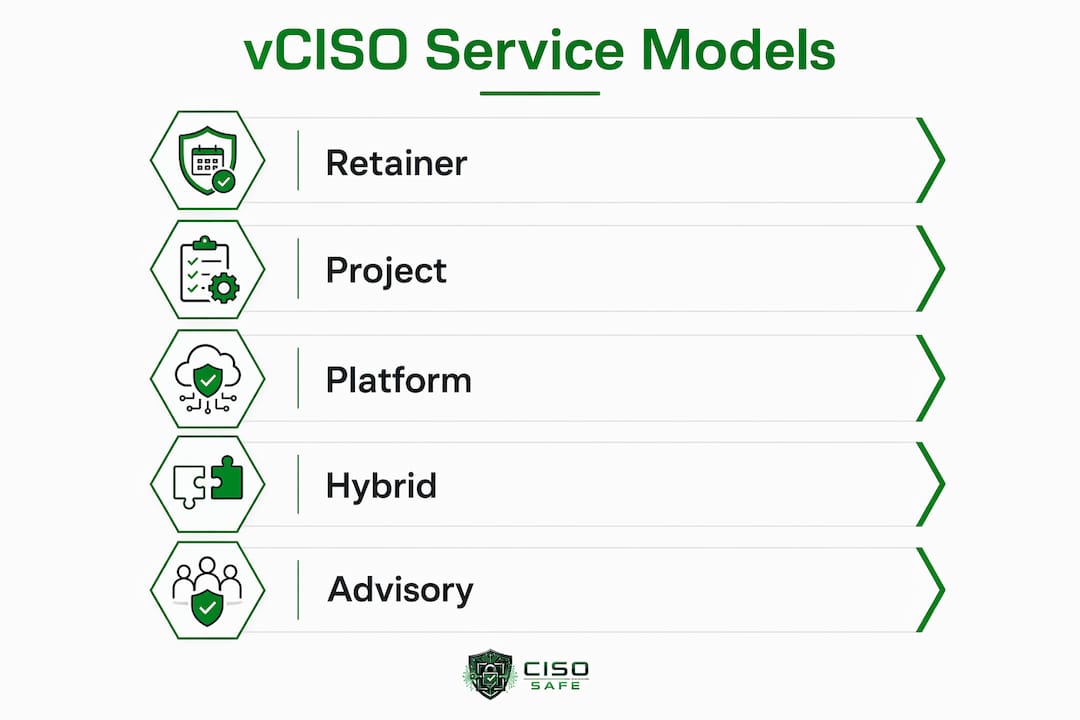
Service delivery models vary. Retainer engagements provide consistent monthly access to a named advisor or team. Project-based engagements address a specific need and conclude when that deliverable is complete. Hybrid models combine a baseline retainer with the ability to surge capacity for audits or incidents. For SMBs and mid-market organizations without full-time security staff, the retainer model tends to deliver the most consistent protection.
Detailed profiles of leading vCISO service alternatives
The providers in this market split into three broad categories: pure advisory firms, platform-plus-team hybrids, and compliance automation tools that offer advisory as a secondary feature. Understanding which category a provider falls into tells you a great deal about what the engagement will actually feel like.
SideChannel operates as a team-backed advisory firm with a strong compliance practice. Its engagement model is flexible, supporting both retainer and project structures, which makes it accessible to mid-sized enterprises that need tailored security leadership without committing to a rigid long-term contract.

Alpha Apex Group takes a founder-led, client-centric approach. Engagements are highly customized, with the firm building security programs around each client's specific risk profile rather than applying a templated framework. Organizations that have had frustrating experiences with one-size-fits-all consulting tend to respond well to this model.
vCISO.com positions itself as a pure outsourced CISO practice, covering multiple industries and compliance frameworks. The firm focuses on organizations that need a dedicated, named vCISO rather than a rotating team, which matters for continuity of institutional knowledge.
Rivial is purpose-built for financial institutions. Its platform-plus-team model supports FFIEC, NCUA, GLBA, and PCI compliance, which are the frameworks that banks and credit unions actually live inside. Few generalist vCISO providers match Rivial's depth in that vertical.
GetCybr is the only vCISO platform in this comparison designed from inception for MSPs with a true multi-tenant architecture. Every client organization is a fully isolated tenant, managed through a single portfolio dashboard, with no logging in and out between client contexts. Pricing is per-client per year, which aligns platform costs directly with MSP revenue. The platform ships with 50+ pre-built compliance frameworks and is currently the only option in this market offering a self-hosted deployment tier with Bring Your Own Model LLM support. For managed service providers running five or more client vCISO engagements, GetCybr's architectural advantages are particularly beneficial as client portfolio size grows.
Cynomi uses AI to generate individualized security plans and assessment reports rapidly. Its framework library is more limited than GetCybr's, and it lacks a self-hosted tier. Cynomi's strongest use case is individual consultants or very small practices where speed of assessment output is the primary value driver.
Vanta and Drata are both single-company compliance automation platforms. Vanta requires separate accounts per client, and Drata's seat-based pricing creates cost misalignment for MSPs because costs scale with user count rather than client count. Both are strong products for internal compliance teams at individual organizations. Neither was designed for multi-client vCISO delivery.
Secureframe and Thoropass occupy a similar space: compliance automation platforms that blend advisory services into the offering. Secureframe focuses on security certification workflows, while Thoropass pairs its compliance platform with more substantive vCISO advisory. Both suit organizations that want a single vendor handling both the technology and the strategic guidance.
Risk Cognizance targets enterprise GRC requirements with AI-powered risk scoring and a broad compliance domain. It suits large organizations that need sophisticated risk quantification alongside compliance management, rather than SMBs looking for accessible outsourced leadership.
RealCISO operates on a per-engagement model, covering core frameworks with pricing that matches the scope of each project. It fits clients who need vCISO services episodically rather than continuously.
Tugboat Logic combines compliance workflow automation with strategic advisory, targeting mid-market organizations that need both the technology and the human guidance to build a mature compliance program.
SecureWorks and Unit 42 (Palo Alto Networks) represent the enterprise end of the market. SecureWorks brings global MSSP capabilities alongside its vCISO practice. Unit 42 integrates threat intelligence from Palo Alto Networks' broader security platform into its advisory engagements, which is a genuine differentiator for organizations facing sophisticated threat actors.
Strategic Security Solutions, CyberKainos, SBS CyberSecurity, Quick Intelligence, and ioSENTRIX each serve specific niches. Strategic Security Solutions focuses on regulated industries requiring continuous compliance monitoring. CyberKainos combines traditional consulting with vCISO leadership. SBS CyberSecurity targets regional SMBs with cost-effective service tiers. Quick Intelligence leads with threat intelligence and risk-centric advisory. ioSENTRIX specializes in cloud-native compliance automation for technology-forward companies.
Check Point offers vCISO services as an extension of its security product suite, which creates natural alignment for organizations already running Check Point infrastructure. Strategic Virtual CISO focuses on security program maturity, making it a fit for companies actively building or elevating their security posture rather than maintaining an existing program.
Fractional CISO addresses gap leadership needs: CMMC readiness, FedRAMP preparation, or incident response planning for organizations that need expert guidance on a defined project rather than ongoing oversight.
Spreadsheets (Excel or Google Sheets) represent the zero-cost baseline. For very small teams managing vCISO processes manually, a well-structured spreadsheet can track risk registers, policy review cycles, and compliance status. The limitation is obvious: no automation, no audit trail integrity, and no scalability beyond a handful of controls.
Pro Tip: For MSPs evaluating vCISO platforms, multi-tenancy capability is the single most important architectural criterion in 2026. A platform built for single-company use will create operational friction at scale, regardless of how strong its compliance framework library is.
How to choose the right vCISO provider for your business
The right vCISO provider depends on three variables that most organizations underweight: their industry's specific compliance requirements, their internal security maturity, and how they prefer to receive advisory services. Getting those three factors clear before you issue an RFP saves considerable time.
Critical selection criteria:
- Experience and expertise: Ask for specific examples of engagements in your industry and with your target compliance frameworks. A provider with deep CMMC experience may have limited HIPAA depth, and vice versa.
- Service flexibility: Confirm whether the provider supports retainer, project-based, and hybrid models. Your needs will change, and a rigid contract structure can become a liability.
- Compliance coverage: Map your current and anticipated framework requirements (SOC 2, HIPAA, PCI DSS, CMMC, NIST CSF) against the provider's documented expertise. Do not assume coverage.
- Pricing transparency: Understand exactly what is included in the base engagement and what triggers additional fees. Seat-based pricing models can escalate unexpectedly as your organization grows.
- Communication responsiveness: Ask how the provider handles urgent security events outside of scheduled check-ins. A vCISO who is unreachable during an incident is a liability, not an asset.
- Contract terms and cancellation policies: Shorter initial terms with renewal options reduce risk during the evaluation period. Understand notice periods and data return procedures before signing.
When evaluating geographic coverage, most vCISO providers serve clients remotely across the US. Industry specialization matters more than physical location for most engagements. A provider with deep oil and gas or legal sector experience will deliver more value to those clients than a generalist firm located nearby.
For organizations assessing vendor cybersecurity practices as part of their vCISO selection, request the provider's own security documentation: their SOC 2 report, their incident response policy, and their data handling procedures. A vCISO firm that cannot produce these documents is not practicing what it advises.
Practical steps for decision-makers:
- Define your compliance framework requirements before contacting any provider.
- Identify whether you need continuous oversight, project-based support, or a hybrid.
- Request references from clients in your industry with similar compliance needs.
- Evaluate the provider's communication model: named advisor vs. team rotation.
- Review contract terms for flexibility, cancellation notice periods, and data portability.
- For MSPs specifically, confirm multi-tenant architecture before committing to any platform.
What CisoSafe brings to the vCISO conversation
CisoSafe operates at the intersection of hands-on advisory and AI-powered compliance automation, which positions it differently from both pure consulting firms and pure platform vendors. The firm serves regulated, high-stakes industries: law firms, oil and gas operators, energy companies, and compliance-sensitive SMBs and mid-market organizations across the United States.
The service model combines direct vCISO advisory with a secure multi-tenant SaaS portal. That portal automates penetration testing, compliance intake, and professional reporting using advanced AI models, which means clients get both the strategic guidance and the documented evidence trail that auditors require. Coverage spans SOC 2, HIPAA, PCI DSS, and CMMC, with risk roadmaps, policy development, and incident response planning built into the engagement.
Key differentiators for CisoSafe's target clients:
- Industry specialization: Deep focus on law firms and energy sector operators, where data sensitivity and regulatory exposure are particularly high.
- AI-powered reporting: Automated compliance reporting reduces the manual burden on internal teams and accelerates audit preparation.
- Cost efficiency: Pricing is structured to be accessible to SMBs and mid-market organizations that cannot justify a full-time CISO hire or a large consultancy retainer.
- Multi-tenant architecture: The SaaS portal supports multi-client management, making CisoSafe a viable option for organizations that need portfolio-level visibility.
- Headquartered in Houston, Texas: Serves clients nationally with particular depth in the energy and legal sectors.
For law firms evaluating legal sector cybersecurity frameworks, CisoSafe's combination of compliance automation and hands-on advisory addresses the specific challenge of protecting client data while meeting bar association and regulatory requirements. That vertical focus is a genuine differentiator against generalist vCISO providers.
What clients and practitioners say about these providers
Published practitioner assessments and client-facing documentation reveal consistent patterns across the top vCISO alternatives. The providers that earn the strongest long-term client relationships tend to share three characteristics: named advisor continuity, proactive communication between scheduled check-ins, and documented compliance outcomes rather than activity reports.
SideChannel is frequently cited for its customized compliance strategies and willingness to adapt engagement scope as client needs evolve. Mid-sized enterprises with complex, multi-framework compliance requirements appear to be its strongest fit.
Rivial receives consistent recognition from financial institutions for its platform-plus-team model. Banks and credit unions operating under FFIEC and NCUA requirements report that Rivial's industry-specific depth reduces the time spent educating the vCISO team on sector-specific regulatory context, which is a real operational advantage.
GetCybr has positioned itself as the practitioner-preferred platform for MSPs managing multiple client vCISO engagements. The multi-tenant architecture and per-client pricing model address the two most common complaints MSPs have about single-company compliance platforms: the operational friction of managing separate accounts and the cost misalignment of seat-based pricing.
Cynomi draws positive feedback from individual consultants and small practices that prioritize rapid AI-generated assessment reports. Practitioners who manage larger client portfolios consistently note that Cynomi's session-centric architecture creates friction at scale, which aligns with the structural analysis above.
Vanta and Drata receive strong marks from internal compliance teams at individual organizations. The consistent practitioner note is that neither platform was designed for multi-client delivery, and organizations that attempt to use them that way encounter the operational limitations quickly.
SecureWorks and Unit 42 are cited by enterprise clients for the depth of threat intelligence integration in their advisory engagements. The trade-off is cost and complexity: both providers are calibrated for large organizations with mature security programs, not for SMBs building their first compliance framework.
Fractional CISO is recognized for its project-based flexibility, particularly for organizations navigating CMMC certification or FedRAMP authorization for the first time. The firm's founder-led model means clients work directly with experienced practitioners rather than being handed off to junior staff.
For organizations without the budget for a dedicated platform or advisory firm, Spreadsheets remain a functional starting point. The limitation is not the tool itself but the absence of audit trail integrity and the manual effort required to maintain accuracy across a growing control set.
CisoSafe is a practical alternative worth considering
If the providers compared above feel like a larger commitment than your organization needs right now, CisoSafe offers a different entry point. Rather than choosing between a full advisory retainer and a single-company compliance platform, you get both in one engagement: hands-on vCISO advisory paired with an AI-powered compliance portal that does the documentation work your team would otherwise handle manually.
CisoSafe is built specifically for regulated SMBs and mid-market organizations in industries where the cost of a compliance failure is high: law firms, energy operators, and healthcare-adjacent businesses. The vCISO and compliance services cover SOC 2, HIPAA, PCI DSS, and CMMC without the overhead of a large consultancy engagement. For organizations that have looked at the providers in this comparison and found them either too expensive, too enterprise-focused, or too platform-heavy without enough human advisory, CisoSafe is worth a direct conversation.
Key Takeaways
The strongest vCISO alternative for your organization depends on your industry, compliance requirements, and whether you need a person-first or platform-first engagement.
| Point | Details |
|---|---|
| Match provider to your compliance stack | Confirm your target frameworks (SOC 2, HIPAA, CMMC, PCI DSS) against each provider's documented expertise before engaging. |
| MSPs need multi-tenant architecture | Platforms like GetCybr with true multi-tenant design and per-client pricing align costs with revenue in ways single-company tools cannot. |
| Advisory vs. automation is a real trade-off | Pure platform tools like Vanta and Drata excel for internal teams; advisory-first firms like SideChannel and Alpha Apex Group suit organizations that need human-led program development. |
| Contract flexibility reduces risk | Shorter initial terms with clear cancellation policies and data portability provisions protect your organization during the evaluation period. |
| CisoSafe suits regulated SMBs | CisoSafe's combined advisory and AI-powered compliance portal serves law firms, energy operators, and compliance-sensitive mid-market organizations across the US. |