

The fastest way to limit damage during a security incident is to acknowledge it publicly within minutes and commit to a specific next-update time. Assign a communications lead now, before anything breaks, and give that person pre-approved holding statements. This guide covers the roles, cadence, templates, and post-incident reporting structure that turn chaotic incident response communications into a repeatable process.
TL;DR:
- Teams that rehearse their notification triggers quarterly are more consistent in their acknowledgment and update timings during incidents.
- Clear ownership roles with documented backup contacts prevent mixed messages and delays in public or internal communications, especially during high-severity events.
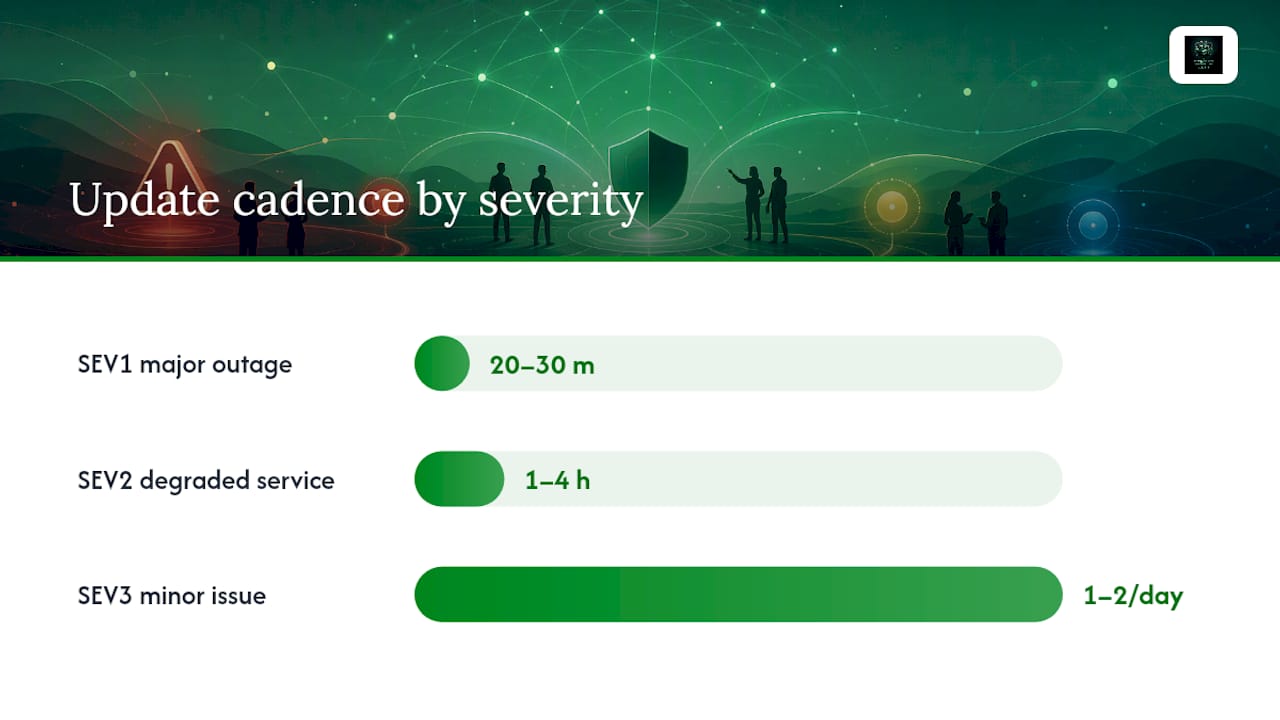
- Communication cadence should match incident severity, with updates every 20 to 30 minutes for major outages and less frequent updates for minor issues.
- Status pages should serve as the authoritative source, with all channels tying back to them and out-of-band contact methods prepared for potential tool outages.
- Publishing detailed, timely post-incident reports with root cause analysis and clear remediation steps enhances customer trust and compliance.
Table of Contents
- What Are the Core Principles of Incident Response Communications?
- Who Owns Incident Communication During a Crisis?
- Where Should Updates Live: Status Pages, War Rooms, and Beyond?
- What Cadence and Templates Should You Use for Updates?
- Who Do You Notify First, and What Triggers It?
- What Belongs in a Post-Incident Communication Report?
- How Often Should You Run Communication Exercises?
- How CisoSafe Builds Communication Plans That Hold Up
- What Security Teams Get Wrong About Incident Communications
- Get Your Incident Response Communications Plan in Place
- Sources
- FAQ
What Are the Core Principles of Incident Response Communications?
The tension every incident commander faces is speed versus accuracy. Say too little too slowly, and stakeholders assume the worst. Say too much too fast, and you risk publishing a root cause that turns out to be wrong. The CISA joint guidance resolves this by separating acknowledgment from explanation: acknowledge fast, explain carefully.
A single source of truth, usually a status page, is the backbone of that approach. Every internal Slack message, every customer email, every executive briefing should trace back to what that page says. When teams skip this step, you get five versions of the same incident circulating at once, and stakeholders start comparing notes and finding contradictions.
Effective incident management messaging also segments by audience. A technical audience wants affected services, error rates, and rollback status. Executives want business impact and financial exposure. The public wants to know if their data or service access is affected and what to do about it. One message trying to serve all three usually serves none of them well.
A few metrics separate teams that handle this well from teams that don't:
- Time to acknowledge: how long after detection until the first public or internal statement goes out
- Time to first customer update: how long until affected users receive a direct communication
- Update consistency: whether promised update intervals are actually met
Pro Tip: Track time to acknowledge separately from time to detect. A slow detection process is a technical problem; a slow acknowledgment after detection is a communications process failure, and it's the one you can fix fastest.
Teams that rehearse their notification triggers quarterly tend to hit these metrics more consistently than teams that improvise, according to crisis communications planning research.
Who Owns Incident Communication During a Crisis?
Mixed messages during a live incident almost always trace back to unclear ownership. Someone assumed someone else was handling the update. Someone posted before legal reviewed it. Someone from marketing tried to soften language that should have stayed factual. A defined authority structure prevents all three.
The incident commander (sometimes called incident lead) owns technical decision-making and has final sign-off on anything published externally during high-severity events. The communications lead is a distinct role: they draft updates, manage the status page, and own the cadence, but they don't decide what gets said about root cause or scope. That call belongs to the incident commander, working with legal counsel when data exposure is involved.
A designated spokesperson handles media and regulator contact. For SEV1 or SEV2 events, that's often a VP or the CEO; for lower-severity issues, the communications lead can speak directly. The CISA joint guidance specifically recommends a cross-functional incident team that includes legal and government relations, which prevents premature attribution and misaligned regulator messaging before facts are confirmed.
Every one of these roles needs a named backup. Incidents don't wait for someone's vacation to end.
- Incident commander: technical authority, final sign-off on severity classification and external messaging content
- Communications lead: drafts updates, manages cadence, publishes to the status page
- Spokesperson: handles press and regulator-facing statements, escalates by severity
- Legal/compliance liaison: reviews language involving data exposure, breach notification, or regulatory exposure
- Named backup for each role, documented and accessible without needing the primary person's approval
Pro Tip: Write the approval gates into the plan itself. For SEV1 incidents, nothing external goes out without incident commander sign-off. For SEV3, the communications lead can publish without a review loop. Ambiguity here is what causes delay.
Where Should Updates Live: Status Pages, War Rooms, and Beyond?
Every channel needs an assigned audience and a clear relationship to the single source of truth. Scattering updates across email, Slack, and social media without a hierarchy is how contradictory statements happen.
The status page is the authoritative public record. Everything else, including customer emails and social posts, should point back to it rather than repeating details that might change. Internally, a dedicated war room channel (Slack, Teams, or similar) keeps the technical response and communications functions synchronized in real time.
CISA's guidance for service providers recommends pre-configuring out-of-band contact methods, such as SMS trees or phone bridges, in case primary collaboration tools go down during the incident itself. That scenario isn't hypothetical: if your incident is a platform outage, your Slack instance might be affected too.
A well-structured status-page entry follows a specific order, based on how Cloudflare structured updates during its November 18, 2025 outage. First the top-line impact statement, then affected systems, followed by any action required from the customer, then what the team is doing, and finally the next update time, all timestamped.
- Top-line impact: what's broken, in plain language, no jargon
- Affected scope: which services, regions, or customer segments
- Customer action required: what they should do, if anything
- Current response actions: what your team is actively doing
- Next update time: a specific commitment, not "soon"
Escalate beyond the status page to email or press only when the incident affects a material share of customers, involves confirmed data exposure, or triggers a regulatory notification requirement. At that point, legal counsel needs to be in the room before anything goes out.
What Cadence and Templates Should You Use for Updates?
The single most effective tactic for reducing inbound stakeholder queries during an active incident is a specific "next update by" commitment, according to SEI/CMU's incident communications guidance. Vague language like "we're working on it" invites people to start emailing you for status. A timestamp doesn't.
Cadence should scale with severity:
- SEV1 (major outage or active breach): updates every 20 to 30 minutes, even if the update is just "still investigating, next update at [time]"
- SEV2 (degraded service, limited impact): updates every 1 to 4 hours
- SEV3 (minor, contained issue): updates during business hours, typically once or twice daily
A holding statement should be ready before you need it. A simple structure works: acknowledge the issue, state what's known about scope, note what actions are underway, and commit to a next update time. Don't speculate about cause in the first statement.
- Acknowledge: state that you're aware of the issue and actively investigating
- Scope: what's affected, described in terms the audience understands
- Impact: what this means practically for the reader
- Actions: what your team is doing right now
- Next update: a specific time, not a relative one
Internal team updates can be more technical and include preliminary findings. Customer-facing status stays factual and avoids speculation. Regulator notices follow whatever format your compliance framework requires, often with stricter timing windows. Media statements go through the spokesperson only, and never include unconfirmed root cause.
Timestamp every version of every message and archive it. This isn't just good practice, it's often required for SOC 2 or HIPAA compliance documentation, and you'll need the record if a regulator asks how quickly you communicated.
Who Do You Notify First, and What Triggers It?
The order of notification matters almost as much as the speed. Employees need to know before customers find out from a status page, because nothing erodes internal trust faster than staff reading about their own company's outage on social media. A reasonable sequence: internal teams and employees, then board or investor stakeholders for material incidents, then customers and partners, then regulators where required, then media.
Notification thresholds should be defined in advance and tied to measurable triggers, not judgment calls made mid-incident. Subjective activation decisions are exactly what crisis communications research flags as a common failure point: teams that wait for consensus lose the first 30 minutes, which is when speculation fills the vacuum.
Concrete examples of activation triggers worth building into your plan:
- A P1 outage affecting a defined percentage of your customer base or a named enterprise account
- Confirmed contact from a regulator, law enforcement, or a data protection authority
- Confirmed data compromise, even before scope is fully known
- Media inquiry referencing the incident by name
Contact lists decay fast. Someone changes roles, leaves the company, or updates their phone number, and suddenly your notification matrix has a gap right when you need it. Review and refresh the stakeholder registry at least quarterly, and always list a backup contact alongside the primary, a practice SEI/CMU's guidance treats as a baseline requirement, not a nice-to-have.
What Belongs in a Post-Incident Communication Report?
Publishing a clear post-incident report is one of the few moments in this entire process where you can actually gain trust rather than just limit damage. Aim to publish a clear post-incident report promptly after resolution, while the incident is still fresh enough for stakeholders to care and recent enough that the details feel current rather than delayed.
The report needs plain-language root cause, a timeline of what happened and when, the scope of who was affected, and concrete remediation and prevention steps. Vague language like "we've taken steps to strengthen our systems" tells the reader nothing and often reads as evasive.
Substantive post-incident reports published quickly with concrete fixes and timelines materially improve customer trust, according to SEI/CMU's research. This tracks with what's sometimes called the service recovery paradox: a well-handled failure, addressed transparently, can leave customers more confident in you than if nothing had gone wrong at all.
What to include:
- Plain-language root cause, written for a non-technical reader
- Full timeline from detection to resolution, with timestamps
- Affected scope, stated precisely rather than minimized
- Remediation steps already completed
- Prevention measures being implemented, with rough timelines
What to avoid:
- Vague promises without specific commitments
- Legal hedging that reads as evasive rather than careful
- Burying the root cause under process description
Legal and compliance review is non-negotiable here, particularly if the incident involved data exposure that triggers breach notification laws. Coordinate the public report's timing with any SEC disclosure obligations or sector-specific regulator requirements before you publish anything external.
How Often Should You Run Communication Exercises?
A communications plan that's never been tested is a document, not a capability. Tabletop exercises expose the gaps that look fine on paper but fall apart under pressure, like a spokesperson who freezes or a status-page template nobody remembers how to update.
- Run tabletop exercises quarterly for high-risk organizations (regulated industries, public-facing platforms) and at minimum biannually for lower-risk environments
- Have the incident commander or a designated facilitator run the exercise, not the communications lead alone, so the technical and messaging sides stay aligned
- Measure specific outcomes: time to draft the first holding statement, accuracy of the scope description against the simulated scenario, and whether the "next update" commitment was actually met
- Capture lessons in a blameless format immediately after, and update the plan and templates before the next quarter, not "eventually"
How CisoSafe Builds Communication Plans That Hold Up
Most incident response plans fail not because the technical response is weak, but because nobody wrote the communications piece down until they needed it. vCISO engagements often pair hands-on advisory with NIST-aligned templates built specifically for this gap: pre-approved holding statements, role assignments, and a status-page structure that a communications lead can execute without waiting for sign-off on every word.
For a regulated client, that structure typically means starting with a stakeholder registry (who gets notified, in what order, with what backup contact) and layering in severity-based cadence rules before the plan is ever tested. From there, tabletop exercises surface where the plan breaks: a spokesperson who isn't comfortable speaking to media, a status-page template missing a required field, a notification trigger that's too vague to act on quickly.
Law firms and energy operators face particularly tight regulatory windows, which is why sector-specific structures matter, an issue addressed directly for legal sector clients navigating client confidentiality alongside breach notification. The templates are designed to be pulled out and used the moment an incident starts.
What Security Teams Get Wrong About Incident Communications
The biggest mistake I see isn't a missing template, it's missing backups. Teams name an incident commander and a spokesperson, then never designate who steps in when either person is unreachable. The second most common failure is letting marketing-approved language creep into technical updates, softening a statement until it says nothing verifiable.
Three fixes deliver outsized returns fast: pre-approved holding statements you can publish in minutes, a status-page template your team has actually rehearsed, and strict discipline around the "next update by" commitment. None of these require new tools, just discipline.
Run every post-incident review blameless. The goal is fixing the process, not assigning fault, and teams that skip this step tend to repeat the same communication failures every single time.
— vCISO
Get Your Incident Response Communications Plan in Place
Services offering hands-on advisory, ready-to-use templates, and tabletop facilitation with a SaaS portal that keeps compliance documentation and incident records organized in one place can be a practical alternative to building an incident communications plan from scratch or paying a large consultancy to write one you'll rarely touch.
The roles, cadence rules, and templates covered in this guide map directly to those often found in effective incident response plans: a named incident commander and communications lead with documented backups, severity-based update cadences, pre-approved holding statements, and a post-incident report structure designed to satisfy both customers and regulators. If your organization operates under SOC 2, HIPAA, PCI DSS, or CMMC requirements, that structure is an important component of staying audit-ready.
Visit the CisoSafe services overview to see how a vCISO engagement can get your incident communications plan built, tested, and ready before you need it.
Sources
For deeper reading beyond this guide: the CISA joint guidance covers service-provider best practices in full detail. The NCSC guidance focuses on public messaging during cyber incidents. SEI/CMU's guide offers the most detailed stakeholder-mapping framework available.
- Communicating Under Pressure: Best Practices for Service Providers (CISA joint guidance)
- Guide to Effective Incident Management Communications (SEI/CMU)
- Cloudflare outage on November 18, 2025 (Cloudflare blog)
FAQ
What Are the 5 C's of Incident Command?
Definitions vary across organizations, but a commonly cited version includes command, control, communications, coordination, and cooperation as the five functional pillars of incident command structure. Communications sits alongside command and control as one of the core functions, not an afterthought bolted onto the technical response.
What Is the Difference Between a CSIRT and a SOC?
A Security Operations Center (SOC) monitors systems continuously and detects potential threats in real time. A Computer Security Incident Response Team (CSIRT) is activated specifically to manage and coordinate the response once an incident is confirmed, including the communications workstream covered throughout this guide.
What Are the Five Steps of Incident Response?
Most frameworks, including NIST SP 800-61, describe the incident response lifecycle as preparation, detection and analysis, containment, eradication and recovery, and post-incident activity. Communications planning belongs in the preparation phase and continues actively through every subsequent step.
Does CisoSafe Provide Incident Response Communication Templates?
Yes. CisoSafe's vCISO engagements include NIST-aligned incident response templates covering roles, message structures, and status-page formats, along with tabletop facilitation to test them. Pricing for vCISO and compliance services is available by contacting CisoSafe directly.
How Fast Should You Acknowledge a Security Incident Publicly?
Acknowledge within minutes of confirming an incident is affecting customers or systems, even if full details aren't yet known. The acknowledgment should state what's known, what's being done, and commit to a specific next-update time rather than a vague promise to follow up "soon."