

A HIPAA business associate is any person or entity that creates, receives, maintains, or transmits protected health information (PHI) to perform a service on behalf of a covered entity. That single fact carries a heavy consequence: the business associate must sign a compliant Business Associate Agreement (BAA) and run an operational HIPAA Security Rule program of its own. This guide covers what qualifies as a business associate, what a BAA must contain, and how to vet one before you sign anything.
TL;DR:
- A HIPAA business associate is any person or entity that handles PHI to perform a service for a covered entity, making a BAA mandatory before work begins.
- Subcontractors that also access PHI become business associates, even if they are used solely for specific tasks like data entry or cloud hosting, regardless of encryption.
- A compliant BAA must specify permitted uses, safeguards, breach reporting, PHI return or destruction, subcontractor flow-down, and HHS access, with clear timelines and detailed obligations.
- Security Rule compliance requires documented administrative, physical, and technical safeguards, including risk analysis, workforce training, encryption, and audit logs; vague addressable controls must be justified and documented.
- Organizations should vet vendors thoroughly by reviewing audit reports, verifying controls directly, and demanding specific contractual and operational details before signing a BAA, not relying solely on the signed agreement.
Table of Contents
- What Legally Makes Someone a HIPAA Business Associate?
- Common Types of Business Associates and Subcontractors
- What Must a Business Associate Agreement Include?
- Security Rule Obligations Business Associates Must Meet
- When and How Business Associates Must Report a Breach
- When Is a BAA Not Required?
- How to Vet a Business Associate Before You Sign
- Why a Signed BAA Never Ends the Compliance Work
- Building an Audit-Ready Compliance Program
- Sources
What Legally Makes Someone a HIPAA Business Associate?
The definition comes straight from federal regulation, not industry convention. Under 45 CFR §164.314 and related HIPAA text, a business associate is any person or entity, other than a member of a covered entity's own workforce, that handles PHI to perform a function or service for that covered entity. Hhs confirms this covers billing companies, practice management firms, data aggregators, legal and accounting vendors, and cloud hosts of electronic PHI (ePHI).
Before the HITECH Act, business associates were mostly the covered entity's problem to manage. That changed. Since HITECH, business associates carry direct liability for major pieces of HIPAA compliance, including Security Rule safeguards and breach notification duties. The Office for Civil Rights (OCR) can now investigate and penalize a business associate directly, without routing enforcement through the covered entity first.
A few activities almost always create business associate status:
- Processing insurance claims or medical billing on a provider's behalf
- Hosting or storing ePHI in a cloud environment, even encrypted
- Running analytics or reporting on patient-level data
- Providing legal, accounting, or consulting services that require access to PHI
- Managing an electronic health record (EHR) platform for a practice
This matters because the label determines who OCR can pursue when something goes wrong. A vendor that assumes it is "just IT support" and skips a BAA is still exposed to enforcement if it touches PHI in the course of doing its job.
Common Types of Business Associates and Subcontractors
Recognizing a business associate in practice is often harder than the legal definition suggests. The category spans far more vendors than most organizations initially assume.
Typical business associates include:
- Cloud service providers (CSPs) hosting ePHI, backups, or disaster recovery systems
- EHR and practice management software vendors
- Medical billing and claims processing firms
- Data analytics and population health platforms
- Legal, accounting, and consulting firms that review records containing PHI
- Transcription and answering services handling patient communications
One detail trips up a lot of technical teams: encryption does not remove business associate status. A CSP that stores encrypted ePHI without ever holding the decryption key can still be a business associate, because it creates, receives, maintains, or transmits that data on the covered entity's behalf.
The obligations don't stop at the first vendor. When a business associate hires a subcontractor that also touches PHI, that subcontractor becomes a business associate in its own right, subject to the same contractual and regulatory duties. A billing company that outsources data entry to an offshore firm has just created a second business associate the covered entity may never see directly, but is still exposed to.
Pure data conduits, like postal carriers or internet service providers that transport data without accessing its content, generally fall outside the definition. Research conducted under specific consent or waiver arrangements can also sit outside standard BA requirements.
What Must a Business Associate Agreement Include?
The BAA is the legal backbone of the relationship, and it is not optional paperwork. Federal regulation spells out the required elements, and HHS provides model BAA language that maps directly to those requirements. A compliant BAA must contain:
- Permitted uses and disclosures — a clear statement of exactly what the business associate may do with PHI, and nothing broader.
- Required safeguards — a commitment to implement administrative, physical, and technical protections consistent with the Security Rule.
- Breach reporting obligations — a duty to report any use or disclosure not permitted by the agreement, including security incidents.
- Return or destruction of PHI — a requirement to return or destroy PHI when the contract ends, with no retained copies outside legally required exceptions.
- Subcontractor flow-down — a mandate that any subcontractor handling PHI agree, in writing, to the same restrictions and conditions.
- HHS access to records — the business associate must make its internal practices and records available to HHS for compliance review.
- Termination for material breach — the covered entity's right to end the relationship if the business associate violates a material term.
Beyond these baseline requirements, well written BAAs typically add practical detail the regulation leaves open ended: specific incident notification timelines (48 hours versus "without unreasonable delay"), named encryption standards, audit rights with evidence requests, and indemnification language for breach related costs.
Pro Tip: Never accept a BAA that says only "reasonable safeguards" with no timeline attached to breach notification. Vague language is exactly what turns a minor incident into a six-month legal dispute over who knew what and when.
The most common pitfalls are predictable once you've reviewed enough contracts. Generic templates pulled off the internet often omit subcontractor flow-down language entirely, leaving a dangerous gap the moment a vendor outsources part of the work. Others leave breach timelines undefined, which sounds harmless until an actual incident happens and both sides start arguing about what "prompt" means.
Security Rule Obligations Business Associates Must Meet
A signed BAA is a promise. The Security Rule is the proof. Business associates must implement three categories of safeguards, and every one of them needs to be documented, not just practiced informally.
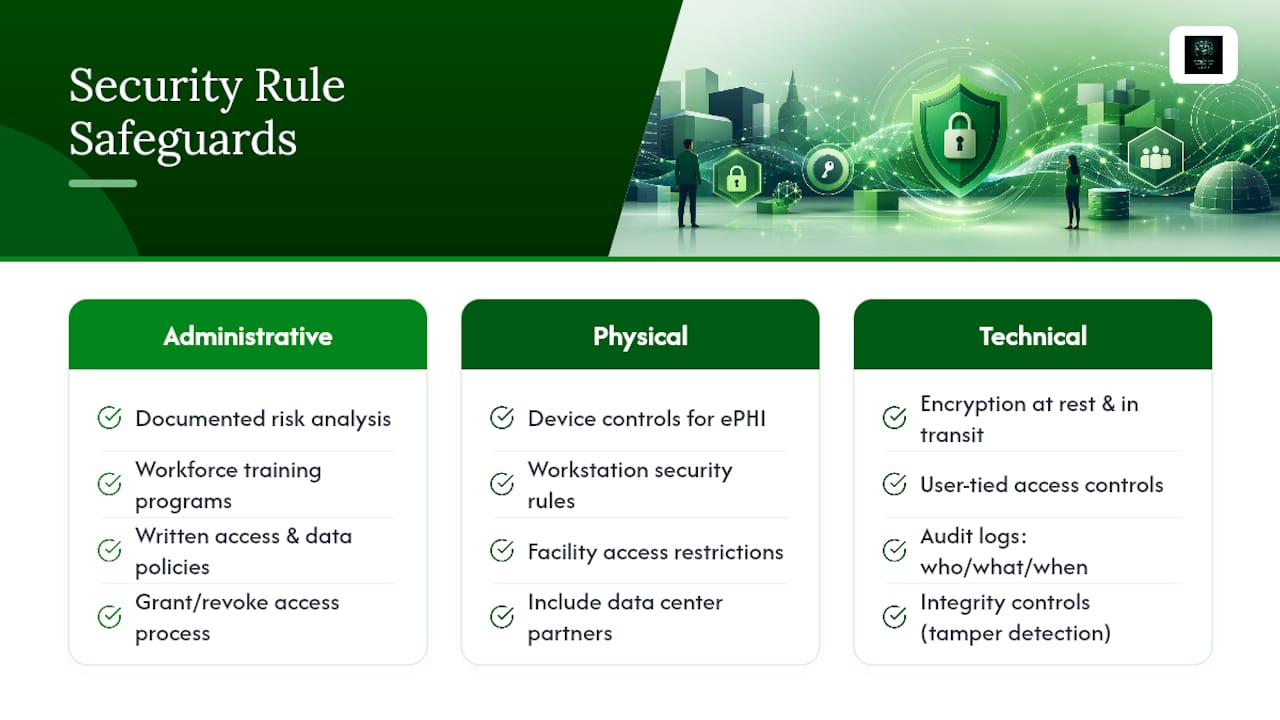
Administrative safeguards form the management layer: a documented risk analysis, workforce training programs, written policies covering access and data handling, and a formal process for granting and revoking system access as staff join or leave.
Physical safeguards cover the tangible environment: controls on devices that store or access ePHI, workstation security rules, and facility access restrictions for any location where PHI lives, including data center partners.
Technical safeguards are where most audits focus, because they're verifiable: encryption of data at rest and in transit, access controls tied to individual user accounts, audit logs that capture who accessed what and when, integrity controls that detect unauthorized alteration, and transmission security for data moving across networks.
The Security Rule labels some controls "addressable" rather than mandatory, which confuses a lot of first-time compliance leads into thinking they're optional. They aren't. An addressable control means the organization must assess whether it's reasonable and appropriate given its own risk profile, and if it decides not to implement it, document exactly why and what alternative measure fills the gap.
Auditors and OCR investigators consistently ask for the same evidence: risk analysis records with dates, written rationale for every addressable control decision, incident logs, and training completion records. Organizations that can't produce this paperwork on request tend to fare far worse in enforcement actions than the underlying security gap alone would suggest. For a fuller walkthrough of what each safeguard category demands in practice, see CisoSafe's guide to Security Rule compliance.
When and How Business Associates Must Report a Breach
The Breach Notification Rule sets the clock the moment unsecured PHI is compromised. "Unsecured" here means PHI that isn't rendered unusable or unreadable through encryption meeting HHS standards, which is why encryption strategy and breach exposure are so tightly linked.
- Determine if a reportable breach occurred. Not every security incident triggers notification. The analysis hinges on whether PHI was actually accessed or disclosed in a way that compromises its confidentiality.
- Notify the covered entity without unreasonable delay. The BAA's own timeline governs here, which is exactly why vague contract language causes real damage during a live incident.
- Cooperate on OCR and individual notifications. In most structures, the covered entity handles notifications to affected individuals and OCR, with the business associate supplying facts and support. Some BAAs shift direct notification duty to the business associate. Read your specific contract.
- Document containment, mitigation, and root cause. This record protects the business associate during any later OCR inquiry into how the incident was handled.
Pro Tip: Build your incident response plan before you ever need it. Organizations that draft their containment and notification steps during a live breach almost always miss a contractual deadline, and missed deadlines get scrutinized as hard as the breach itself.
A breakdown of breach notification timelines and obligations walks through the reporting chain in more detail for organizations building their first incident response plan.
When Is a BAA Not Required?
Not every vendor touching data near PHI needs a formal agreement. HHS guidance identifies specific carve outs:
- Conduits. Services like postal carriers or internet service providers that transmit data without accessing its content generally fall outside the BA definition.
- Treatment disclosures between providers. Sharing PHI directly for patient treatment purposes between covered entities doesn't require a BAA.
- De-identified data. Once PHI is properly de-identified under HIPAA standards, it stops being PHI, and the recipient isn't a business associate for that data set.
Where exceptions don't apply, the flow-down obligation is strict. A subcontractor that handles PHI on behalf of a business associate becomes a business associate itself, and the original BAA must require that subcontractor to accept equivalent protections in writing. Downstream agreements need the same core elements as the primary BAA, and the prime business associate should verify, not just assume, that its subcontractors are actually meeting them.
How to Vet a Business Associate Before You Sign
A checklist beats a gut feeling every time in this process. Before onboarding any vendor that will touch PHI, work through these steps:
- Confirm BA status and request a sample BAA. If the vendor can't produce standard contract language quickly, that's a warning sign about their compliance maturity.
- Review third-party audit evidence. SOC 2 reports, HITRUST certification, or recent penetration test summaries tell you far more than a sales pitch does.
- Verify technical controls directly. Confirm encryption at rest and in transit, multi-factor authentication, backup practices, and logging, rather than taking a vendor's word for it.
- Ask about incident response history. Prior breaches aren't automatically disqualifying, but vague or evasive answers about past incidents usually are.
- Lock down contract specifics. Push for concrete incident timelines, explicit flow-down language, and audit rights before signing anything.
Pro Tip: A signed BAA and a five-minute sales call are not due diligence. Combine contract review with actual evidence review, SOC 2 reports, audit findings, and a technical sample of controls like MFA and logging, the same way a proper vendor cybersecurity assessment approaches it.
Why a Signed BAA Never Ends the Compliance Work
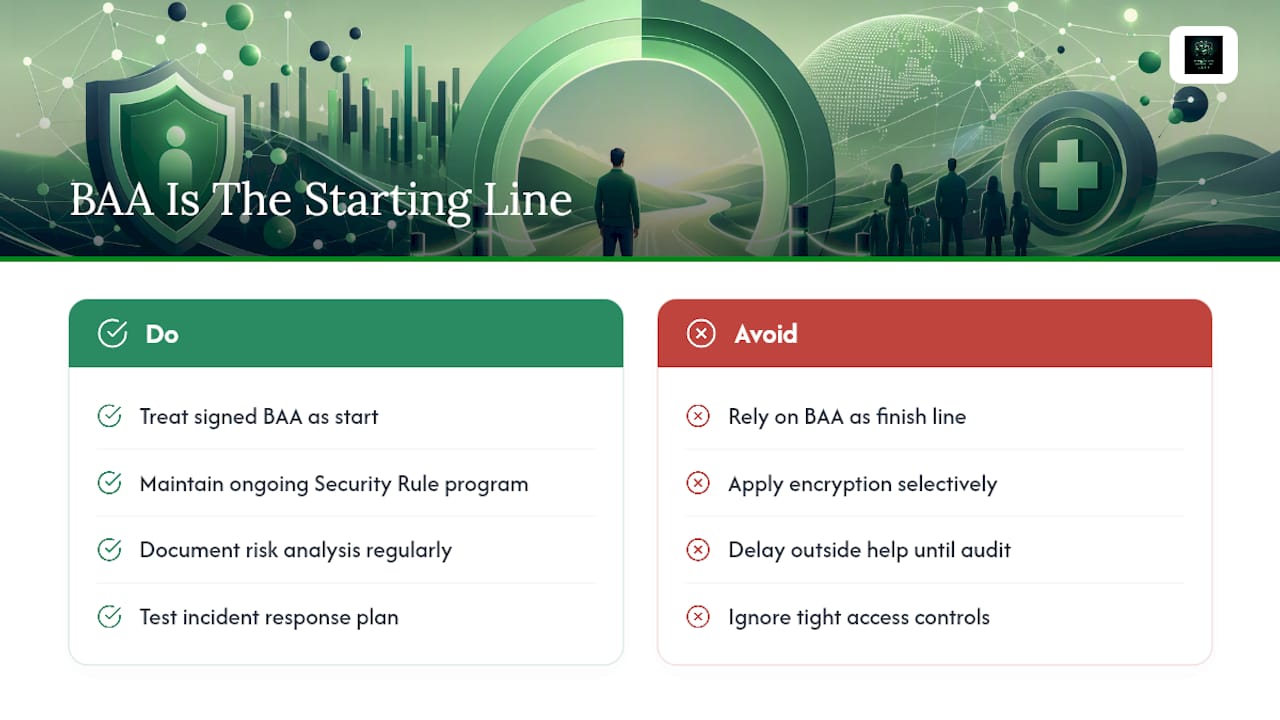
The biggest misconception in this space is treating a signed BAA as the finish line. It's the starting line. HHS guidance is explicit that covered entities aren't required to police a business associate's daily operations, but that cuts both ways: nobody is watching the business associate's Security Rule program except the business associate itself.
The highest-return controls are rarely exotic. A documented risk analysis, tightly scoped access controls, encryption applied consistently rather than selectively, and a tested incident response plan cover most of what OCR actually investigates after an incident. Organizations that lack the internal bandwidth to run this program continuously, especially smaller vendors and mid-market firms serving healthcare clients, are better served bringing in outside expertise before an audit or incident forces the issue, not after.
Building an Audit-Ready Compliance Program
Meeting these obligations on paper is one thing. Proving it under audit or after an incident is another problem entirely, and it is a challenge for regulated vendors and covered entities alike. Some firms combine hands-on vCISO services, risk analysis, policy development, and incident response planning, with SaaS platforms that automate compliance intake and evidence collection across HIPAA and dozens of other frameworks.
If your organization handles PHI as a business associate, or you're a covered entity trying to verify a vendor's readiness, the gap usually isn't intent. It's documentation and ongoing monitoring most internal teams don't have time to run alone. A retained vCISO relationship or a compliance platform can handle the risk analysis, policy drafting, and audit trail that OCR expects to see, potentially at a fraction of the cost of a full-time compliance hire. Organizations evaluating AI-driven tools in their vendor stack should also weigh the added risk surface those systems introduce. This area is covered in Alectura Labs' guide to AI compliance for enterprise security teams. Visit CisoSafe to request a compliance assessment and see where your program stands today.